


Most advice about the best longevity supplements starts in the wrong place. It points you toward the newest capsule, the most impressive acronym, or the product with the boldest promise about cellular repair. That approach confuses biological plausibility with proven human benefit.
NMN can raise blood NAD+ in clinical trials. Rhodiola may help with stress-related fatigue. Those findings matter, but neither one has established that people live longer, avoid disability, or remain stronger as they age. Meanwhile, basic nutrients such as omega-3, vitamin D, magnesium, and creatine often receive less attention because they aren't novel. A smarter routine starts with what your diet, bloodwork, training, and medical history show you need, then treats fashionable compounds as optional experiments rather than foundations.
Table of Contents
- Why the Most Hyped Longevity Supplements Are Not Always the Best
- What a Longevity Supplement Is Actually Trying to Do
- The Most Marketed Longevity Ingredients and What They Really Do
- The Foundational Basics That Beat the Hype on Human Evidence
- How to Evaluate a Longevity Product Before You Buy
- Biomarkers That Tell You If a Longevity Supplement Is Working
- Building Your Own Longevity Routine That Holds Up Over Time
Why the Most Hyped Longevity Supplements Are Not Always the Best
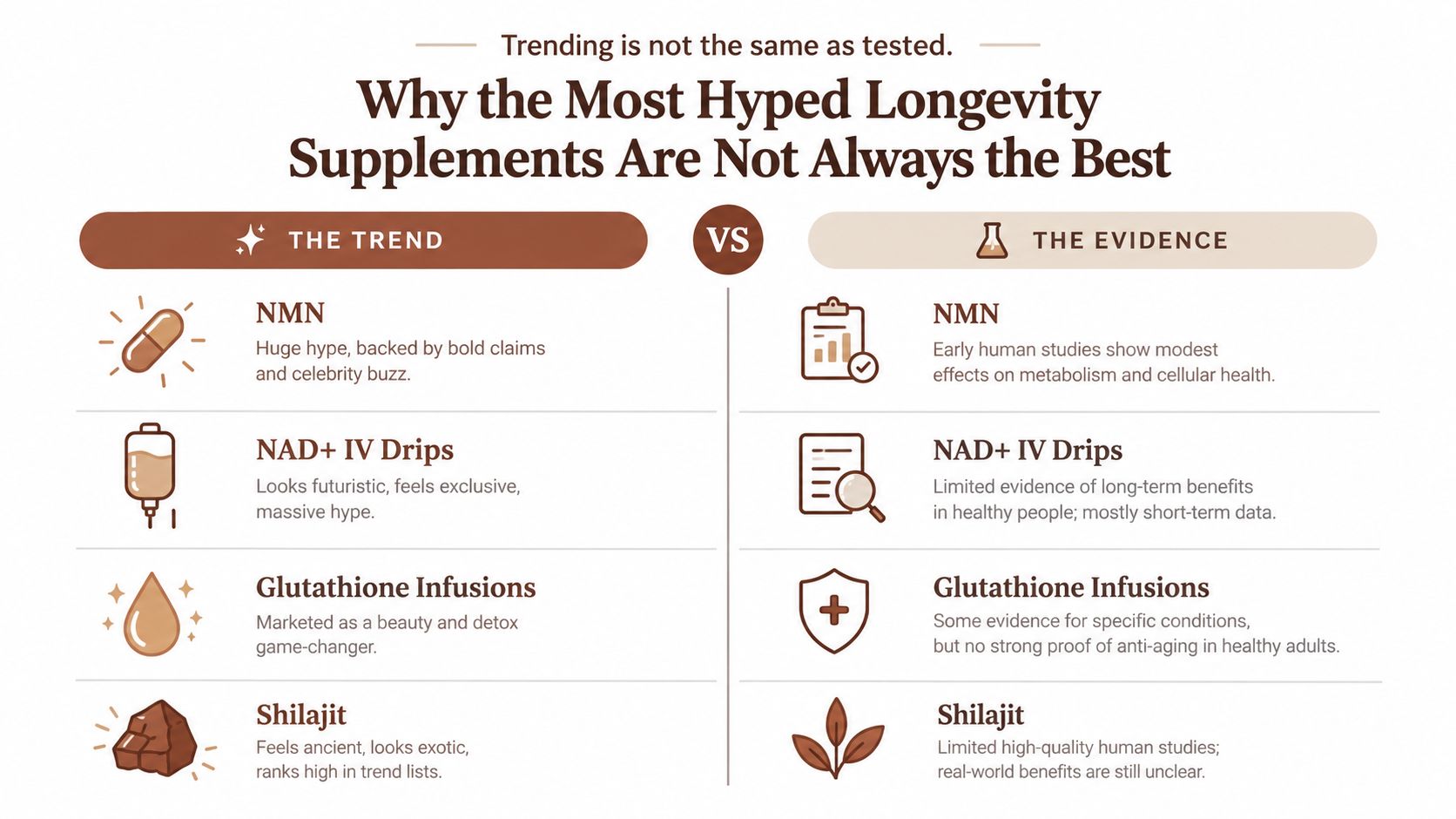
The most popular longevity ingredient isn't automatically the most useful purchase. Social media rewards novelty, dramatic language, and visible protocols. That makes NMN, NAD+ IV drips, glutathione infusions, and shilajit easy to market, even when the strongest human evidence concerns a biomarker, a short-term symptom, or a narrowly defined outcome.
The central mistake is treating a plausible mechanism as a finished result. A supplement can influence NAD+, oxidative stress, or cellular signaling without proving that it improves the outcomes you care about, such as strength, mobility, metabolic health, or independence later in life. Product pricing often reflects novelty and positioning more than the quality of the clinical endpoint.
Practical rule: Don't pay for a longevity story until you know which human outcome the product has actually tested.
NMN illustrates the problem clearly. A 2024 review in PubMed Central's summary of NMN randomized trials covered eight randomized trials published from 2021 through 2023, involving 342 middle-aged or older adults. The studies used 250 to 2,000 milligrams per day for 14 days to 12 weeks. Blood NAD+ usually increased, but several functional outcomes were mixed or unchanged. One multicenter trial in 80 healthy adults aged 40 to 65 tested 300, 600, and 900 milligrams daily for 60 days, with the strongest overall clinical signal at 600 milligrams per day. Another placebo-controlled study in 30 healthy adults used 250 milligrams daily for 12 weeks and reported higher NAD+ without major safety concerns.
That is meaningful evidence of target engagement, not proof of lifespan extension. A 2025 meta-analysis also found no support for NMN or NR preserving muscle mass or function in adults over 60, a useful counterweight to the assumption that raising NAD-related biomarkers automatically produces better aging outcomes. The broader evidence gap is summarized in a review of NAD+ precursors and human outcomes.
Hype density versus evidence density
Foundational basics have a less exciting sales pitch. Omega-3, vitamin D, magnesium, and creatine can address dietary shortfalls, support physical capacity, or improve a measurable health marker when a person needs them. Their value depends on context, and none should be treated as a guaranteed anti-aging intervention, but their human evidence is generally more practical than a claim built around a single cellular pathway.
This guide therefore doesn't rank ten products from best to worst. It uses a stricter question: Does this product address a demonstrated need, use a studied form, disclose its active dose, and offer a way to check whether it worked? If the answer is no, the product may still be interesting, but it shouldn't be presented as a foundation.
What a Longevity Supplement Is Actually Trying to Do
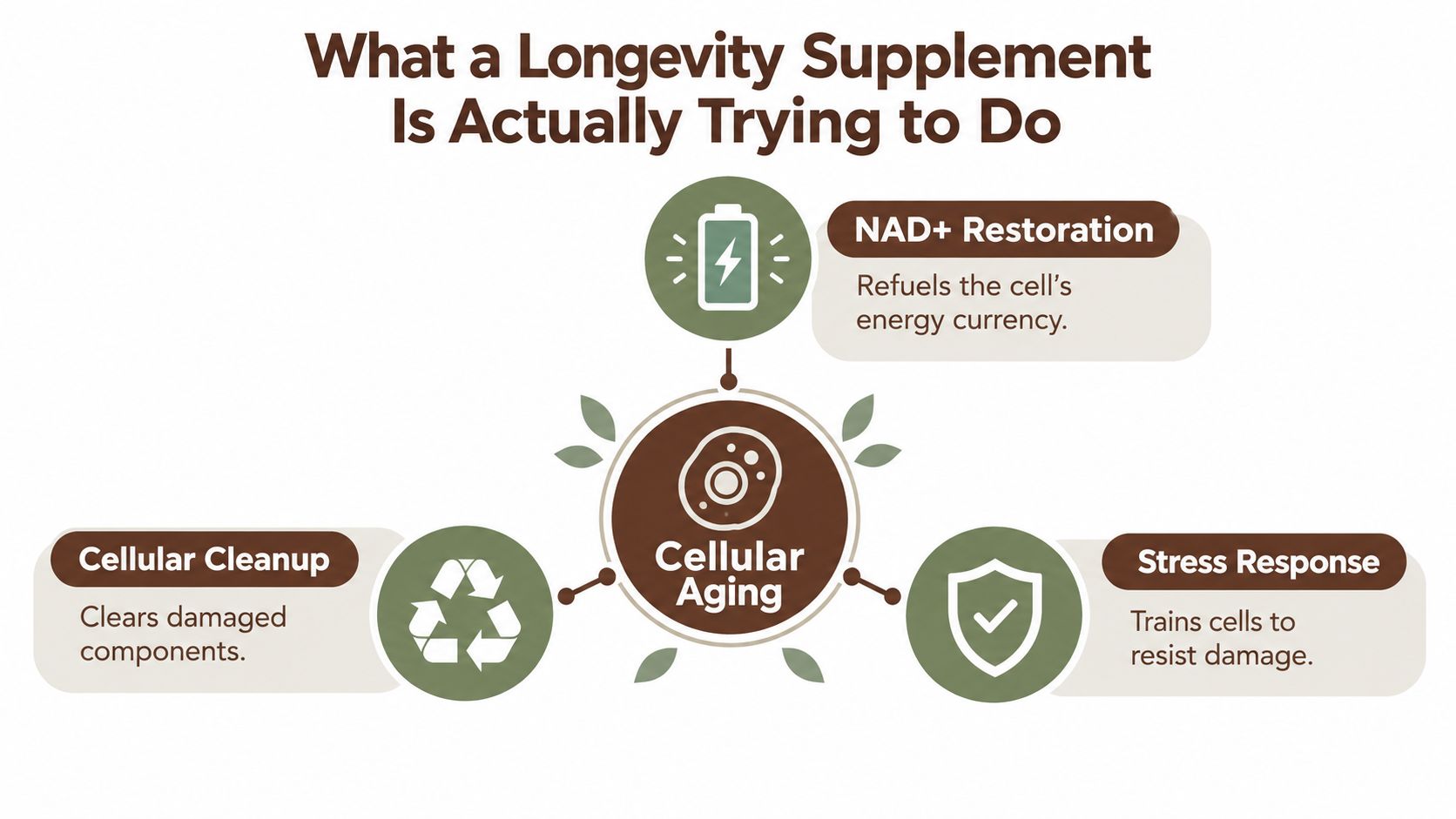
A longevity supplement should have a clear biological job. In practice, most products make their case through one of three reference frames: NAD+ restoration, cellular stress management, or mitochondrial function. These frames help you translate a polished product page into a testable question.
NAD+ restoration focuses on a molecule involved in cellular energy metabolism and other maintenance processes. NMN and NR are precursors intended to help the body make more NAD+. Human trials show that NMN can raise blood NAD+, but the clinical meaning of that rise remains uncertain. A recent human cohort analysis also challenged the common marketing premise that whole-blood NAD+ necessarily declines in a simple, decisive way with age. The report found that whole-blood NAD+ stayed remarkably stable with age, which makes the biomarker worth studying but not sufficient as a definition of biological aging. That uncertainty is discussed in an overview of NMN and urolithin A.
Cellular stress management covers oxidative stress, inflammation, and the way cells respond to pressure. Antioxidant or adaptogenic products often sit here. The useful question isn't whether a compound sounds protective in a cell dish. Ask whether human trials show a meaningful improvement in fatigue, inflammation, physical performance, or another outcome that matters to you.
Mitochondrial function concerns how efficiently cells turn fuel into usable energy. Creatine, magnesium, and some more specialized compounds are marketed through this frame. Yet direct measurement of mitochondrial efficiency isn't convenient for routine consumers, so claims often leap from mechanism to promise.
A practical definition
For buying purposes, define a longevity supplement as a product that meaningfully moves a relevant biological or functional measure in a living human. A change in a blood marker can be useful, but it isn't interchangeable with better strength, better glucose control, improved recovery, or longer life.
You can use the hallmarks of aging guide to understand the broader biological themes, and Longevity Clinics' journal insight for a plain-language view of how longevity programs connect testing, prevention, and lifestyle. If you're specifically considering an NMN product, the NMN Supplement is one example of a capsule positioned around NAD+ precursor support. Its product snapshot describes beta-NMN, third-party testing, and a suggested two-capsule daily use, but those product details don't establish a clinical longevity outcome.
Before worrying about brand or delivery format, write down the claimed lever and the outcome you want to change. If a product can't answer both questions, it belongs in the curiosity category, not your core routine.
The Most Marketed Longevity Ingredients and What They Really Do
The right way to audit a marketed ingredient is to separate four things: its strongest defensible claim, the quality of human evidence, the outcome you can reasonably expect, and the outcome the advertising implies without proving. On that basis, the category becomes much less mysterious.
NMN and NR are NAD+ precursors. NMN has randomized human evidence showing that oral supplementation can increase blood NAD+, including dose-responsive findings in a multicenter trial, but functional endpoints have been mixed. NR belongs in the same evidence-gap conversation. These compounds are reasonable candidates for a monitored personal experiment, not substitutes for exercise, nutrition, or treatment of a deficiency. Sublingual marketing may sound more advanced than oral capsules, but the verified evidence here doesn't establish that sublingual delivery produces superior longevity outcomes.
NAD+ infusions appeal to people who want to bypass digestion and create a dramatic treatment experience. The existence of a more intensive delivery method doesn't prove a better long-term result. The evidence provided supports discussion of measured NAD+ changes from oral precursors, not a claim that IV treatment extends lifespan or improves hard outcomes.
Glutathione is central to the body's antioxidant system, which makes it a natural target for products described as cellular defense. Liposomal glutathione and precursor combinations are often marketed as more bioavailable, but the available brief doesn't establish a reliable human longevity benefit or a decisive advantage for one delivery system. Treat the claim as mechanistic unless a product presents relevant human data.
Rhodiola rosea has a more specific and credible use case. A review in the British Journal of Nutrition identified 16 human trials from 2000 through 2023, involving 363 participants, for exercise performance and fatigue-related outcomes. A separate systematic review found that some trials reported improvements in physical and mental fatigue, including one double-blind study using 576 milligrams daily for 28 days in stress-related fatigue, but concluded that the total evidence was insufficient for high confidence. The Rhodiola Rosea product is therefore best judged against a stress or fatigue goal, not a broad anti-aging promise.
Shilajit is commonly associated with fulvic acid, minerals, energy, and resilience. Those associations don't amount to a strong longevity evidence base in the material provided. Choose it only if you're comfortable with limited human outcome data and unusually strict purity verification, because contamination and sourcing deserve more attention than the marketing narrative.
Astaxanthin is a carotenoid antioxidant with research interest around skin and oxidative-stress measures. That makes it a targeted antioxidant option, not a demonstrated life-extension compound. A realistic expectation is modest support for a defined goal, if any, rather than a measurable change in overall aging.
| Ingredient | Strongest claim | Human evidence grade | Realistic expectation |
|---|---|---|---|
| NMN | Raises blood NAD+ | Biomarker evidence, mixed functional results | A measurable NAD+ change may occur, but broader benefits remain uncertain |
| NR | Supports NAD-related biology | Human biomarker interest, inconclusive longevity outcomes | Treat as an experimental precursor, not a proven anti-aging solution |
| NAD+ infusions | Delivers NAD+ directly | Not established here for lifespan or hard outcomes | A more intensive format doesn't guarantee a better result |
| Glutathione | Supports antioxidant defenses | Mechanistic and formulation-dependent | Don't assume liposomal delivery equals proven longevity benefit |
| Rhodiola rosea | Helps some fatigue and stress contexts | Small, mixed human evidence | Consider it for stress-related fatigue, not direct cellular aging |
| Shilajit | Provides fulvic-acid and mineral support | Thin human longevity evidence | Product purity matters more than sweeping claims |
| Astaxanthin | Antioxidant and possible skin support | Targeted evidence, not lifespan evidence | Use for a defined antioxidant or skin goal, if appropriate |
If your real concern is stiffness rather than cellular aging, a practical review of natural joint pain relief supplements may be more relevant than buying a product labelled for longevity. The best supplement is the one matched to the problem you can define and measure.
The Foundational Basics That Beat the Hype on Human Evidence
The foundational stack wins because it starts with needs that people can identify. Omega-3, vitamin D, magnesium, and creatine each has a role connected to cardiovascular, musculoskeletal, metabolic, or performance outcomes. That doesn't make them universal prescriptions. It makes them more sensible starting points than an expensive compound chosen solely because it appears in a longevity podcast.
Omega-3 is the clearest example of an ingredient that can be evaluated through status and diet. EPA and DHA are established nutrients, and cardiovascular trials such as VITAL and REDUCE-IT are relevant to cardiovascular endpoints, although the results of one trial shouldn't be generalized into a universal promise for every supplement user. Vitamin D is similarly most useful when a person has low status or a clear clinical reason to correct it. Its established relevance is strongest around bone, muscle, and immune health, not a guaranteed extension of life.
Magnesium supports many enzymatic processes, including those involved in energy metabolism. The practical decision is usually about diet, symptoms, medications, kidney health, and the form tolerated, rather than choosing the most fashionable label. Creatine has an especially strong rationale for adults who train or want to preserve muscle and physical function. Human research also supports interest in cognitive and muscular performance, but it still isn't evidence that creatine extends lifespan.
| Ingredient | Human evidence strength | Typical effective dose | Average monthly cost | Primary longevity-relevant outcome |
|---|---|---|---|---|
| Omega-3 EPA and DHA | Relatively strong for selected cardiovascular outcomes | Use the studied amount for the specific product and goal | Compare products by active EPA and DHA, not capsule count | Cardiovascular and inflammatory support |
| Vitamin D3 | Strong for correcting low status and supporting bone and muscle health | Base use on bloodwork and clinical guidance | Usually evaluated as a basic nutrient purchase | Bone, muscle, and immune support |
| Magnesium | Established physiological role, with benefits dependent on need | Select a tolerated form and clinically appropriate amount | Compare elemental magnesium, not label size | Energy metabolism, muscle, and possible sleep support |
| Creatine monohydrate | Broad human evidence for muscular performance, with cognitive interest | Use a consistent evidence-based protocol | Compare cost per usable daily serving | Strength, lean tissue support, and performance |
| NMN or NR | Biomarker evidence, clinical outcomes still inconclusive | Use only with clear monitoring and medical context | Novelty products often require closer value scrutiny | NAD-related biomarker movement |
| Rhodiola rosea | Small and mixed evidence for stress-related fatigue | Match extract and amount to the studied context | Compare standardization and testing | Fatigue and stress resilience |
| Glutathione, shilajit, or astaxanthin | Depends heavily on the specific outcome and formulation | Avoid guessing from marketing language | Compare verified active content and testing | Targeted, not established, longevity support |
The comparison isn't an argument against all specialized products. It is an argument for sequencing. Correct a clear insufficiency, protect muscle and cardiovascular health, and then decide whether a hyped compound adds enough information or benefit to justify its cost. A science-based overview of healthy aging supplements can help you compare ingredient roles without treating every option as equally proven.
A topical product such as NAD+ Cream belongs in a different category from a systemic nutrient. Don't assume that a topical format produces the same biological exposure or measurable outcome as an oral supplement.
How to Evaluate a Longevity Product Before You Buy
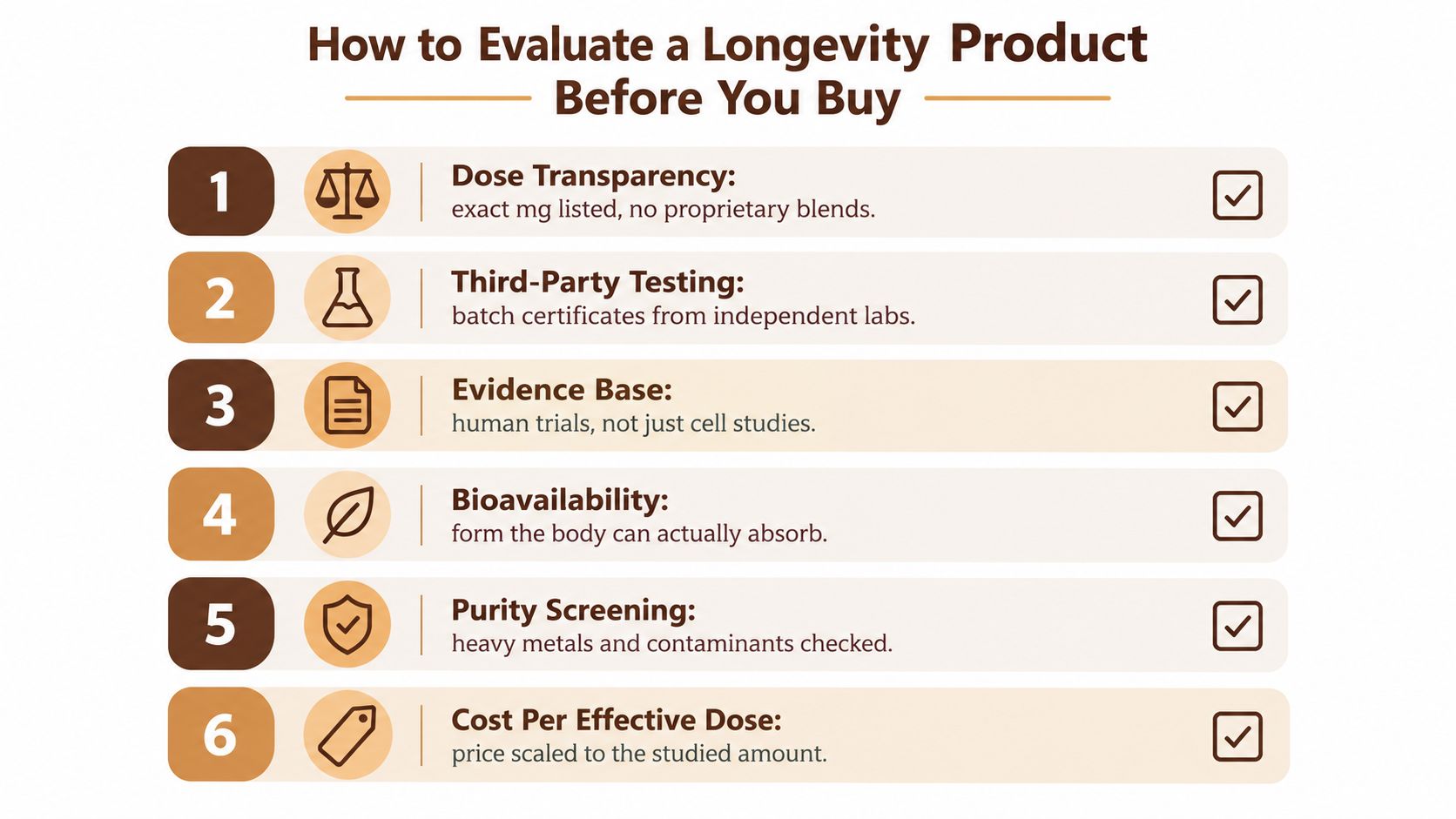
A good product page should let you make a decision without decoding vague language. Use these six checks before you add anything to your basket.
Start with the label
Dose transparency comes first. Look for the exact amount of each active ingredient, not a proprietary blend that hides the quantities. The instant test is simple: can you compare the labelled dose with a human study without guessing?
Third-party testing is the next filter. Look for credible independent certification, such as USP, NSF, or ConsumerLab verification, and check whether the company makes batch-level Certificates of Analysis available. A claim that a product is tested isn't the same as showing what was tested.
Evidence base should refer to humans and a relevant outcome. Cell studies can explain why an ingredient deserves investigation, but they can't tell you whether your energy, strength, inflammation, or healthspan will improve. Ask whether the study used the same form and amount that appears on the label.
Bioavailability matters, but it shouldn't become another marketing shortcut. Liposomal, micronized, and chelated forms may be useful for some compounds, yet the form only matters if it improves absorption or the outcome that you care about. The instant test is whether the brand provides human evidence for its specific formulation.
Check the delivery and the claims
Capsules, softgels, powders, and sublingual products each create different practical trade-offs around stability, convenience, taste, and absorption. A dual-delivery capsule may separate ingredients that don't sit well together, but a more complicated format isn't automatically better. Ask what problem the format solves and whether the brand has tested that solution in humans.
Formula synergy should be demonstrated, not implied by a long ingredient list. NMN plus another compound may sound appealing, but extra ingredients can make it impossible to identify what helped or caused a side effect. Fewer, clearly dosed ingredients usually produce a cleaner experiment.
Finally, look for red flags:
- Exaggerated claims: Be wary of language promising to reverse aging, guarantee longevity, or replace medical care.
- Undisclosed sourcing: You should know the active ingredients, manufacturing standards, and testing process.
- Missing batch details: A product without traceable lot information is harder to investigate if quality concerns arise.
- Price without context: Calculate the cost per effective, studied serving rather than comparing bottle prices.
For broader guidance on picking supplements with confidence, use the same discipline across vitamins, minerals, and specialized compounds. A product framed around cellular energy, such as the Cell Energy Supplement, still needs to pass the same tests for dose, evidence, purity, and value.
Biomarkers That Tell You If a Longevity Supplement Is Working
Subjective energy is useful feedback, but it is noisy. Sleep, caffeine, training load, stress, illness, and expectation can change how you feel without changing your underlying health. Biomarkers give you a better way to ask whether a supplement has altered something relevant.
Start with the marker tied directly to the intervention. For vitamin D, use serum 25-hydroxyvitamin D and interpret the result with a clinician rather than chasing a universal target. For omega-3, an omega-3 index can show whether EPA and DHA status has moved. For metabolic health, HbA1c provides a longer-view picture of glucose regulation. High-sensitivity C-reactive protein, or hs-CRP, can help track systemic inflammation, although a single result can be affected by acute illness or training stress.
NAD-related testing is more specialized. Whole-blood NAD+ or an NAD+/NADH ratio may help investigate whether a precursor is engaging its intended pathway, but these measures aren't as standardized or clinically interpretable as routine tests. The recent uncertainty around age-related whole-blood NAD+ also means you shouldn't treat a higher value as a direct proxy for slower aging.
| Biomarker | Useful interpretation | Test frequency | What it tells you |
|---|---|---|---|
| 25-hydroxyvitamin D | Compare with your laboratory range and clinical context | Establish a baseline, then retest after a consistent trial period | Whether vitamin D status has changed |
| Omega-3 index | Assess movement from your personal baseline | Baseline and follow-up after sustained intake | Whether EPA and DHA status has improved |
| HbA1c | Interpret with other glucose measures and medical history | Periodic clinical monitoring | Longer-term glucose regulation |
| hs-CRP | Avoid interpreting during acute illness | Repeat when health and training are stable | A broad signal of inflammatory activity |
| Whole-blood NAD+ or NAD+/NADH | Use specialty-lab results cautiously | Only when the test is available and clinically meaningful | Whether a NAD-focused intervention changed a biochemical measure |
Use a baseline and a decision rule
Test before starting when possible. Keep the product, dose, diet, and routine stable long enough to make the follow-up useful, then retest at an interval appropriate to the marker. Don't change three products at once, because an improved result won't tell you which intervention produced it.
Some outcomes, especially mitochondrial efficiency and long-term healthspan, lack affordable direct biomarkers. That doesn't justify guesswork. Track practical proxies such as strength progression, recovery, sleep quality, blood pressure, glucose markers, and physical function. If you have no baseline, no defined outcome, and no follow-up plan, supplement use becomes a faith-based practice rather than a data-driven routine.
Building Your Own Longevity Routine That Holds Up Over Time
A durable routine should be easy to evaluate and easy to stop. The following four-week sequence keeps novelty from taking over.
Week one, establish the basics. Review diet, sleep, resistance training, medications, and relevant bloodwork. If a clinician identifies low vitamin D, inadequate omega-3 status, or another clear need, correct that first. Creatine can be considered in the context of strength and performance goals, while magnesium should reflect diet, tolerance, and medical history.
Week two, add one target. Choose a single specialized ingredient only when you can explain the target. NMN makes sense as a monitored NAD-related experiment for someone who understands that a biomarker response may not translate into a functional benefit. Rhodiola is more logically matched to a stress-fatigue goal than to a general anti-aging promise.
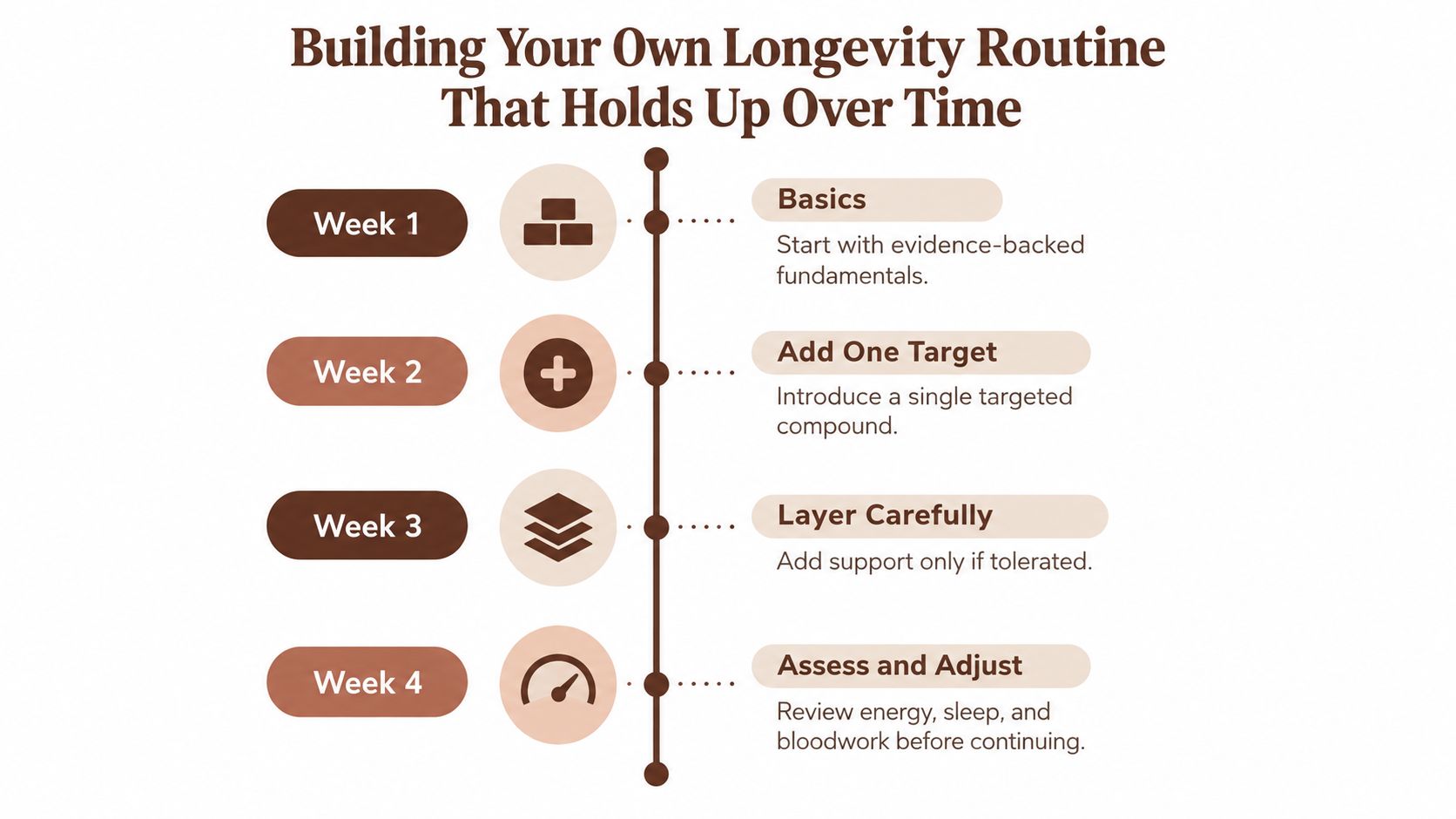
Week three, layer carefully. Keep a short log of the product, timing, sleep, training, digestion, mood, and any unwanted effects. Don't add another compound just because the first one feels subtle. A quiet result is still information, especially when the ingredient's main evidence concerns a biomarker rather than a noticeable sensation.
Week four, assess and adjust. Review whether the product met its stated purpose, whether you tolerated it, and whether testing can answer the question. If you want fewer separate capsules, a multi-delivery formulation may be a consolidation choice, but convenience shouldn't hide doses or make the routine impossible to audit.
The routine still rests on sleep, adequate protein, and resistance training. Supplements can't compensate for consistently poor recovery, insufficient food quality, or declining muscle use. They can support a well-built plan, correct a shortfall, or provide a focused experiment. They can't turn a weak foundation into a durable healthspan strategy.
Before starting a new product, speak with a qualified healthcare professional if you take prescription medication, have a medical condition, or are pregnant or nursing. A measured, staged routine will usually teach you more than a large stack assembled in one enthusiastic purchase.
REVETIX offers longevity-focused products including NMN, Rhodiola rosea, and topical formats, so you can evaluate different delivery approaches within the evidence-aware framework above. Review the formulations and product information at REVETIX, then choose only what matches a defined goal, a transparent label, and a plan to assess results.