


You're tired at the same time every afternoon, and you've probably blamed it on lunch, sleep, stress, or just getting older. Maybe your workouts feel more expensive than they used to, or your word-finding goes fuzzy right when you need your brain to stay sharp. Those moments can feel personal, but they're often the first place people notice a broader shift in how their cells are handling energy.
That's why the idea of a cell energy supplement is so appealing. It promises a direct line from biochemistry to how you feel, which is a reasonable question to ask, especially when the usual fixes haven't fully solved the problem. The harder part is separating what's well supported from what's mostly marketing.
Table of Contents
- Why Your Cells Feel Older Than You Do
- The Cellular Energy Engine Explained
- Key Ingredients Behind Cell Energy Supplements
- How Delivery Formats Actually Compare
- What the Evidence Really Shows
- How to Evaluate Any Cell Energy Product
- Safety, Side Effects, and the Smart Way to Start
Why Your Cells Feel Older Than You Do
The frustration usually starts small. You hit the same wall at 3 p.m., need an extra day to recover from a workout that used to be routine, or pause mid-sentence because the word won't come. Those aren't proof of one single problem, but they're the kind of lived clues that make people look for a cell energy supplement in the first place.
At the cellular level, aging isn't one dramatic event, it's a slow reduction in efficiency. Mitochondria, the structures that turn nutrients into usable energy, don't seem as forgiving under chronic stress, poor sleep, under-recovery, or the wear that accumulates over time. A useful mental model is this, if the cell is a factory, then energy output depends on both the machinery and the fuel shuttles that keep electrons moving.
Why the same day can feel harder
People often expect fatigue to show up only as sleepiness. In reality, it can look like foggy attention, slower recovery, or a lower tolerance for stress. That's why articles about fatigue, brain fog, and recovery from energy insights from Longwelle resonate so strongly, they're talking about the same daily friction many readers already feel.
The biology underneath that friction is still being mapped. NAD-related chemistry matters because it helps cells keep electron transfer moving, but a molecule going up in a lab report doesn't automatically mean your afternoon feels better. That gap between a lab marker and lived experience is the central question in this topic.
A supplement can only help with the bottleneck it actually reaches. If the issue is sleep debt, under-eating, or overtraining, no capsule is going to replace those basics.
That's the right place to start evaluating any cell energy supplement. Not with the promise of turning back time, but with a practical question, can it meaningfully support the cellular processes that are linked to energy in humans, and can you feel that support in daily life?
The Cellular Energy Engine Explained
Think of cellular energy like a rechargeable battery system with a messenger moving power between compartments. NAD+ is one of those messengers, it helps shuttle electrons so cells can keep producing usable energy. NMN and NR are better thought of as chargers or precursors, not the battery itself, because they feed the system that makes more NAD+.
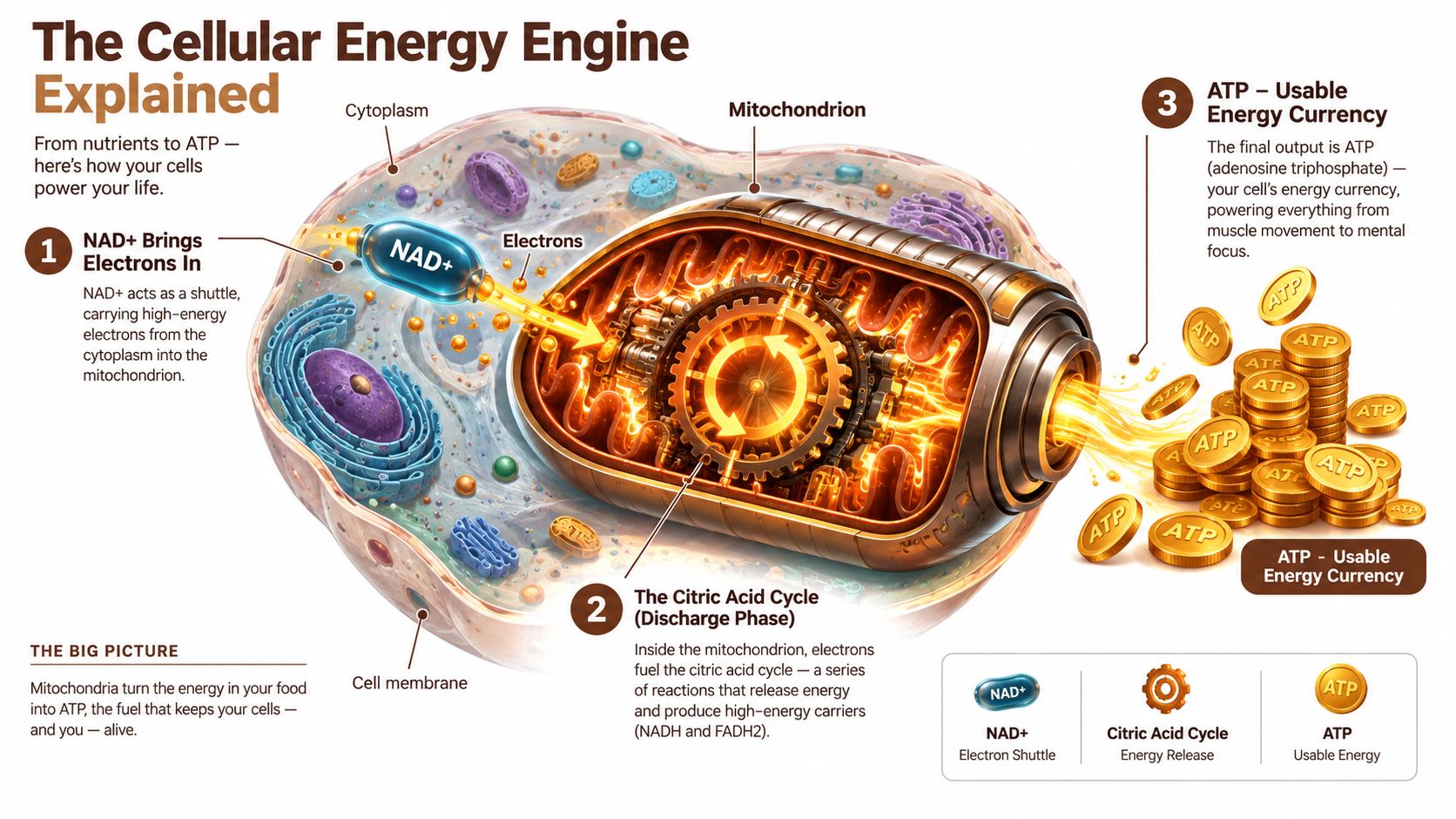
The usable energy your body spends is ATP. Mitochondria make it by processing nutrients through pathways that depend on NAD+ availability, so when people talk about supporting “cell energy,” they're usually talking about keeping that flow efficient. A simple way to picture it is this, the cell burns fuel, NAD+ helps carry the charge, and ATP is the coin the cell spends.
What the terms mean in plain English
Cytosolic NAD+ lives in the fluid outside the mitochondria, while mitochondrial NAD+ supports energy production inside the mitochondria. That distinction matters because some supplements may raise blood or cellular markers without proving they change the exact compartment you care about most. It's one reason the field looks better on paper than it does in outcome studies.
This also explains why people bring up sirtuins, DNA repair, and metabolic flexibility. Those are biologically plausible downstream effects of a healthier NAD+ environment, but plausibility isn't the same as proof of better day-to-day function. The pathway makes sense, the human payoff still has to earn its place.
If you like tracking health inputs, mitochondrial support through tracking can be useful as a habit. The point isn't to obsess over every metric, it's to notice whether sleep, training, and supplementation are moving your energy in the same direction.
A product like NMN Supplement fits into this story as a direct precursor to NAD+, not as a shortcut around biology. That distinction matters, because a precursor can influence the system without guaranteeing a dramatic feeling of energy.
Practical rule: If a product claims to “boost cellular energy,” ask whether it's supplying a precursor, changing absorption, or just rebranding a familiar ingredient.
Key Ingredients Behind Cell Energy Supplements
The ingredient list matters more than the label theme. A cell energy supplement might lean on NAD precursors, stress adaptogens, antioxidants, or mineral cofactors, but those categories don't all do the same job. Some are trying to influence the NAD system directly, while others are aiming at fatigue perception, stress response, or basic nutritional support.
| Ingredient | Typical Dose | Mechanism | Evidence Strength | Realistic Outcome |
|---|---|---|---|---|
| NMN | 250 mg/day to 900 mg/day in the human studies cited here | Raises NAD+ as a direct precursor | Moderate for biomarker change, limited for lived outcomes | May raise NAD+ and related metabolites, but real-world energy gains remain unproven |
| NR | Not stated in the verified data | Another NAD precursor that supports circulating NAD-related metabolites | Moderate for biomarker change | Can increase NAD+ markers, outcome benefits still unclear |
| Direct NAD+ | Not stated in the verified data | Intended to deliver NAD+ directly | Weaker oral evidence overall | Often framed as a shortcut, but systemic effects are less established |
| Rhodiola rosea | Not stated in the verified data | Adaptogenic stress support, distinct from NAD biology | Mixed | May help perceived fatigue in some people, not a guaranteed energy fix |
| Glutathione | Not stated in the verified data | Antioxidant support and oxidative stress defense | Adjunctive | Supportive, not a standalone energy driver |
| CoQ10 | Not stated in the verified data | Supports mitochondrial energy chemistry | Adjunctive | More often used for energy support than as an NAD booster |
NMN and NR deserve separate attention
NMN has repeated human evidence showing it can raise NAD+. In one 2022 clinical study, healthy adults taking 250 mg/day for 4 weeks showed a significant and sustained increase in whole-blood NAD+ with no apparent adverse effects reported, and a separate trial found oral NMN up to 900 mg/day for 60 days was safe and well tolerated while raising blood NAD concentration and improving measures such as the 6-minute walk test, SF-36, and biological-age-related markers, according to the review at the clinical evidence summary. A 2023 review also noted that four randomized controlled trials had already tested NMN over 12-week intervention periods and that NMN appears safe for up to 24 weeks while tending to increase NAD+ or related metabolites in multiple tissues.
NR belongs in the same broad family, but it's not just a duplicate of NMN. Recent reviews show NR and NMN both raise NAD-related biomarkers, while nicotinamide doesn't behave the same way over time, which is a good reminder that ingredient choice matters.
Where the other ingredients fit
Rhodiola is a different kind of tool. The systematic review on Rhodiola rosea found mixed results, with only some physical-fatigue and mental-fatigue studies reporting benefit, and the overall conclusion was that the evidence was still insufficient to confirm effectiveness. That makes it more sensible to think of Rhodiola as a stress-resilience ingredient than as a replacement for sleep, food, or recovery.
Shilajit, glutathione, and CoQ10 are usually adjuncts. They may support broader mitochondrial or oxidative-stress pathways, but they aren't interchangeable with NAD precursors. If a formula throws all of them into one stack, that doesn't automatically make it better, it just makes the mechanism harder to interpret.
For a deeper ingredient-by-ingredient breakdown, the internal guide on what is NMN, benefits, uses, safety, and how it supports NAD is worth reading after this.
How Delivery Formats Actually Compare
The format can matter as much as the ingredient. A capsule, gummy, cream, or patch can all look like a cell energy supplement, but they don't carry the same evidence for absorption, dose consistency, or systemic effect. The market often treats them as if they're equivalent, and that's where readers can get misled.
| Format | Bioavailability Evidence | Dose Precision | Convenience | Best For |
|---|---|---|---|---|
| Oral capsule | Strongest overall evidence for NAD precursors | High | High | People who want measurable ingredient intake |
| Gummy | Less consistent because of matrix constraints | Medium to low | High | Casual use, if the dose is clearly labeled |
| Sublingual tablet | Variable and ingredient-dependent | Medium | Medium | People who dislike swallowing capsules |
| Transdermal patch | Claims are less independently verified | Medium | High | Users prioritizing convenience over precision |
| Topical cream | Best suited to skin or localized use | Low for systemic goals | High | Localized application, not a clear whole-body NAD strategy |
Oral NMN has the clearest support when the goal is to raise NAD-related markers systemically. That doesn't mean oral wins every time, but it does mean the burden of proof is higher for patches and creams when they're marketed as if they can do the same job as oral precursors. The question to ask is simple, is the format delivering enough of the active ingredient in a way that can affect the bloodstream?
Convenience isn't the same as effectiveness
Gummies are easy to take, but the matrix often limits how much active ingredient fits in one serving. Creams are pleasant to apply, but a topical product aimed at general “energy” should be treated carefully unless it's specifically designed for localized skin support. Patches appeal to people who want a hands-off routine, but the evidence base for transdermal NAD boosting is much thinner than for oral precursors.
If you're comparing formats, the internal guide on what are NAD patches and how do they compare with capsules is a useful check against marketing claims. It helps separate convenience from actual delivery confidence.
One practical lens is adherence. If you'll forget capsules but reliably use a patch, a weaker format you use can beat a stronger format you abandon. Still, if your goal is precise precursor dosing, capsules usually give you the cleanest readout.
What the Evidence Really Shows
The biggest mistake people make is assuming a biomarker rise automatically means a better day. NMN can raise NAD+ in humans, and NR can do the same, but the leap from “marker changed” to “I feel different” is still shaky. That gap is exactly where a lot of cell energy marketing gets ahead of the science.
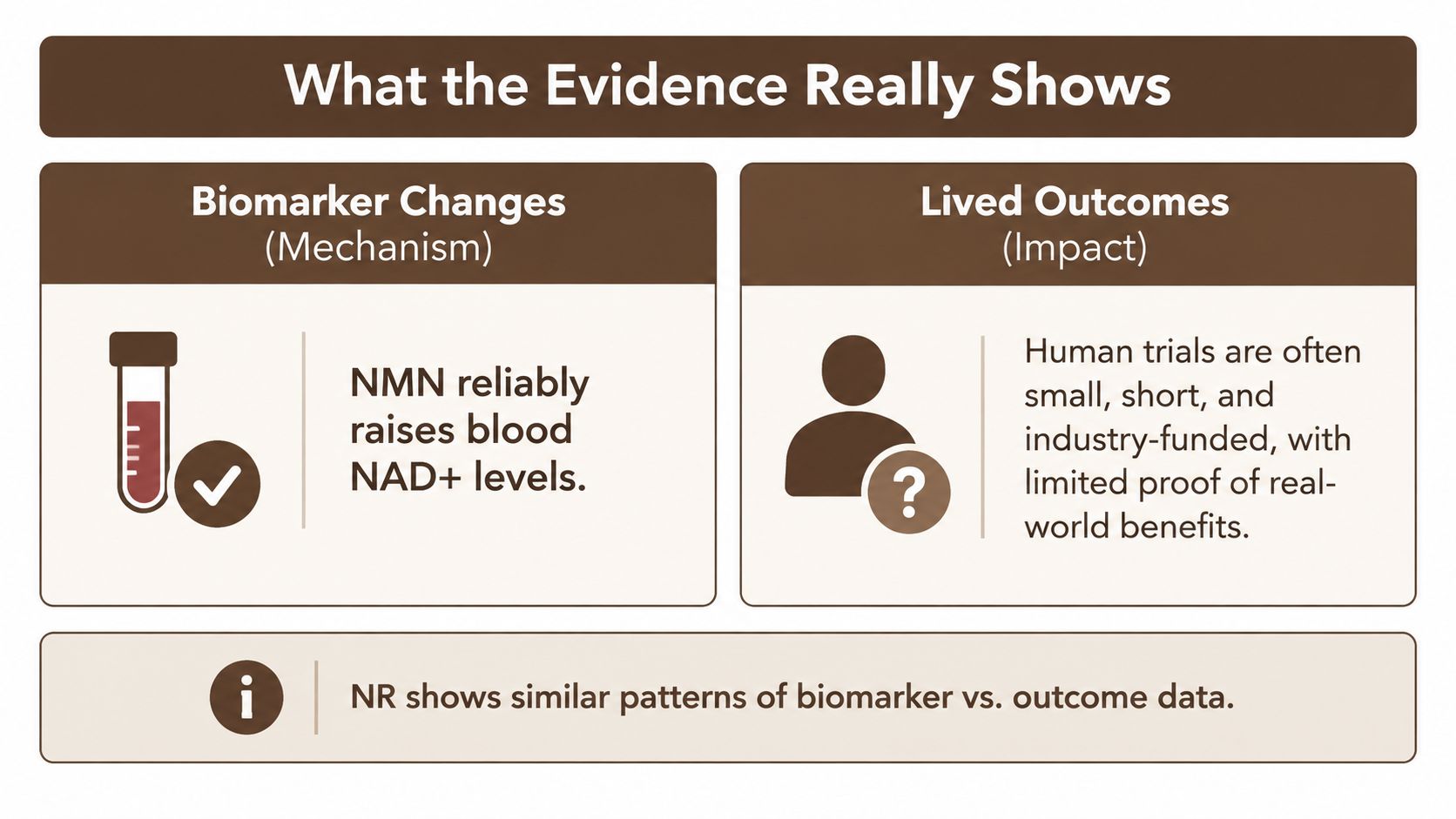
The broader NAD+ literature has grown, but human outcomes remain mixed. A 2026 systematic review identified 113 eligible intervention studies, including 33 human studies, and concluded that oral NR and NMN consistently showed biochemical target engagement in circulating or cellular NAD-related metabolites, while healthspan outcomes were often heterogeneous or null, according to the review summary. An earlier 2024 systematic review from the American Physiological Society evaluated 10 studies totaling 489 participants for NAD and NADH supplements, which shows the clinical literature is still relatively small even as interest grows.
Why the lived outcome gap matters
A supplement can move a lab value and still fail to change cognition, recovery, or endurance in any noticeable way. That's not a failure of chemistry, it's a reminder that the body is more complicated than a single pathway. In the NAD world, the question isn't whether the supplement does anything, it's whether what it does matters to a person on a Tuesday afternoon.
The clearest contrarian point is this. The benefits of raising NAD+ are still unverified in large human studies, and a 12-week trial in older adults with mild cognitive impairment found NR raised blood NAD+ but did not significantly improve cognition, cardiovascular function, or whole-brain blood flow, as noted in this clinical coverage. That's exactly why readers should be careful with claims that sound bigger than the evidence.
Bottom line: Biomarker success is real, but it isn't the same as outcome success.
Rhodiola sits in a different lane. Its evidence is mixed, but the target is perceived fatigue and stress tolerance rather than NAD elevation. That makes it useful in a formula conversation, yet it also keeps expectations realistic.
How to Evaluate Any Cell Energy Product
Quality control is where a lot of good-looking labels fall apart. If you're choosing a cell energy supplement, start with proof, not packaging. The fastest way to narrow the field is to ask whether the company can document what's in the bottle and how it was made.
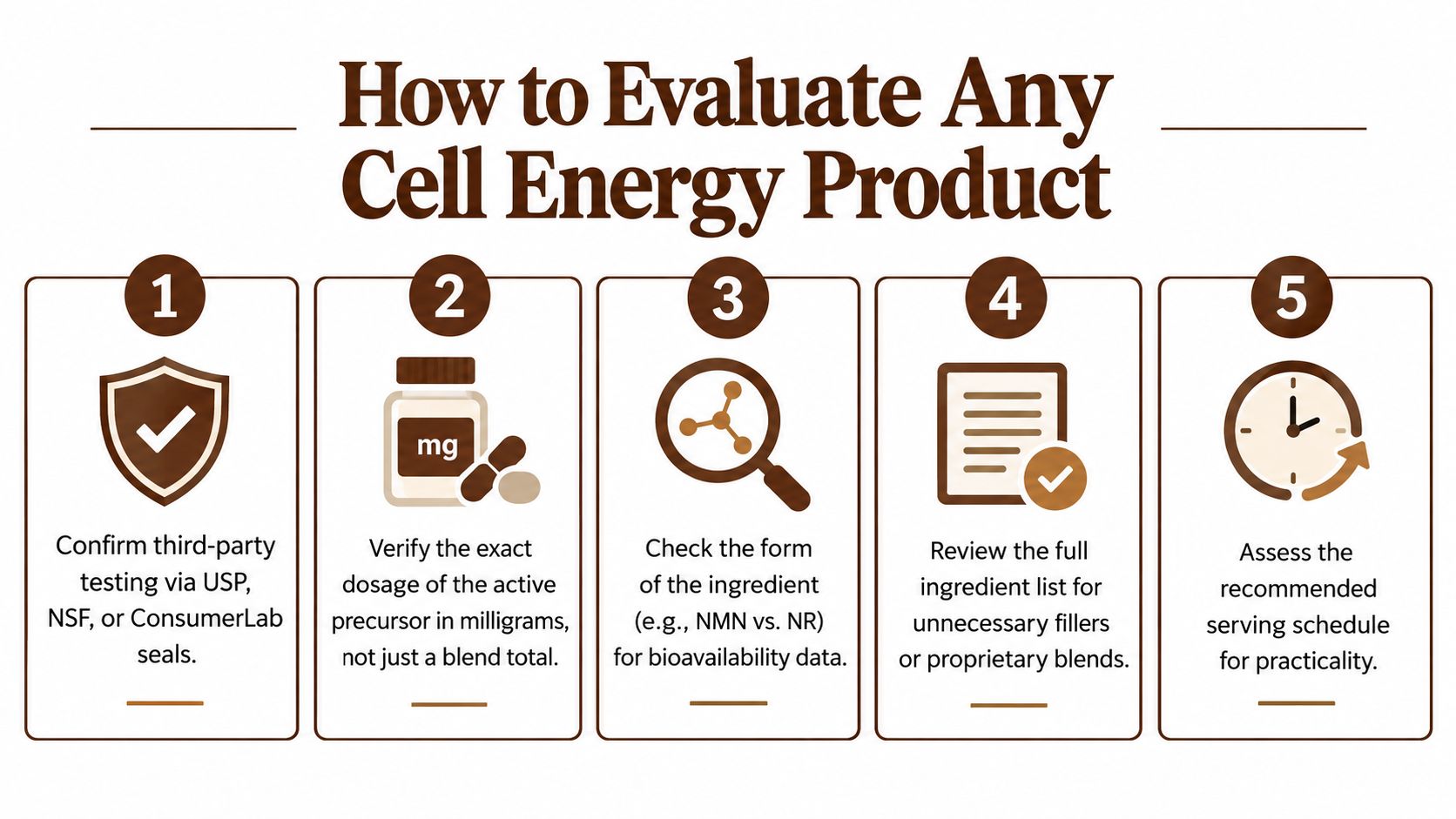
- Check for third-party testing. Look for USP, NSF, or ConsumerLab seals, or ask for a Certificate of Analysis. That tells you the company is willing to verify identity and purity outside its own marketing team.
- Read the exact milligrams. A proprietary blend hides the actual dose. If the label won't tell you how much NMN, NR, or Rhodiola you're getting, you can't judge whether the product matches the evidence.
- Look for manufacturing standards. cGMP and documented lab testing matter because they reduce the odds of inconsistent batches. A supplement can sound advanced and still be poorly controlled.
- Check the ingredient logic. Synergy can be real, but only when the combination makes mechanistic sense. A formula that combines NMN with supportive compounds is different from one that pads the label with trendy extras.
- Spot the red flags. Unsupported longevity promises, missing test reports, celebrity-only endorsements, and oddly inflated pricing all deserve skepticism. A product doesn't become more scientific because it uses a minimalist design and a futuristic font.
A simple comparison filter
Use this quick rule when two or three products seem similar. Pick the one that gives you the exact active dose, the cleanest testing documentation, and the delivery format you'll use. If those three things aren't clear, keep moving.
The publisher's product lineup includes Himalayan Shilajit Gold Gummies, which are positioned as a shilajit and ashwagandha gummy format with trace minerals. That kind of product should still be evaluated by the same standards, especially on dose transparency and whether the delivery format matches the outcome you want.
If the label is vague, treat the claim as vague too.
Safety, Side Effects, and the Smart Way to Start
The safest way to begin is boring, and that's a good thing. Start with one product, track how you feel, and give it time before adding another. For many NAD precursors, long-term human safety data beyond 12 months is still limited, and that alone is enough reason to avoid stacking several new compounds at once.
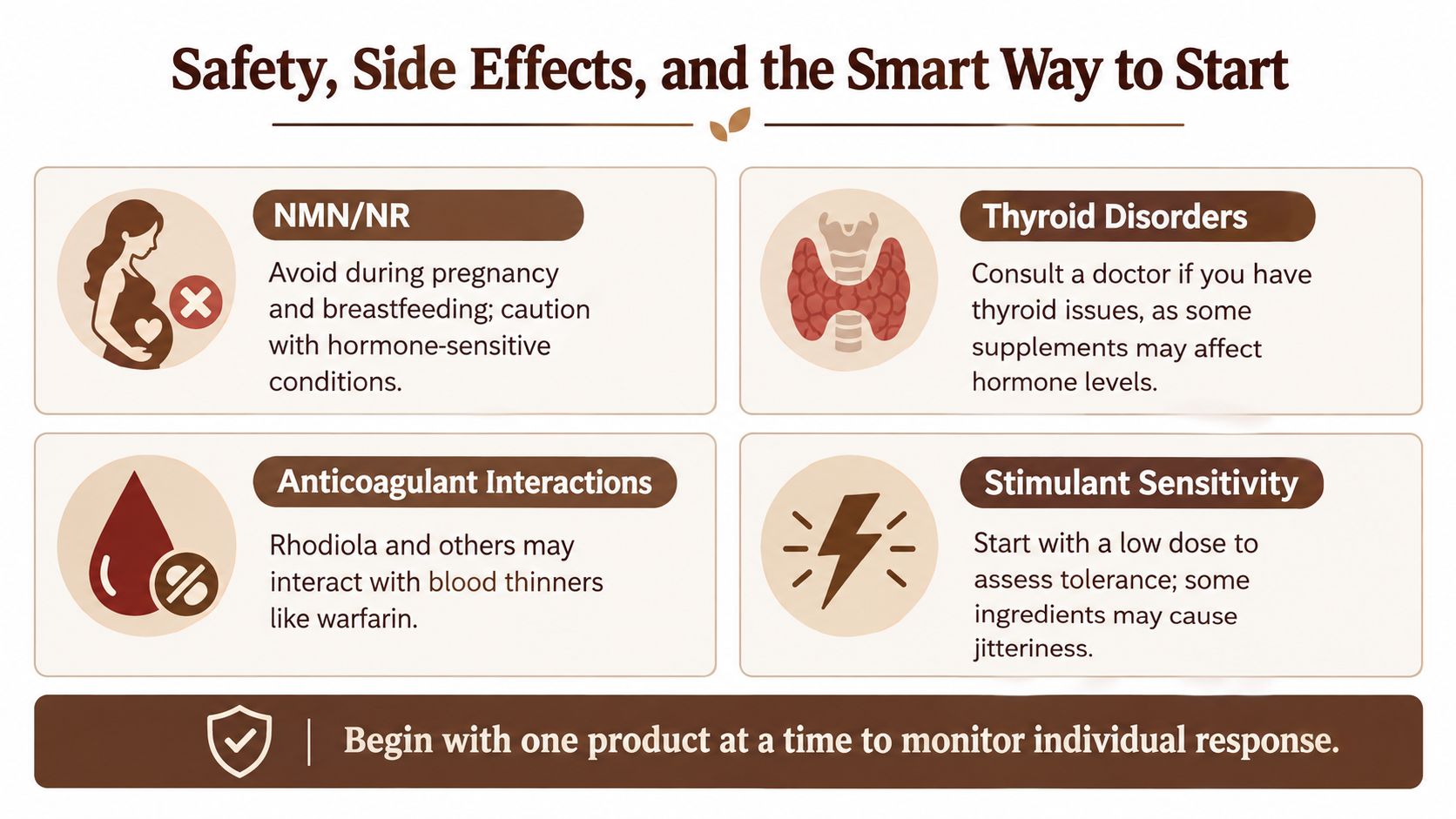
NMN and NR should be treated cautiously during pregnancy and breastfeeding, and people with hormone-sensitive conditions should also talk to a clinician first. Rhodiola can be stimulating for some users, and the internal overview at Rhodiola rosea plant is worth reviewing if you're sensitive to energizing herbs or take medications that affect mood or blood pressure.
People on SSRIs, MAOIs, blood pressure medications, diabetes medications, anticoagulants, or anyone with active cancer or hepatic impairment should check with a clinician before trying a new energy-focused supplement. Thyroid disorders also deserve extra caution, because fatigue can come from hormone imbalance rather than a missing supplement ingredient. If you already have a medical explanation for low energy, that deserves attention before you buy another bottle.
The smart way to start is simple, baseline labs if you have an underlying condition, one product at a time, and an eight-week review window before you judge the result. Keep a short journal of sleep, afternoon energy, workouts, and digestion. A supplement that helps only when you're also sleeping well and eating enough may still be useful, but it's not a magic switch.
What actually deserves your trust
A good cell energy supplement should fit into a bigger system that includes sleep, resistance training, protein intake, and honest tracking. If the label promises certainty, the evidence usually doesn't. If the product gives you a clear dose, a plausible mechanism, and a way to test your response, that's a much better place to start.
If you want a more disciplined way to compare formulations, visit REVETIX and look at how its NMN, Rhodiola, shilajit, and topical options are presented alongside their ingredient purpose. Use the same standards from this guide when you read those labels, then choose the format and dose you can evaluate effectively over time.