


You hit the familiar midafternoon slump. Coffee helped earlier, but your focus has faded, your body feels heavy, and you're wondering whether the problem is sleep, stress, aging, or something happening inside your cells. That's where NAD+, short for nicotinamide adenine dinucleotide, enters the conversation.
NAD+ is a molecule your cells use to process nutrients, transfer energy, and support several repair-related enzymes. It's become popular in longevity circles because researchers can measure it in human blood, and because NAD+ biology connects metabolism with aging. But an important distinction often gets lost in the excitement: raising an NAD+ biomarker isn't the same as proving better energy, sharper cognition, or longer healthspan.
Table of Contents
- Introduction to NAD Plus
- History of NAD Plus Research
- How NAD Plus Works in Cells
- Key Roles of NAD Plus in Metabolism
- NAD Plus Role in Aging and Longevity
- Clinical Evidence and Consumer Applications
- Common Misconceptions About NAD Plus
- Conclusion and Practical Takeaways
Introduction to NAD Plus
A useful answer to “what is NAD plus?” starts with a simple comparison. Think of NAD+ as a reusable shuttle operating inside your cells. In one form, it accepts energy-carrying electrons. In another form, NADH, it transports those electrons to places where the cell can use them. The shuttle must keep cycling for energy metabolism to continue.
That doesn't mean a tired afternoon automatically signals low NAD+. Fatigue has many possible causes, and no supplement can identify the cause on its own. NAD+ is better understood as part of the machinery that lets cells convert food into usable energy, rather than as a stimulant that produces an immediate lift.
Scientists also study NAD+ because it helps enzymes involved in DNA repair, protein regulation, and cellular signaling. Those roles make it biologically important, but they don't prove that taking an NAD+ product will reverse aging or solve everyday tiredness.
Practical rule: Separate three questions. Does a product raise NAD-related biomarkers? Does it change symptoms? Does it improve a meaningful long-term health outcome?
Readers who want a consumer-friendly starting point can review this guide to understanding NAD supplementation. The most useful questions are what NAD+ does inside cells, how the body makes it, which delivery methods have been studied, and whether human results match the promises made in marketing.
History of NAD Plus Research
NAD+ has a longer scientific history than its recent presence in wellness marketing suggests. British biochemists Arthur Harden and William John Young first discovered NAD+ in 1906 while studying yeast fermentation. Their work helped connect the molecule with the way living systems convert nutrients into usable energy, according to this history of NAD research.
That early discovery mattered because fermentation offered researchers a controllable way to observe chemical reactions in living cells. NAD+ eventually became connected with vitamin precursors such as niacin, while later biochemical research placed it across several pathways that keep metabolism running.
The scientific story then broadened. Researchers learned that NAD+ wasn't only an electron carrier involved in energy conversion. It also served as a substrate consumed by enzymes involved in DNA repair, protein deacetylation, and signaling. That shift changed the way scientists viewed NAD+. It became less like a passive vitamin helper and more like a shared cellular resource.
More than a century of research explains why NAD+ attracts attention in aging biology today. The molecule sits where several foundational processes meet, including energy production and stress responses. However, a long research history doesn't automatically validate every modern product claim. It establishes biological importance, not proof that a particular capsule, cream, patch, or infusion produces a desired outcome.
How NAD Plus Works in Cells
A cell may need to process nutrients while also repairing damage and responding to signals. NAD+ helps coordinate some of these tasks by switching between two related forms:
- NAD+ accepts electrons: In its oxidized form, it can receive electrons during chemical reactions.
- NADH carries electrons: After accepting them, NAD+ becomes NADH and transports the electrons to another reaction.
- The cycle continues: NADH can release its electrons, returning to NAD+ so the cycle can repeat.
The pair works like a reusable shuttle. NAD+ picks up electron cargo, becomes NADH, delivers that cargo, and returns empty for another trip. Cells need this exchange because many reactions depend on a workable balance between NAD+ and NADH.
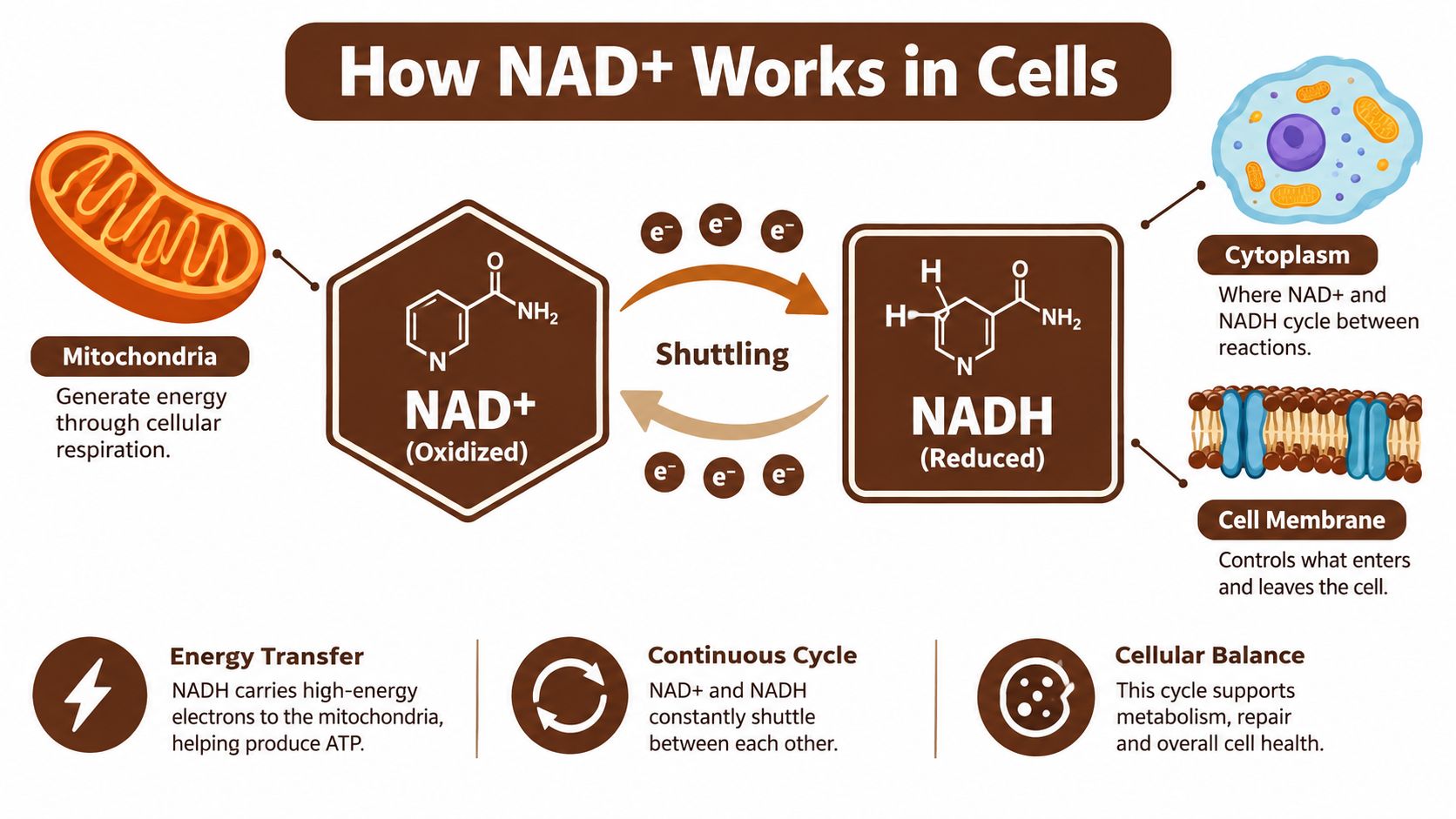
NAD+ participates in redox reactions across glycolysis, the pyruvate dehydrogenase complex, the tricarboxylic acid cycle, and oxidative phosphorylation. These pathways process nutrients and pass their chemical energy toward the cell's energy-producing systems. NAD+ is not fuel itself. It helps transfer energy in an organized sequence.
NAD+ also serves as a substrate for enzymes such as sirtuins, PARPs, and CD38. These enzymes connect it with protein deacetylation, DNA repair, and calcium signaling, as described in this review of NAD+ metabolism and cellular function. That broader role explains why a change in an NAD+ biomarker does not automatically predict a noticeable change in health or performance.
Delivery adds another layer for consumers. A precursor must be absorbed, processed, and used by tissues before it can influence NAD+ pathways. Readers comparing options can review Celonyx Labs NAD precursors and explore this guide to NMN benefits, uses, safety, and NAD support. NMN is discussed as a precursor, not as an identical replacement for NAD+.
An NMN Supplement illustrates an oral product positioned around precursor delivery. Its product information identifies beta-NMN as the active form and states that the capsules are third-party tested, vegan-friendly, gluten-free, and made in a GMP-certified facility. These details describe the product and its manufacturing claims. They do not establish a specific health outcome.
Key Roles of NAD Plus in Metabolism
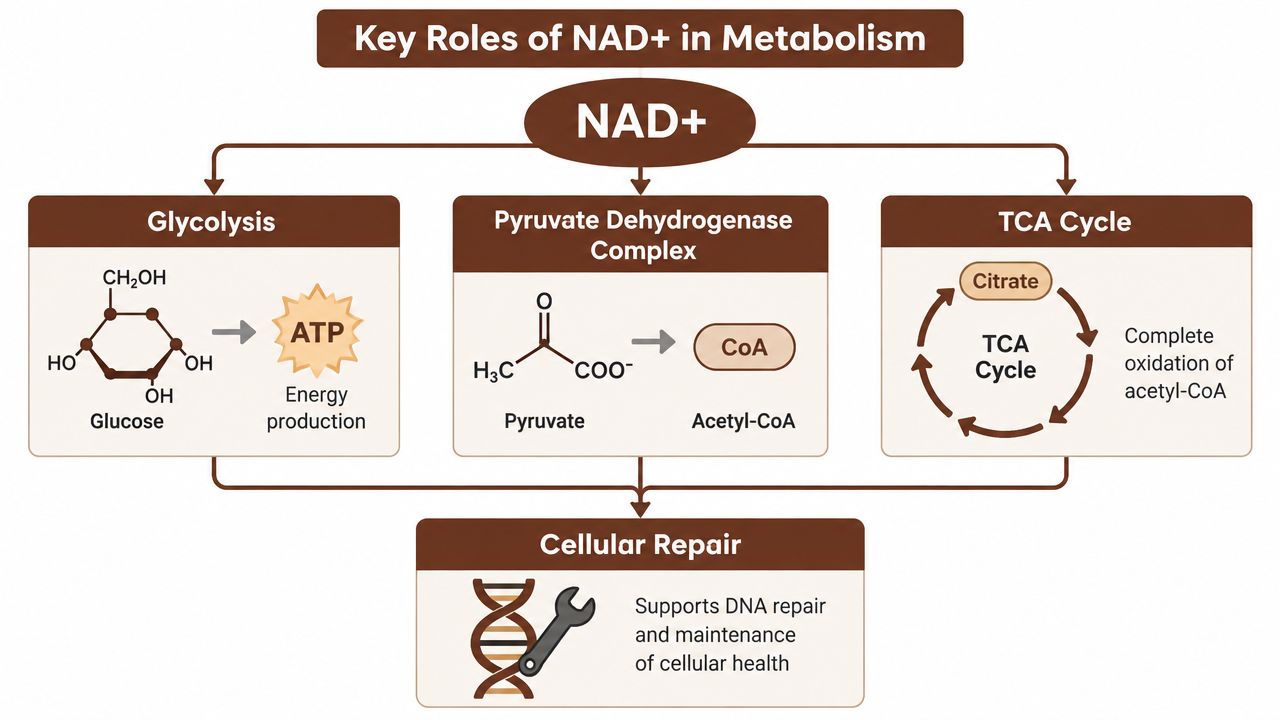
After a meal, a cell must convert nutrients into usable energy while maintaining its internal systems. NAD+ helps coordinate that work by carrying electrons between enzyme-driven reactions. It does not create energy by itself. It acts more like a reusable shuttle, moving electrons through pathways that process carbohydrates and other nutrients.
Energy pathways
During glycolysis, cells split glucose into smaller molecules and use NAD+ in electron-transfer reactions. The products can then enter the pyruvate dehydrogenase complex, which prepares them for the tricarboxylic acid cycle. As carbon compounds are processed in that cycle, NAD+ accepts electrons and becomes part of the next stage of energy transfer.
Those electrons eventually reach oxidative phosphorylation. In mitochondria, this chain of transfers supports the production of cellular energy. If NAD+ recycling or availability becomes limited, reactions that depend on it may slow, creating a bottleneck. This explains why NAD+ is described as a metabolic hub, while also showing why a higher NAD+ measurement does not automatically mean better performance in a healthy person.
The following video offers a visual explanation of the pathways involved:
Repair and signaling
NAD+ also serves as a resource for enzymes involved in cellular maintenance. Sirtuins use it during protein deacetylation, which can affect cellular regulation. PARPs consume it during responses to DNA damage and repair, while CD38 uses it in processes connected with calcium signaling.
The same pool therefore supports two broad demands: electron transfer for metabolism and enzyme activity linked to maintenance. Stress can increase competition for that shared resource. Cellular and biochemical studies support these roles, as noted earlier in the article.
Delivery creates a separate question for consumers. A topical formula acts at the skin surface and should not be treated as equivalent to an intracellular metabolic intervention. For example, PDRN Volufiline NAD+ BALM is described as a targeted skin balm containing PDRN, Volufiline, collagen, NAD+, peptides, and retinol. Its stated purpose concerns visible skin appearance, hydration, and targeted application, not proof of a systemic change in NAD+ biology.
NAD Plus Role in Aging and Longevity
Aging research focuses on NAD+ because several cellular systems depend on it at once. If the available pool becomes less adequate, cells may have more difficulty supporting both metabolic reactions and enzyme systems involved in stress responses. That possibility has made NAD+ a target for research into healthy aging, mitochondrial function, and repair biology.
Human biomarker data provide a more grounded starting point than broad longevity promises. In a 2022 study of 1,518 participants, average whole-blood NAD+ measured 33.0 ± 5.5 μmol/L, and the researchers observed a significant age-related decline before age 50, particularly among participants aged 40 to 49. The same study reported higher average NAD+ in men than women, 34.5 versus 31.4 μmol/L, as detailed in the Frontiers study on blood NAD+ and age.
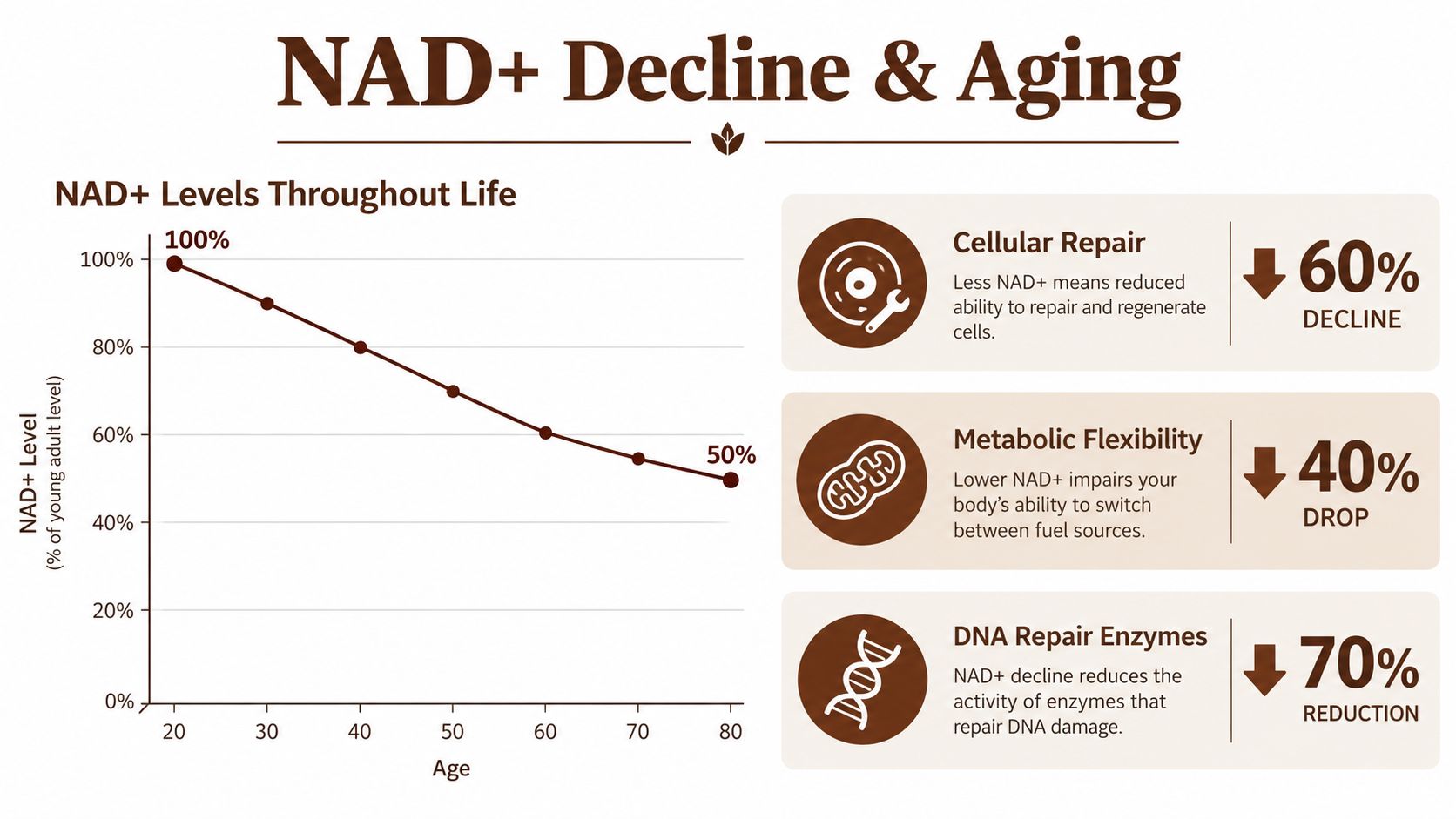
These findings show that NAD+ is a measurable biomarker that varies across people. They don't show that every age-related symptom results from NAD+ decline, or that restoring a measured level will extend a person's life. In fact, newer discussions have challenged the assumption that blood NAD+ always falls uniformly with age, which is another reason to avoid treating one biomarker as a complete aging score.
People exploring longevity functional medicine may find it useful to discuss symptoms, medications, health history, and testing together rather than selecting a product based on age alone. A broader science-based guide to healthy aging supplements can also help place NAD+ precursors alongside sleep, movement, nutrition, and other health priorities.
Clinical Evidence and Consumer Applications
A useful consumer question is simple: does a higher NAD-related biomarker lead to a noticeable health benefit? Current evidence gives a cautious answer. Reviews report that NMN and NR can raise blood NAD+ and appear generally well tolerated in early human research, while findings on aging, metabolic health, and cognition remain mixed, as summarized in this review of NAD+ precursor studies.
A later 2026 PRISMA-guided review of 113 studies reached a similar conclusion. Oral NR and NMN consistently increased NAD-related biomarkers and were generally well tolerated. Evidence for broader healthspan, metabolic, and performance benefits remained limited, with several human outcomes mixed or showing no clear effect. The full findings appear in this analysis of oral NR and NMN evidence.
Comparing delivery formats
| Format | What it may change | Main evidence question |
|---|---|---|
| Oral NMN or NR | Supplies precursors that the body converts through NAD+ pathways | Does a biomarker increase produce a meaningful health benefit? |
| Cream or balm | Applies ingredients to the skin surface and targeted areas | Does topical use affect local appearance, and how much reaches deeper tissue? |
| Patch | Provides a transdermal delivery format | Is absorption consistent, and does it outperform oral delivery? |
| IV or intramuscular NAD+ | Delivers NAD+ through a clinical administration route | Are there convincing outcome data for the route itself? |
Delivery is part of the biology. An oral precursor must survive digestion, enter circulation, and undergo intracellular conversion. A patch or injection follows a different path, so a more direct route does not automatically produce better results.
Recent reviews have described limited outcomes evidence for IV or intramuscular NAD+ itself. A trial in older adults with mild cognitive impairment found that NR increased blood NAD+ without improving cognition, cardiovascular function, or whole-brain blood flow, according to this review of NAD+ delivery and clinical translation.
The practical comparison of NAD patches and capsules should focus on evidence, ingredients, tolerability, and convenience rather than delivery claims. A topical NAD+ Cream belongs to a separate category. Without product-specific clinical evidence, evaluate it as topical skincare rather than assume it produces the systemic effects associated with oral precursors.
Common Misconceptions About NAD Plus
A blood NAD+ reading is a signpost, not a destination. Myth one, more is always better. NR and NMN can raise NAD-related biomarkers, yet the 2026 review of 113 studies found broad healthspan and performance benefits remained limited and mixed, as reported in the systematic review.
Myth two, every NAD+ product works systemically. A cream or balm acts mainly where it is applied. An oral precursor must pass through digestion, enter circulation, and undergo conversion inside cells. Delivery route affects exposure, but stronger biomarker changes do not automatically mean better outcomes.
Myth three, NAD+ reverses aging. NAD+ supports important cellular reactions, while aging reflects many interacting systems. It is a promising research target, not a standalone reversal mechanism.
Myth four, a higher NAD+ reading proves better health. Biomarkers can show that a pathway responded. They cannot alone demonstrate improved cognition, stamina, or longevity. Consumers should therefore compare delivery methods and outcome evidence, not just product claims.
Conclusion and Practical Takeaways
NAD+ is a central coenzyme involved in energy metabolism, electron transfer, cellular signaling, and repair-related enzyme activity. Research supports the idea that oral precursors can raise NAD-related biomarkers, but real-world benefits remain less certain.
Use a measured approach:
- Start with fundamentals: Prioritize sleep, regular movement, adequate nutrition, and medical care for persistent fatigue.
- Evaluate the route: Treat capsules, patches, creams, and clinical infusions as different interventions.
- Read the endpoint: Ask whether evidence shows a biomarker change, symptom improvement, or a meaningful health outcome.
- Seek guidance: Discuss supplements with a healthcare professional if you're pregnant, nursing, taking prescription medication, or managing a health condition.
If you're comparing products, REVETIX offers an oral NMN supplement alongside topical NAD+ formats for consumers interested in different delivery approaches. Visit REVETIX to review the available product information and choose an option that matches your goals and expectations.