


Clinical reviews describe Rhodiola rosea side effects as generally mild, with only five adverse events reported across three studies in a 2012 review of 11 clinical studies involving 446 participants. The bigger concerns are potential herb-drug interactions and the lack of established safety data for pregnant people, breastfeeding people, and children.
You may be looking at a Rhodiola bottle because stress has left you tired, unfocused, or dependent on stimulants to get through the day. The word “natural” can make the decision feel simple, but Rhodiola rosea isn't automatically suitable for every person or every medication list.
The practical question isn't whether Rhodiola can ever cause discomfort. It can. The better question is whether the product, dose, health situation, and other medicines make a trial reasonable. Most reported problems are manageable, but a thoughtful safety check matters more than assuming every Rhodiola extract behaves the same way.
Table of Contents
- What the Research Says About Rhodiola Rosea Safety
- Common Rhodiola Rosea Side Effects Explained
- Who Should Avoid Rhodiola Rosea or Use Caution
- Rhodiola Rosea Drug Interactions and Medicine Risks
- How to Use Rhodiola Rosea More Safely
- The Bottom Line on Rhodiola Rosea Side Effects
What the Research Says About Rhodiola Rosea Safety
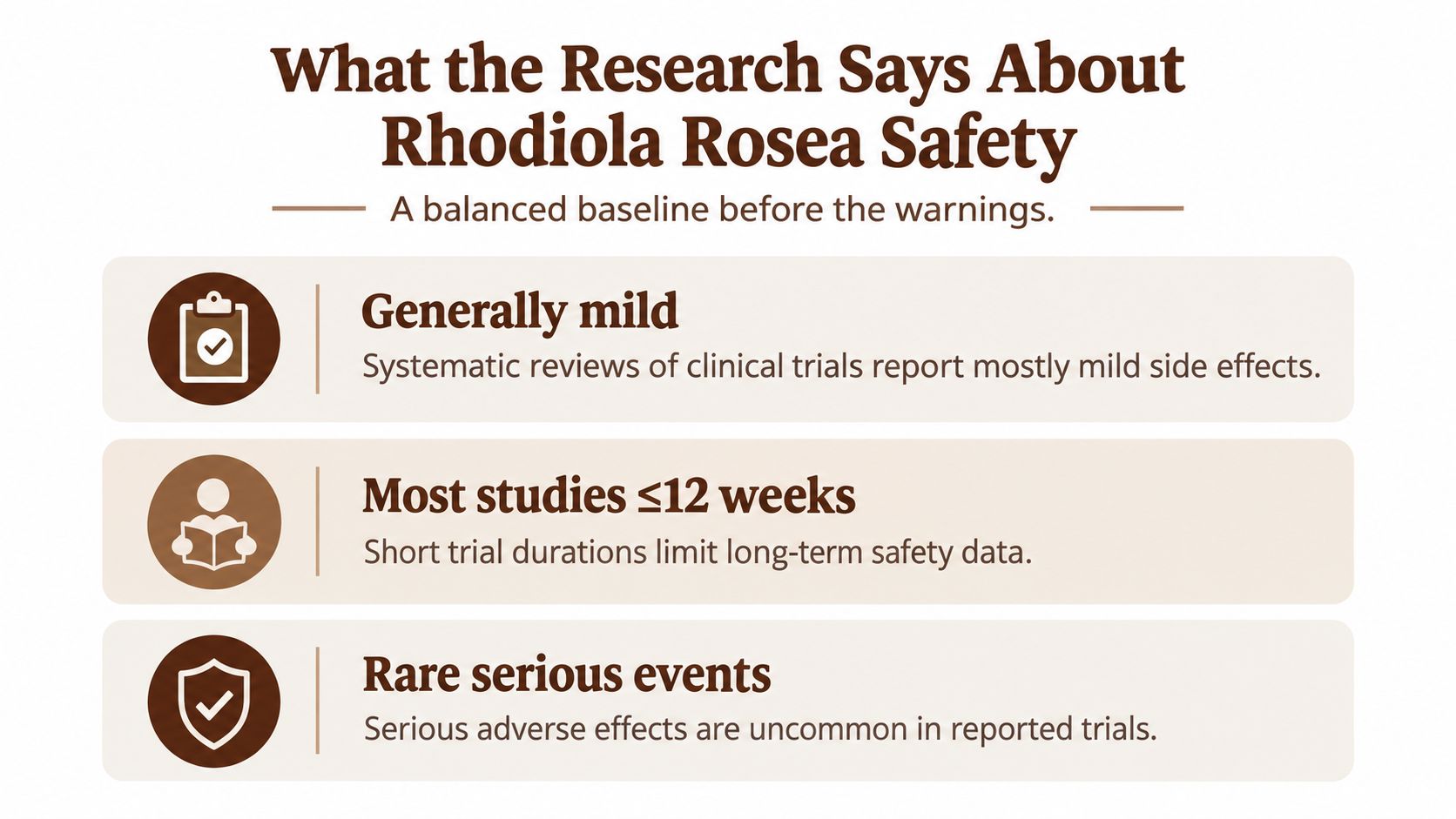
The short-term safety picture is more reassuring than many supplement warnings suggest. A 2012 systematic review assessed 11 clinical studies involving 446 participants who received Rhodiola rosea or placebo. Across three studies, researchers recorded only five adverse events, and the review characterized the identified effects as generally mild. The review also concluded that Rhodiola had a very low observed occurrence of side effects, while warning that the available evidence was limited. (2012 systematic review of Rhodiola safety)
That low event count deserves careful interpretation. In one trial, two participants taking 200 mg daily for four weeks reported headaches. One was described as minor and the other as serious, but the available summary doesn't establish that either headache was caused by Rhodiola. A separate long-term study recorded one minor headache and one case of insomnia among Rhodiola users, while other headaches, insomnia, and hypersalivation appeared in placebo participants. This pattern makes causation difficult to separate from ordinary symptoms that occur during a study.
Why low event counts can mislead
Clinical trials often use small groups, short follow-up, and inconsistent methods for recording adverse events. They may also exclude people who are pregnant, breastfeeding, taking several prescriptions, managing complex illness, or under the age of adulthood. Those exclusions make a trial cleaner, but they also mean the results may not represent the person considering Rhodiola at home.
The product itself creates another variable. A standardized Rhodiola rosea extract isn't necessarily equivalent to a loose root powder or a preparation made with a different extraction method. Differences in botanical identity, extract ratio, solvent, marker compounds, and dose can change tolerability, so safety findings can't automatically transfer from one formulation to another. Readers comparing products should first understand what the label identifies, as discussed in this guide to the Rhodiola rosea plant.
Practical rule: “Generally mild in short clinical studies” means the observed risk was low in those study conditions. It doesn't mean adverse effects are impossible or that every extract is interchangeable.
The right baseline is therefore balanced. Rhodiola doesn't appear to produce frequent severe toxicity in the available clinical evidence, but the evidence gaps are important. Pregnancy, breastfeeding, childhood use, long-term daily use, and complex medication combinations remain areas where caution should replace confidence.
Common Rhodiola Rosea Side Effects Explained
European safety assessments group reported Rhodiola reactions into three broad areas: the nervous system, the gastrointestinal tract, and the skin. Listed possibilities include headache, nervousness, insomnia, dizziness, nausea, vomiting, abdominal pain, diarrhea, rash, and itching. The European Medicines Agency states that reliable frequencies can't be estimated from the available evidence. (European Medicines Agency assessment of Rhodiola rosea)
That uncertainty matters because a list of reported symptoms can sound like a prediction. It isn't. Some people may notice no change, while others may experience a headache, unsettled stomach, or difficulty sleeping soon after starting. The research doesn't support assigning a dependable probability to any individual symptom.
The symptoms people usually notice
The nervous-system complaints are often the most disruptive in everyday use. Nervousness, restlessness, dizziness, headache, or insomnia can make an energy-oriented supplement feel counterproductive, particularly for someone already sensitive to stimulating products. If sleep becomes worse after starting, continuing unchanged isn't a good test of discipline. It's a reason to pause and reassess the product, timing, and other stimulants.
Digestive reactions can include nausea, vomiting, abdominal pain, or diarrhea. Skin reactions such as rash or itching are also listed. These symptoms may have several possible causes, so a clear record of when the supplement began and when symptoms appeared can help a pharmacist or clinician assess whether Rhodiola is a plausible contributor.
Study observations provide useful context. One study summarized by the EMA found no serious side effects attributed to the extract when participants used 567 mg daily for 28 days. Another study using 340 mg or 680 mg daily for six weeks showed a similar overall safety profile, although dizziness and dry mouth were observed in a study using 340 mg daily. These findings are reassuring for those study conditions, not a guarantee for every product or person.
Stop taking Rhodiola and seek medical advice if symptoms are severe, rapidly worsening, or accompanied by signs of a serious reaction. A new persistent problem deserves attention even if it seems minor, because continuing a supplement can make it harder to identify the cause.
A product such as Rhodiola Rosea may be presented as a daily option containing naturally occurring compounds such as rosavins and salidroside, but those descriptions don't remove the need to check your own tolerance and medication risks.
Who Should Avoid Rhodiola Rosea or Use Caution
The clearest reason to avoid self-directed Rhodiola use is missing safety evidence, not proof that the herb causes harm in every vulnerable group. Safety during pregnancy and lactation hasn't been established. Clinical references also advise caution or avoidance for children, and Merck advises caution for people with autoimmune disorders. (Merck Manual guidance on Rhodiola)
Situations that need clinician review
- Pregnancy or breastfeeding: Don't treat an absence of reported problems as evidence of safety. The relevant studies haven't established a reliable safety profile for these life stages.
- Children and adolescents: The clinical evidence doesn't adequately answer whether Rhodiola is appropriate for developing bodies, so self-experimentation isn't a sensible default.
- Autoimmune disorders: Merck advises caution, and the broader evidence doesn't clarify how Rhodiola may affect people whose immune systems are already dysregulated.
- Multiple medicines: The more prescriptions and supplements someone takes, the harder it becomes to predict combined effects. A pharmacist can often perform a focused interaction review before use.
- Complex health conditions: Blood-pressure problems, glucose-control issues, mood disorders, and cardiovascular concerns can all change the risk calculation. A supplement that feels mildly energizing to one person may be unsuitable for another.
These cautions also apply when Rhodiola is combined with other products marketed for energy, stress, or longevity. For example, an NMN Supplement is a separate product category with its own ingredients and medication considerations. Adding several products at once makes it difficult to identify which ingredient caused a symptom or changed a medicine's effect.
The safer rule is simple: higher-risk groups should obtain clinician or pharmacist input before starting Rhodiola. That review is especially important if symptoms such as fatigue, low mood, poor sleep, or dizziness could reflect an untreated medical issue rather than a need for an adaptogen.
For readers comparing adaptogens, the differences discussed in Rhodiola rosea vs. ashwagandha shouldn't be reduced to “energizing” versus “calming.” Each ingredient has different evidence gaps, formulation differences, and interaction questions.
Rhodiola Rosea Drug Interactions and Medicine Risks
The most important risk may not be a standalone headache or stomach upset. It may be a change in how another medicine is absorbed, transported, or broken down. That change can be difficult to notice until a medicine becomes less effective or produces stronger effects than expected.
Human probe-substrate data found a modest reduction in CYP2C9 activity. Preclinical evidence also suggests possible effects on CYP3A4 and P-glycoprotein, although the clinical significance remains uncertain. These pathways matter because they help the body process or transport medicines. The concern is greatest with drugs that have a narrow therapeutic window, including warfarin and phenytoin, where even a modest change in exposure can affect safety.
The interaction categories that deserve attention
Rhodiola has also been described as having monoamine-oxidase-inhibitory activity. That creates a plausible pharmacodynamic route for additive effects with antidepressants, stimulants, or medicines that affect blood pressure. A reported case of tachyarrhythmia during concurrent antidepressant use reinforces the need for caution, but it doesn't prove that a predictable interaction occurs in everyone.
Merck identifies possible additive or opposing effects involving antidepressants, glucose-lowering drugs, antihypertensives, warfarin, anti-inflammatory medicines, and immunosuppressants. The practical issue isn't to assume that every combination is dangerous. It's to avoid assuming that every combination is harmless.
Before taking Rhodiola, ask a clinician or pharmacist to review:
- Anticoagulants: Warfarin and similar medicines require particular care because altered metabolism can change exposure and bleeding risk.
- Anticonvulsants: Phenytoin is specifically relevant to the CYP2C9 concern, and seizure treatment generally requires consistent medicine levels.
- Antidepressants: Theoretical monoamine effects and the reported tachyarrhythmia case make unsupervised combinations unwise.
- Antihypertensives and glucose-lowering drugs: Additive effects could contribute to blood pressure or glucose changes in susceptible people.
- Stimulants: Combining Rhodiola with stimulant medicines or energy products may make nervous-system effects harder to predict.
A supplement interaction check should start with your complete medication list, not with the question of whether a product is “natural.”
People who want broader background on evaluating botanical and supplement combinations can also consult HempWell USA's drug interaction guide. It isn't a substitute for a Rhodiola-specific medication review, but it reinforces an important habit: assess the active ingredients and the medicines together.
Don't stop a prescribed medicine to make room for Rhodiola. Ask the prescriber who manages it, and provide the product label or a photograph of the supplement facts panel so the reviewer can assess the exact preparation.
How to Use Rhodiola Rosea More Safely
A cautious trial starts before the first capsule. The goal is to reduce uncertainty, not to prove that you can tolerate a product at any cost.
A practical routine
1. Check the label before checking out. Look for the full botanical identity, a clearly described extract ratio, the extraction solvent, declared marker-compound standardization, and the amount per serving. If the label doesn't explain what preparation you're taking, the safety evidence is harder to apply.
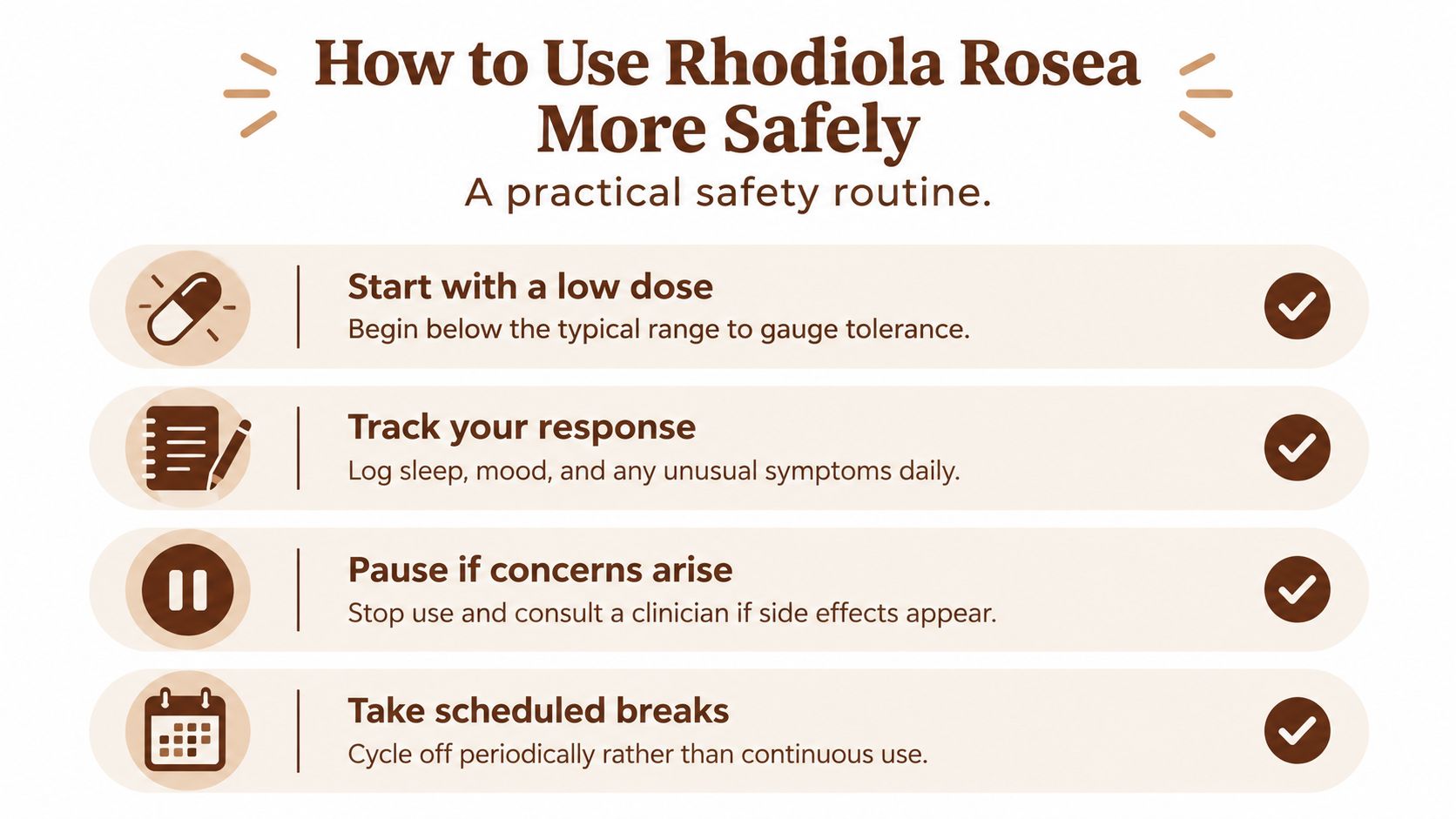
2. Start conservatively. Use the lowest labeled serving rather than jumping to a larger amount. Don't introduce Rhodiola on the same day as several other new supplements, a concentrated stimulant, or a major change in caffeine intake. If a reaction appears, you'll have fewer possible causes to untangle.
3. Choose a consistent time. If Rhodiola seems activating, taking it earlier in the day may be more tolerable than taking it close to bedtime. The right response to new insomnia isn't to push through it. Pause, record what happened, and discuss the next step with a professional if symptoms continue.
4. Track the response. For the initial trial, note sleep quality, nervousness, dizziness, headaches, digestive symptoms, and any unusual change in mood or heartbeat. A short daily record is more useful than relying on a vague memory several weeks later.
The EMA has reported preparations with no serious side effects attributed to the extract in specific short studies, but those findings don't eliminate the need for product-specific caution. A different extract, dose, or treatment duration can have a different tolerability profile.
Pause use if a concerning symptom appears, particularly a pronounced change in sleep, mood, digestion, balance, or cardiovascular sensations. Seek medical advice rather than repeatedly adjusting the dose when symptoms are persistent, severe, or difficult to explain.
People considering another adaptogen may find the discussion of ashwagandha for stress relief useful as a reminder that “stress support” products still require condition- and medication-specific judgment. For additional practical guidance on timing and routine, see how to take Rhodiola rosea, while treating any product-specific instructions as secondary to advice from your clinician.
The Bottom Line on Rhodiola Rosea Side Effects
The available clinical evidence presents Rhodiola rosea as generally well tolerated in the short term, with reported problems such as headache, nervousness, insomnia, dizziness, digestive upset, rash, and itching. The evidence doesn't provide reliable frequencies for those reactions, and a low event count shouldn't be confused with proof of zero risk.
The more consequential questions concern interactions and uncertainty. Rhodiola may affect drug-metabolizing or drug-transport pathways, and its possible monoamine-oxidase-inhibitory activity makes combinations with antidepressants and stimulants worth reviewing. Warfarin, phenytoin, blood-pressure medicines, glucose-lowering drugs, anti-inflammatory medicines, and immunosuppressants deserve particular attention because the consequences of altered effects may be more significant than a temporary headache.
Pregnancy, breastfeeding, childhood, and autoimmune disease are also situations where the evidence doesn't justify casual self-treatment. If you fall into one of those groups, take prescription medicines, or manage a complex condition, clinician review is the sensible starting point.
For an otherwise healthy adult, a transparent product label, conservative use, symptom tracking, and a willingness to stop can reduce avoidable risk. Rhodiola may be a reasonable option for some people seeking stress or energy support, but informed caution is more useful than either blanket alarm or unconditional trust.
REVETIX offers Rhodiola rosea capsules alongside products focused on longevity, cellular energy, and performance support, giving you an option to review when comparing supplement formulations. Visit REVETIX to examine the available product information, then discuss whether Rhodiola fits your medicines, health history, and goals with a qualified clinician.