


You've bought a rhodiola supplement, taken a capsule at a random point in the day, and then wondered whether the subtle lift you expected was real. Perhaps you took it after lunch and felt alert for hours. Perhaps you took it late, slept poorly, and blamed the herb. Both experiences can happen when timing, dose, and extract composition aren't working together.
The label's headline milligram figure only tells part of the story. A raw-root capsule and a standardized Rhodiola rosea extract aren't interchangeable, because the amount of rosavins and salidroside can vary considerably between products. Commercial testing found rosavin content ranging from 0.01% to 3.08% across U.S. products, which makes a label-led approach less reliable than it appears (clinical safety review).
Table of Contents
- Why Timing and Dosing Matter for Rhodiola Rosea
- Finding Your Ideal Rhodiola Rosea Dosage
- When to Take Rhodiola for Maximum Benefit
- Cycling Strategies to Prevent Tolerance
- Safety Precautions and Potential Interactions
- Building a Sustainable Daily Routine
Why Timing and Dosing Matter for Rhodiola Rosea
A typical mistake looks harmless. You wake up tired, rush through breakfast, forget your supplement, remember it during an afternoon slump, and take it with coffee. The next night, you're restless and decide rhodiola “isn't for you.” The problem may not be the herb itself. You've combined inconsistent timing with an uncertain extract and possibly too much stimulation.
Rhodiola rosea is generally better treated as a daytime adaptogen than as a multivitamin. Its traditional uses centered on endurance, productivity, fatigue, altitude tolerance, and resilience. That pattern has continued into modern herbal practice, where standardized preparations are used for symptoms associated with mental and physical stress, including fatigue, exhaustion, and irritability (historical phytomedicinal review).
Why random use often disappoints
Random consumption creates three practical problems:
- You can't interpret your response. If the timing changes every day, you won't know whether a benefit or unwanted effect came from the dose, food, sleep, caffeine, or the product itself.
- You may take it too late. Health guidance commonly advises avoiding rhodiola before bedtime because its effects can feel stimulating (rhodiola safety and use guidance).
- You may mistake extract strength for root weight. Two capsules carrying the same raw milligram amount can deliver different quantities of the compounds used to characterize standardized extracts.
The practical principle is straightforward: use a consistent product, take it early, and adjust from a low starting point according to physical feedback. A useful response should feel like clearer, steadier capacity, not a wired rush. If you feel unusually tense, restless, irritable, dizzy, or unable to settle at night, the protocol needs changing.
Practical rule: Rhodiola should help you handle a demanding day, not force you to push through signals that your body needs recovery.
Finding Your Ideal Rhodiola Rosea Dosage
The first question isn't “How many milligrams should I take?” It's “What exactly are those milligrams?” A capsule containing raw root powder isn't equivalent to a capsule containing a standardized extract. The second question is whether the label identifies the extract's rosavin and salidroside content.
Common clinical and consumer use falls around 200–600 mg per day, while studied programs have included 170 mg daily for 4 weeks and 340–680 mg daily of standardized SHR-5 extract for up to 12 weeks (dose and safety overview). Exercise protocols can look very different. A recent review identified approximately 200 mg, containing about 1% salidroside and 3% rosavins, taken 60 minutes before exercise as a practical acute approach. Strength and power use may involve approximately 1,500 mg daily, with 500 mg within 1 hour before exercise, showing why the goal and extract profile matter (exercise-focused review).
Read the label before you adjust the dose
Look for:
- Botanical identity: The label should identify Rhodiola rosea, not just “rhodiola.”
- Plant part: Root or root-and-rhizome information helps clarify what the product contains.
- Standardization: A stated rosavin and salidroside percentage is more informative than root weight alone.
- Serving instructions: Check whether the listed amount is per capsule or per full daily serving.
- Single-dose limits: Canadian guidance places common adult limits around 680 mg per day of extract and 200 mg per single dose (regulatory and safety summary).
| Primary Goal | Suggested Daily Range | Standardization Target |
|---|---|---|
| General daytime energy and stress support | 200–600 mg | Clearly stated rosavin and salidroside content |
| Acute exercise support | About 200 mg before exercise | About 1% salidroside and 3% rosavins |
| Strength or power protocol | Around 1,500 mg daily in reviewed protocols | A defined extract profile, with clinician guidance for higher intake |
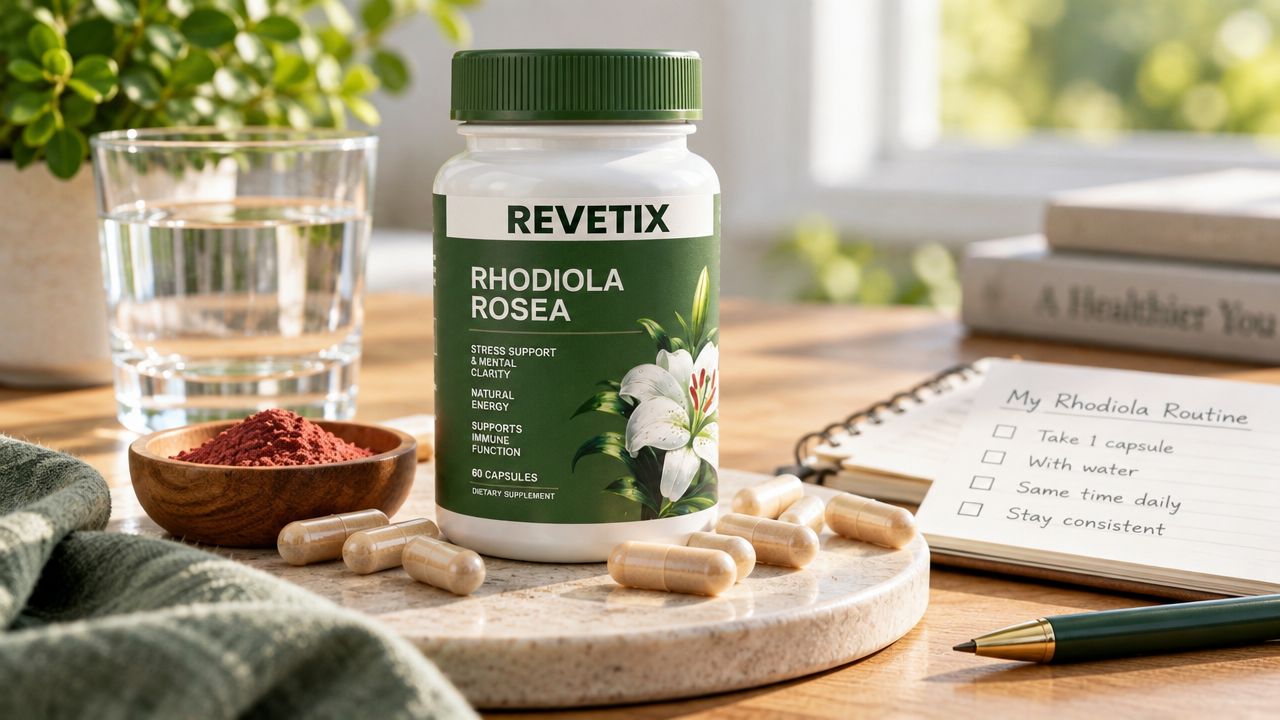
A product such as Rhodiola Rosea is presented as a capsule for daily calm, clarity, and energy support, with rosavins and salidroside identified as naturally occurring compounds. That description doesn't remove the need to inspect the actual supplement facts panel and assess your own response.
Start at the lower end of the relevant range, especially if you're sensitive to stimulating supplements. Keep the dose stable long enough to judge it, and don't increase just because a stronger effect sounds better. A smaller, well-characterized extract can be more predictable than a larger amount of poorly standardized powder.
For a more direct product reference when comparing formulations, review the REVETIX Rhodiola Rosea product information.
When to Take Rhodiola for Maximum Benefit
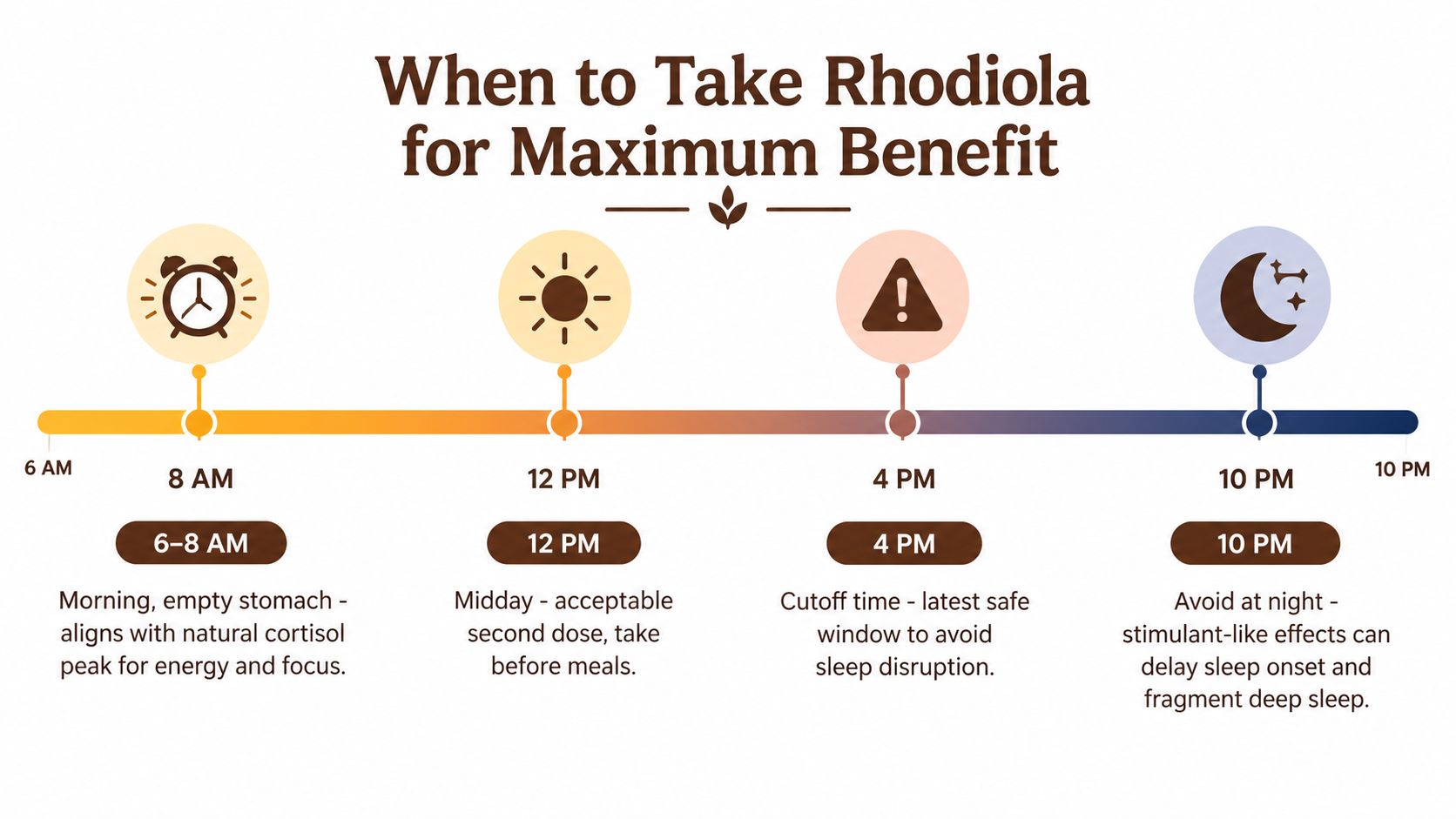
For most users, morning is the cleanest starting point. Take rhodiola after waking, either before food if your stomach tolerates it or with breakfast if an empty stomach causes discomfort. The goal isn't to force absorption at the expense of comfort. A routine you can repeat is more useful than a theoretically perfect schedule you abandon.
Traditional European practice often used rhodiola drops 15–30 minutes before eating, with regimens described as 5–10 drops two or three times daily for 10–20 days. Historical records also describe higher drop counts for fatigue-related psychiatric use, but those older preparations shouldn't be copied casually into modern concentrated extracts (traditional use review). The form of the product matters, so liquid-drop traditions aren't direct capsule instructions.
Choose the schedule that matches the task
For morning focus: Take your measured serving early in the day. Keep caffeine steady while you test rhodiola, otherwise you won't know which ingredient is driving the response.
For a midday demand: A second dose may be appropriate for some routines, but keep it well before bedtime and stay within the product's directions and single-dose guidance.
For training: The reviewed acute exercise protocol uses approximately 200 mg 60 minutes before exercise, with about 1% salidroside and 3% rosavins (exercise protocol review). That's a targeted pre-workout approach, not a reason to add repeated doses throughout the day.
For late-day fatigue: Don't automatically use rhodiola to override sleep pressure. If the dose makes you alert at the wrong time, move it earlier or reduce it. Adults are generally advised to avoid taking rhodiola before bedtime because of its stimulating effects (daytime timing guidance).
A daytime product such as Himalayan Shilajit Gold Gummies is described as combining shilajit, ashwagandha, and minerals in a gummy format. If you use several energizing products, introduce them separately so you can identify which one affects sleep, mood, digestion, or alertness.
For additional context on how rhodiola is positioned in wellness routines, see rhodiola rosea health benefits.
Cycling Strategies to Prevent Tolerance
Cycling rhodiola is best understood as a cautious way to manage uncertainty, not as a guaranteed method for preventing receptor changes. There's limited evidence for long-term effects, and higher-dose or continuous use hasn't been studied as thoroughly as short- to moderate-term use (clinical safety review). A break gives you an opportunity to assess whether the supplement is still helping and whether your baseline energy has improved through sleep, food, training, and workload changes.
Historical regimens commonly used defined courses rather than indefinite daily intake. One traditional review describes periods of 10–20 days, while another fatigue-related approach could extend to 1–2 months with different drop amounts (traditional phytomedicinal review). Those preparations and practices aren't identical to modern capsules, but they support a useful practical idea, use rhodiola in intentional blocks.
Use feedback instead of a rigid hack
A simple approach is to establish a stable morning dose, track how you feel, and schedule a pause when the response becomes unclear. During the pause, note:
- Energy: Do you feel naturally capable, or are you relying on stimulation to start the day?
- Sleep: Has bedtime settling or sleep continuity changed?
- Mood: Are you calm and resilient, or more impatient and reactive?
- Physical signals: Are dizziness, dry mouth, or restlessness appearing?
Some people prefer planned workday breaks, while others stop after a demanding period ends. I don't recommend increasing the dose to chase the first week's sensation. A fading noticeable effect doesn't automatically mean tolerance. It can mean your workload changed, your sleep deteriorated, or the product's active-compound content is inconsistent.
If you need rhodiola continuously to function, investigate the underlying fatigue rather than extending the supplement indefinitely. Persistent exhaustion deserves medical attention, particularly when it arrives with mood changes, palpitations, unexplained weight change, or disrupted sleep.
Safety Precautions and Potential Interactions
“Natural” doesn't mean universally safe. Rhodiola can feel stimulating, and product variability means the same stated root amount may not produce the same experience from one bottle to another. Safety reviews report relatively few adverse events overall, but note mild, dose-related insomnia, irritability, dizziness, and dry mouth (product variability and safety review).
Stop signs and medication questions
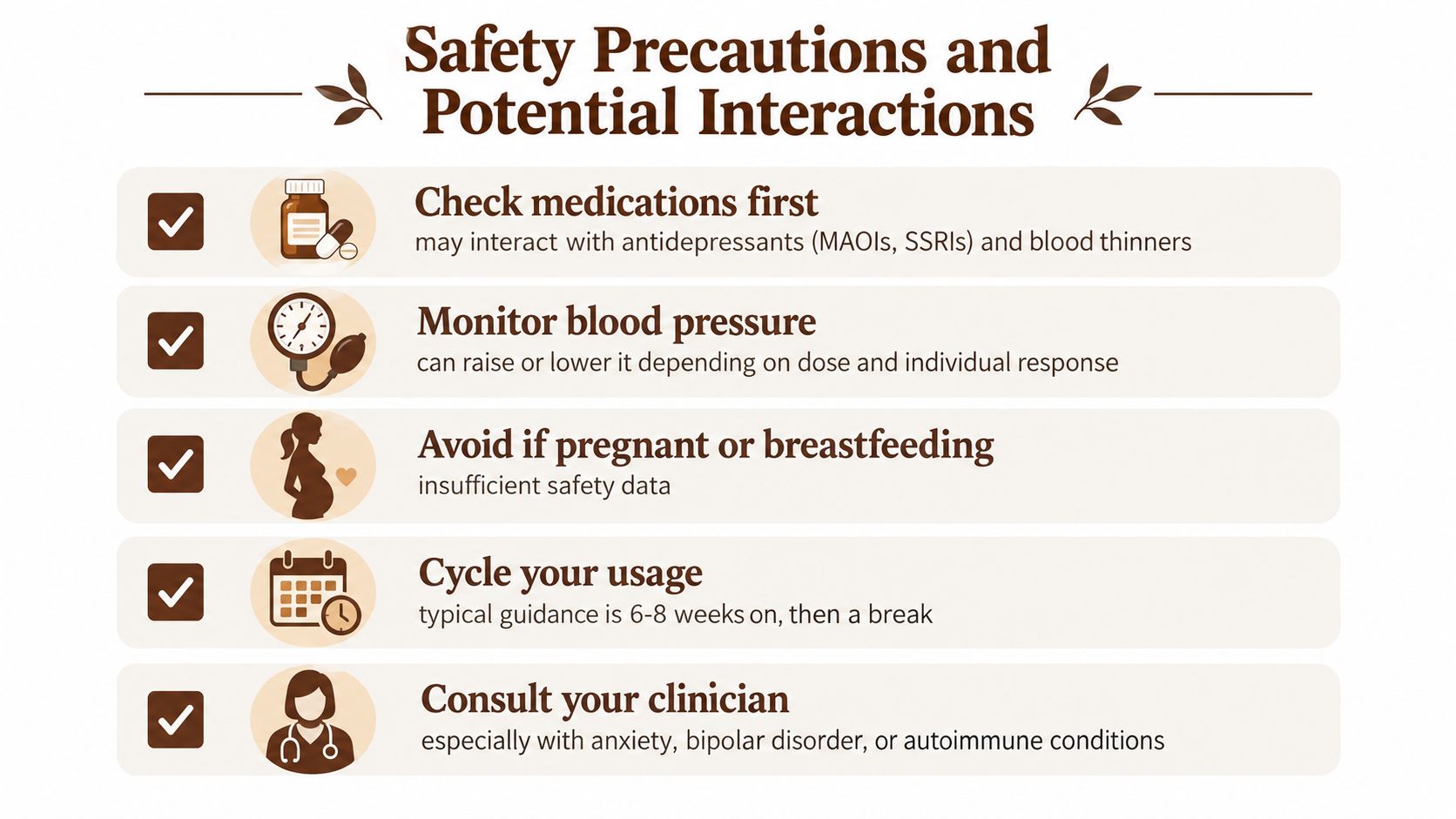
Reduce the dose or stop using rhodiola if you develop new sleep disruption, marked irritability, dizziness, excessive salivation, or an uncomfortable sense of overstimulation. Don't try to counter those symptoms with another supplement. First remove the likely trigger and observe whether the symptoms settle.
The interaction concern deserves more attention than it usually receives:
- Antidepressants: Use caution with SSRIs and SNRIs, and ask your prescriber before combining them with rhodiola.
- Bipolar disorder: Rhodiola may be inappropriate without clinical supervision because psychiatric interactions have been reported.
- Cardiovascular symptoms: A manic episode and tachyarrhythmia have been reported when rhodiola was used with antidepressants, so palpitations, heightened mood, or reduced need for sleep warrant prompt medical advice (Memorial Sloan Kettering safety reference).
- Pregnancy and breastfeeding: Avoid self-directed use when safety data are insufficient.
- Prescription medicines: Ask a pharmacist or clinician to review the full combination, including other stimulating products.
Stop and seek medical guidance: New mania-like symptoms, a racing or irregular heartbeat, severe agitation, or persistent insomnia aren't normal signs that rhodiola is “working.”
If you're comparing rhodiola with other energy-oriented products, remember that a product such as NMN Supplement has its own formulation and medication considerations. Its product snapshot describes morning use and advises consultation before use during pregnancy, nursing, or prescription medication use. That doesn't establish compatibility with rhodiola, so treat the combination as a clinical question rather than an automatic stack.
Building a Sustainable Daily Routine
A workable routine has fewer moving parts than most supplement stacks. Start with one standardized rhodiola product, use it at the same early-day time, and record your dose, meal timing, caffeine, training, sleep, energy, and any adverse effects. This gives you a useful personal comparison instead of relying on memory.
A practical morning sequence
- Review the label. Confirm the botanical identity, extract amount, and stated rosavin and salidroside content.
- Choose one starting dose. Stay within the product directions and avoid jumping to high exercise-oriented protocols for general daytime use.
- Take it early. Use an empty stomach only if you tolerate it. Otherwise, take it with breakfast.
- Keep other variables stable. Don't introduce caffeine changes, another adaptogen, or a new performance product on the same day.
- Record physical feedback. Clear energy is useful. Jitteriness, irritability, dizziness, dry mouth, or poorer sleep are reasons to adjust.
A pre-measured capsule can simplify consistency. REVETIX Rhodiola Rosea is described as a daily capsule using Rhodiola rosea for stress resilience, energy, and focus support. Treat any capsule as a baseline to evaluate, not proof that the labeled dose suits your physiology.
Energy management also includes movement, recovery, and pacing. For a broader non-supplement perspective, review these fatigue strategies from BionicGym, especially if your tiredness persists despite a sensible routine.
Some users also explore cellular-energy products, but combining them makes attribution harder. The REVETIX cell energy supplement guide can provide additional brand context, while a topical item such as PDRN Volufiline NAD+ BALM belongs to a separate skincare category and shouldn't be treated as part of an oral rhodiola protocol.
The right endpoint is not the strongest sensation. It's a repeatable morning routine that supports your day without disturbing sleep, mood, or cardiovascular comfort.
REVETIX offers rhodiola capsules alongside other oral and topical products focused on everyday energy, performance, cellular-energy support, and longevity routines. Visit REVETIX to review the rhodiola formulation and compare it with the wider range, then choose a protocol you can monitor consistently and discuss with a clinician when medications or health conditions are involved.