


You've slept poorly, answered messages before breakfast, and spent the day switching between demanding tasks. By late afternoon, you're exhausted but still too wired to settle. That combination of stress-related fatigue, reduced concentration, and emotional strain is where many people start asking about rhodiola rosea health benefits.
Rhodiola rosea isn't a universal energy cure or a substitute for sleep, medical care, or recovery. Its more credible role is narrower: a standardized botanical that may support people whose main problem is fatigue linked to stress, particularly when mental performance suffers under pressure. The evidence is promising in some settings, but independent reviews also describe it as conflicting or insufficient for firm conclusions.
Table of Contents
- Why Rhodiola Rosea Matters for Modern Stress
- How Rhodiola Rosea Works as an Adaptogen
- The Strongest Evidence for Stress and Fatigue Relief
- Cognitive Performance and Exercise Recovery, What the Research Shows
- Who Benefits Most From Rhodiola Rosea Supplementation
- How to Use Rhodiola Rosea Safely and Effectively
- Making the Decision, Is Rhodiola Rosea Right for You
Why Rhodiola Rosea Matters for Modern Stress
A sleep-deprived professional may start the day mentally slow, tense up during meetings, and remain unable to settle at night. Interrupted sleep, constant notifications, long workdays, financial pressure, and limited recovery can create a persistent pattern rather than one dramatic stress event. For this group, rhodiola rosea is relevant because its proposed use centers on stress-related fatigue and mental performance under pressure.
Rhodiola's history connects traditional practice with modern extract research. Independent reviews describe medicinal use across Europe and Asia, including Russia, Scandinavia, and other European regions, for work performance, endurance, fatigue, depression, and altitude sickness. A historical analysis traces a documented European medicinal reference to Dioscorides in 77 A.D., as summarized by the National Center for Complementary and Integrative Health.

Clinical research later examined standardized extracts in randomized and observational studies. Traditional use explains why the herb became significant, but it does not establish that every current supplement works the same way. Extract identity, standardization, dose, participant profile, and the outcome being measured can all change the result.
A targeted tool, not a miracle
A double-blind, placebo-controlled study of the SHR-5 extract reported better mental performance, especially concentration, and a lower cortisol response to awakening stress among people with burnout-related fatigue, as recorded in its PubMed trial record. This supports interest in rhodiola for a specific stress phenotype, not as a universal treatment for every form of low energy.
The practical fit is clearest for someone experiencing stress-linked mental fatigue, such as a burned-out professional whose concentration declines during demanding work. People who are primarily sleep-deprived may need recovery and sleep assessment first. Anyone seeking guaranteed mood improvement, replacement for medical care, or a stimulant-like surge should set expectations low. Benefits, when present, are likely to be modest and situation-dependent.
A short visual overview can place the herb in context:
How Rhodiola Rosea Works as an Adaptogen
The word adaptogen is used broadly, so it needs a practical definition. In supplement discussions, it generally refers to a botanical intended to help the body respond to physical or psychological stress without acting like a conventional stimulant or sedative. That label doesn't guarantee a clinical effect, and it doesn't tell you which type of stress a person may respond to.
Rhodiola rosea's best-known compounds are rosavins and salidroside. Researchers study them as part of the plant's broader extract, rather than treating one compound as a complete explanation for every reported benefit. The proposed relevance is the stress-response system, including the hypothalamic-pituitary-adrenal axis, which helps coordinate hormonal responses to challenge.
A useful analogy is a thermostat. Caffeine can feel like pressing a boost button, while rhodiola is discussed as supporting regulation of the system that responds to stress. That doesn't mean rhodiola can't feel activating. Some people may experience greater alertness, while others may notice little or no immediate change.
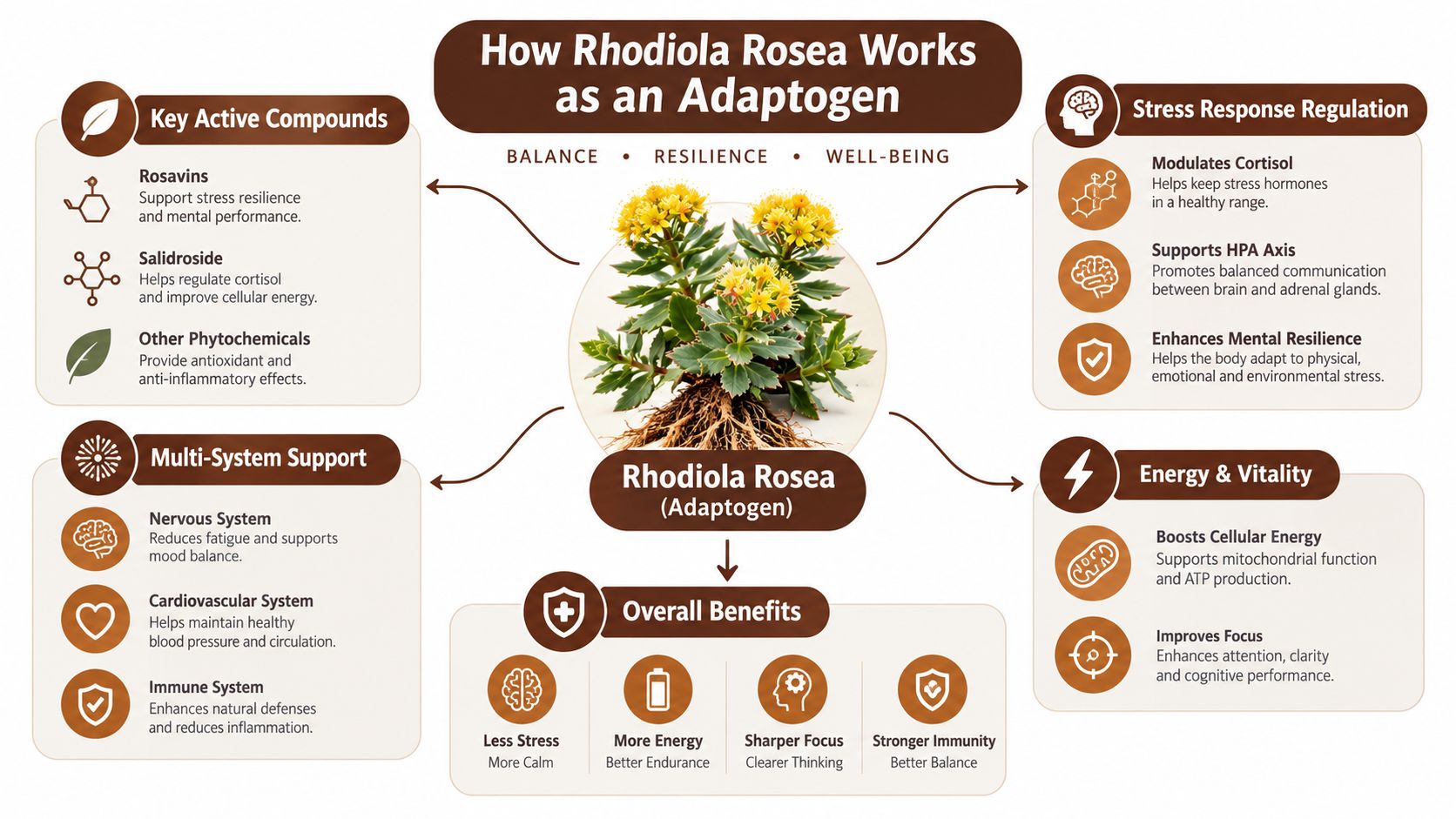
Why extract quality changes the discussion
A label that says “rhodiola” leaves important questions unanswered. The plant species, plant part, extraction method, and standardization influence how closely a product resembles the preparations used in research. Readers can learn more about the plant's traditional background in this guide to the rhodiola rosea plant, but traditional identity still isn't the same as clinical validation.
A product such as Rhodiola Rosea presents the ingredient as a daily supplement containing naturally occurring rosavins and salidroside. That description may be useful for understanding the formulation, but it shouldn't be treated as proof that every user will experience calmer stress, sharper focus, or steadier energy.
Practical rule: Think of rhodiola as a stress-context supplement. The more your complaint resembles stress-related fatigue and concentration difficulty, the more relevant the research becomes.
The Strongest Evidence for Stress and Fatigue Relief
A sleep-deprived professional may reach for rhodiola after several demanding weeks, especially when stress is paired with mental exhaustion and poor concentration. The strongest clinical case is narrower than “more energy for everyone.” Rhodiola may provide noticeable support for stress-related fatigue, with mental performance as a related outcome.
One randomized, double-blind, placebo-controlled trial enrolled 60 patients with fatigue syndrome. Participants received a standardized SHR-5 extract at 144 mg per day for 28 days. The study reported a statistically significant anti-fatigue effect, improved mental performance, and a notable increase in the ability to concentrate. It also found a decreased cortisol response to awakening stress, as reported in the PubMed record for the trial.
The findings are relevant to people who feel mentally depleted under sustained pressure because they connect a common complaint with a measured stress-response outcome. They do not establish rhodiola as a treatment for every form of tiredness. Fatigue linked to anemia, thyroid disease, depression, sleep disorders, medication effects, infection, or insufficient sleep needs a different assessment.
What the wider evidence says
A systematic review of 11 randomized trials found benefit in 2 of 6 studies of physical fatigue and 3 of 5 studies of mental fatigue. The reviewers still judged the overall evidence insufficient for firm conclusions. Results were positive in some trials, but inconsistent across users and preparations. The review is available through the National Library of Medicine.
A separate applied study enrolled 101 adults aged 30 to 60 with life-stress symptoms. Participants used 200 mg of standardized rhodiola extract twice daily for 4 weeks, and the study reported steady improvement in stress symptoms, fatigue, quality of life, mood, concentration, disability, and functional impairment. Its open-label design limits confidence because participants knew what they were taking. The result is useful for generating a practical hypothesis, not for proving that rhodiola works reliably for everyone.
Sleep remains a major confounder in fatigue research. Anyone comparing age-related sleep changes with other causes of tiredness can consult ageing sleep explained by experts. Persistent sleep problems should be assessed directly rather than covered up with a stimulating supplement.
The practical conclusion is modest. Rhodiola is most plausible for stress-linked fatigue and concentration difficulty, particularly in people who remain functional but feel depleted. Expect noticeable support, not a dramatic transformation. A guide on how to read scientific papers can help readers judge trial design and limitations.
For comparison, Himalayan Shilajit Gold Gummies combine shilajit, ashwagandha, and minerals in a gummy format. That formulation is different and should not be assumed to reproduce the rhodiola evidence.
Cognitive Performance and Exercise Recovery, What the Research Shows
Rhodiola's cognitive effects are most plausible when mental work is performed under stress, fatigue, or sustained demand. The SHR-5 trial described earlier reported better mental performance and concentration in people with fatigue syndrome. That supports a narrower conclusion: rhodiola may help mental endurance during strain. It does not establish improved intelligence, lasting cognitive protection, or a general memory benefit.
A sleep-deprived professional or student may therefore notice a difference only when stress and mental fatigue are driving the fog. Rhodiola cannot repay sleep debt, treat an undiagnosed sleep disorder, or correct a medical cause of poor concentration. If confusion, exhaustion, or cognitive changes persist, assessment should come before a supplement trial.
The practical test is whether the problem is reduced capacity under pressure rather than a primary sleep or health disorder.
Exercise claims need more restraint
Exercise research is less convincing than the marketing suggests because physical fatigue has produced less consistent results than mental fatigue. As the review showed earlier, physical-fatigue findings were the weaker half of the evidence base, while mental-fatigue results were more favorable. The pattern supports rhodiola more strongly for stress-related mental fatigue than for universal endurance or recovery enhancement.
That distinction matters for athletes and active professionals. Feeling more capable during a demanding session does not prove faster tissue repair, less soreness, or protection from overtraining. Claims about recovery should be tied to a specific extract and a directly measured outcome rather than to a general feeling of energy.
Evidence boundary: Rhodiola may support concentration when stress and fatigue interfere with performance. That differs from evidence of long-term cognitive protection or dependable athletic enhancement.
Before comparing rhodiola with other focus products, define the problem. Is the aim calmer attention, relief from mental exhaustion, stimulation, or better sleep? This guide to focus and concentration supplements can help distinguish those goals without treating every ingredient as interchangeable.
An NMN Supplement is positioned around NAD+ precursor support and cellular energy, a different rationale from rhodiola's stress-related fatigue research. Combining products makes it important to review total ingredients and potential medication interactions with a qualified professional.
Who Benefits Most From Rhodiola Rosea Supplementation
A sleep-deprived professional facing a deadline, a student with stress-related mental fatigue, and someone with persistent physical exhaustion may all describe low energy. Rhodiola is more relevant to some of these patterns than others. Match the supplement to the stress phenotype, including the trigger, dominant symptom, and any medical warning signs.
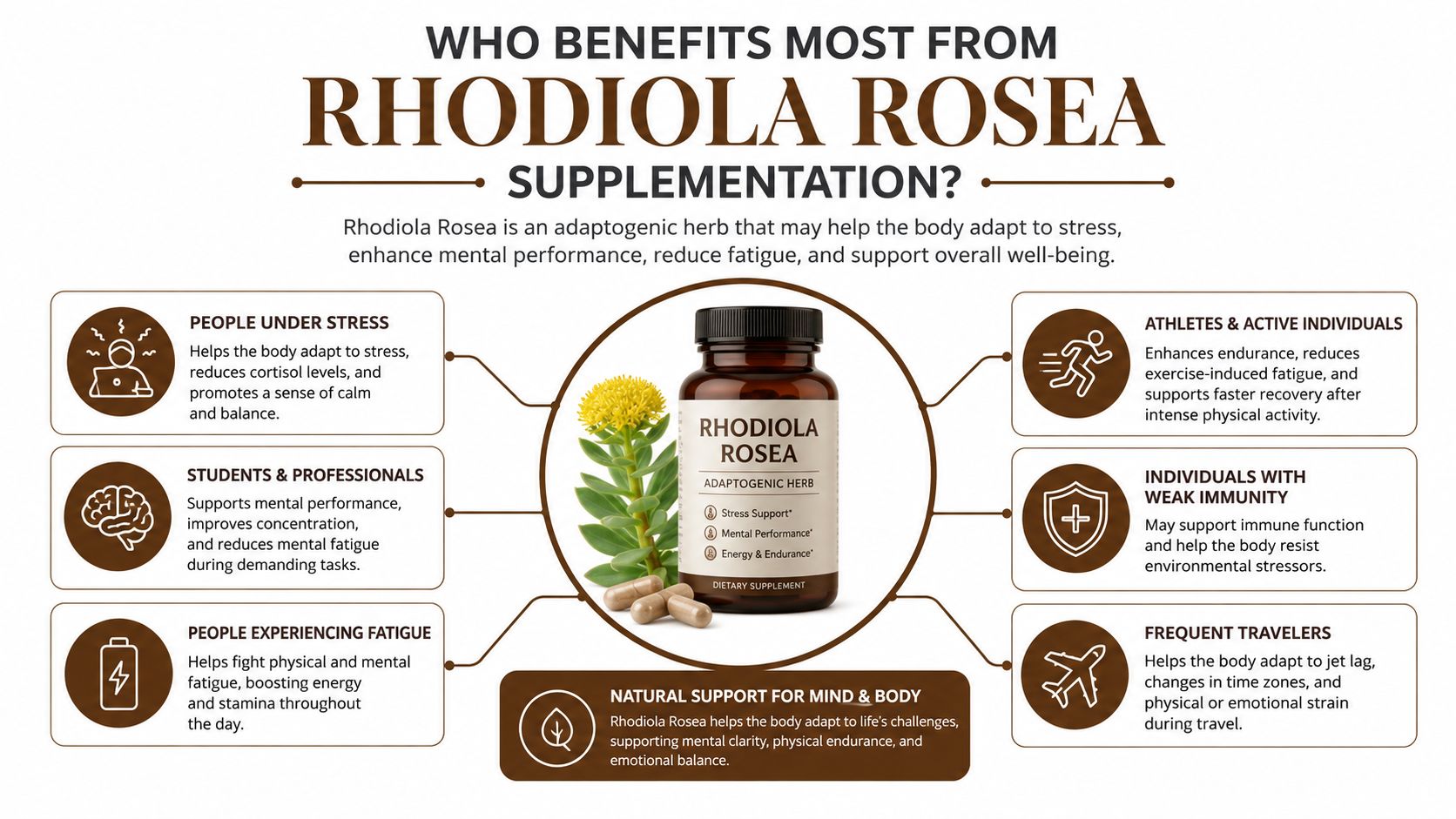
A practical comparison
| Stress pattern | How rhodiola fits | Confidence in the evidence |
|---|---|---|
| Sleep-deprived professional | May help when mental fatigue is stress-linked, but cannot replace sleep or treat a sleep disorder | Limited to moderate |
| Burnout-like fatigue | Closest to the stress and fatigue profile studied with standardized extracts | Promising, still not definitive |
| Mentally fatigued student | May support concentration during demanding work when pressure is a major factor | Limited |
| Depressive symptoms | Research exists, but clinical findings remain conflicting or equivocal | Uncertain |
| Persistent physical exhaustion | Medical, sleep, nutritional, and medication causes need investigation first | Not a self-treatment target |
The burnout-like pattern is the clearest potential match. Someone depleted after prolonged pressure, unable to concentrate, and experiencing stress-related impairment resembles the groups examined in rhodiola research. The likely benefit, if it occurs, is modest support for mental stamina or perceived fatigue, not restoration from severe burnout. Depression, anxiety, or serious functional decline require appropriate clinical care.
Sleep-deprived professionals should set realistic expectations. Rhodiola may reduce the impact of stress-related mental fatigue for some people, yet it cannot correct inadequate sleep, shift-work disruption, or an underlying sleep condition. A person who feels stimulated but sleeps worse has made a poor trade, regardless of any daytime energy benefit.
Students may consider rhodiola as a study aid. Its practical role is narrower: possible concentration support when pressure and mental exhaustion are central. Persistent low mood, hopelessness, panic, or major sleep disruption call for professional assessment rather than self-treatment with an adaptogen.
Who should pause before trying it
Human evidence for fatigue, depression, and adaptogenic effects remains conflicting or equivocal, according to independent sources. Merck Manual states that high-quality human studies proving rhodiola treats a health condition are lacking, as summarized in Drugs.com's rhodiola review.
People taking prescription medication, managing a chronic condition, pregnant or breastfeeding, or experiencing significant mood symptoms should consult a clinician or pharmacist before use. Stop if rhodiola causes unusual activation, restlessness, agitation, emotional instability, or worsening sleep. Those effects indicate a poor fit, even when the product promises greater energy.
How to Use Rhodiola Rosea Safely and Effectively
Use the study protocols described in the evidence section above as reference points, not universal prescriptions. Extract type and standardization affect how a capsule should be interpreted, so the label matters as much as the capsule count.
Start with the product, not the promise
Choose a product that clearly names Rhodiola rosea, identifies the extract, and reports its standardized compounds. Rosavins and salidroside are useful label details. A stated rosavin-to-salidroside ratio can improve consistency, but the ratio alone does not prove that the product matches every SHR-5 study.
Read the supplement facts panel for the amount of extract per serving, the extract ratio, and whether the listed rosavins and salidroside refer to standardized amounts or merely the plant's presence. Avoid products that provide only a proprietary blend or vague “rhodiola complex” without quantities. The protocols described earlier should not be copied automatically when the commercial extract differs.
Timing and monitoring
Morning use is the cautious starting point because rhodiola can feel activating for some people. Avoid late-day dosing if you notice restlessness or poorer sleep. Follow the label, introduce one new supplement at a time, and record concentration, fatigue, sleep, mood, and unwanted effects.
Stop and seek medical advice if symptoms worsen, particularly agitation, significant insomnia, mood elevation, or concerning physical symptoms. Review potential medication interactions with a clinician or pharmacist, especially when treatment affects mood, alertness, blood pressure, or the stress response.
Safety check: A standardized label improves consistency, but it does not make rhodiola risk-free or appropriate for everyone.
Do not expect a verified onset, duration, or long-term benefit. Define a specific goal, observe the response for a limited period, and stop if there is no meaningful improvement or if symptoms worsen. Persistent fatigue requires health assessment rather than indefinite supplement escalation.
Making the Decision, Is Rhodiola Rosea Right for You
Rhodiola makes the most sense when your main complaint is stress-related mental fatigue, particularly if concentration and daily function decline during demanding periods. The evidence is less persuasive for a general energy promise, broad exercise enhancement, or self-treatment of a diagnosed health condition.
Use this decision filter:
- Name the primary problem. If it's burnout-like fatigue and reduced concentration under pressure, rhodiola is more relevant than if the problem is unexplained physical exhaustion.
- Check the foundation. Poor sleep, inadequate food intake, untreated illness, medication effects, and persistent psychological distress need attention first.
- Choose a transparent extract. A label should identify the plant and provide meaningful information about standardization.
- Set a modest goal. Look for improved ability to complete normal tasks, not a stimulant rush or a guaranteed mood change.
- Monitor the response. Worsening sleep, agitation, or mood instability is a reason to stop and seek guidance.
- Escalate appropriately. Depression, severe anxiety, functional decline, or prolonged fatigue belongs in a conversation with a healthcare professional.
The research remains active. A 2025 systematic-review protocol is targeting fatigue, stress, and cognitive performance, while newer reviews continue to discuss possible benefits alongside differences in extracts, outcomes, and study quality, as noted in Drugs.com's evidence overview. That combination of promise and uncertainty is the honest position.
If you decide to explore rhodiola, choose a clearly identified product, take it earlier in the day, record what changes, and avoid stacking several stimulating or adaptogenic products at once. A supplement should earn its place in your routine through a useful, tolerable response, not through a compelling label.
REVETIX offers Rhodiola Rosea capsules positioned for daily stress resilience, energy, and mental focus, alongside products such as Himalayan Shilajit Gold Gummies and NMN Supplement for different wellness goals. Visit REVETIX to review the available formulations and choose an option that fits your needs, while checking with a healthcare professional if you take medication or have an ongoing health condition.