


You've opened a scientific paper because you need an answer, not a literature degree. Perhaps you're checking whether a supplement has credible evidence, trying to understand a health claim, or deciding whether a new finding applies to your work. Instead, you're staring at a dense abstract, unfamiliar statistical terms, and several pages of methods that seem designed to slow you down.
The solution isn't to read faster from the first page to the last. Learning how to read scientific papers well means reading selectively, starting with the decision you need to make, then testing whether the paper can support it. You'll move through the article in a deliberate order, stop when it fails your relevance test, and spend time only where the evidence deserves scrutiny.
Table of Contents
- Why Reading a Paper Cover to Cover Fails You
- Understanding How Scientific Papers Are Structured
- A Practical Workflow for Reading Any Paper Efficiently
- How to Critically Appraise What You Just Read
- Spotting Statistical Pitfalls and Overstated Conclusions
- Turning Papers Into Actionable Insights Without Misreading Them
Why Reading a Paper Cover to Cover Fails You
You open a study to answer a practical question, then begin at the title and move line by line. By the time you reach the results, you may understand the vocabulary but still not know whether the findings apply to your decision.
A paper is not a novel. Its sections help you locate different kinds of evidence, including the research question, study design, findings, and interpretation. Reading in publication order can give background details more attention than the evidence that determines whether the study is useful.
Suppose you are evaluating a study about cognitive performance. The participants may differ from the people you care about, or the researchers may have measured an association rather than a causal effect. Those distinctions can change the meaning of the conclusion, even if the paper's terminology seems clear.
Start with one question:
What decision might this paper influence, and what evidence would I need before trusting it?
Use that answer to choose your reading path. For a relevance check, begin with the title, abstract, figures, and conclusion. If the paper could guide an action, examine the sample, comparison groups, measurements, analysis, uncertainty, and limitations. You are testing the paper's usefulness, not trying to memorize every paragraph.
According to the University of Southern California's scholarly article guide, readers can begin with the abstract or conclusion, then inspect the introduction, figures, methods, and discussion instead of proceeding straight through. Check whether the conclusions match the data, including the sample size and confidence intervals.
A paper can be interesting yet irrelevant, relevant yet too weak for action, or useful while leaving uncertainty unresolved. Your job isn't to finish every paper. It's to determine what the paper can responsibly tell you.
Understanding How Scientific Papers Are Structured
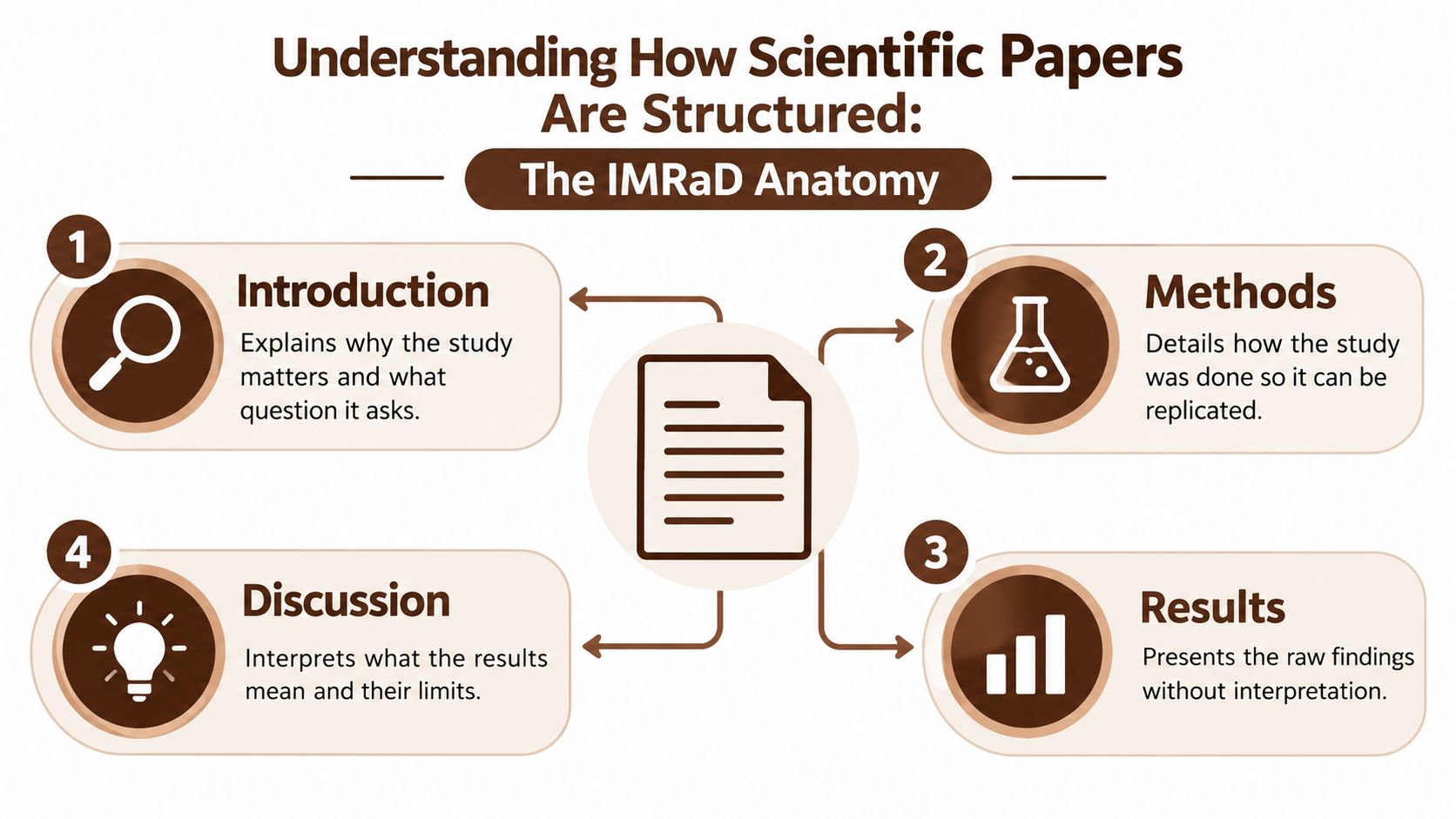
A paper can feel dense until you know where each kind of answer usually appears. Most primary research papers use the IMRaD structure, meaning Introduction, Methods, Results, and Discussion. It works like a map, helping you choose the section that can resolve your immediate question instead of reading every paragraph in order.
Introduction
The Introduction explains why the study was done. Find the problem, the gap in existing research, and the question or hypothesis under examination. Background can provide context without affecting your decision, so give special attention to the final paragraphs, where the broad topic usually becomes a specific, testable aim.
Methods
The Methods show how the study was conducted. They may describe participants, interventions, comparison groups, measurements, laboratory procedures, and statistical plans. On a first pass, identify the study design and its fit with the question. A technically detailed method cannot answer a causal question if the design only observes an association.
Results
The Results report what researchers observed. Look here for measured outcomes, tables, figures, and statistical analyses. Check the result behind any strong statement in the abstract, including the size of the difference and the uncertainty around it. The Results section supplies the evidence, while later interpretation belongs elsewhere.
Discussion
The Discussion explains what the authors believe the findings mean. It connects results with earlier work, addresses limitations, and suggests implications. Read it as an interpretation layer. Keep what the data show separate from what the authors infer, especially when the wording sounds broader than the measurements support.
The IMRaD pattern is a reading aid, not a fixed rule. Reviews, letters, conference abstracts, and other formats may combine sections, rename them, or omit details. Confirm the paper's layout before jumping to Results, then use a practical guide to research papers if an unfamiliar format makes the reading path unclear.
The same checks apply to supporting research for a product description such as PDRN Volufiline NAD+ BALM. Identify the claim, find the relevant measurement, inspect how it was tested, and separate observed evidence from marketing interpretation.
A Practical Workflow for Reading Any Paper Efficiently
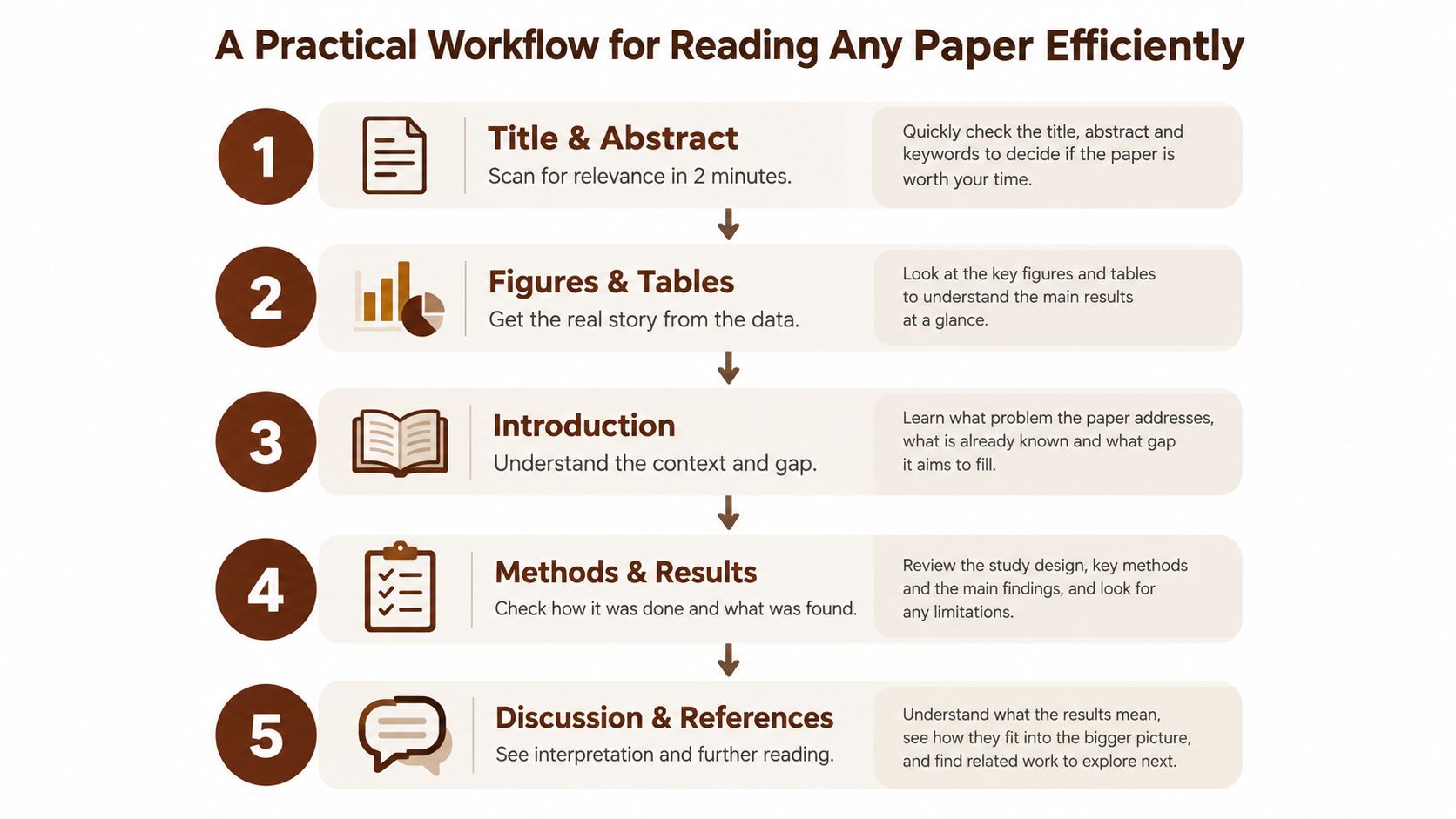
Use this sequence when you need a dependable first reading. It's deliberately non-linear. Each step gives you a reason to continue or stop.
Start with the title and abstract
Read the title, abstract, keywords, and author information. Write down the paper's apparent question in your own words. Then ask whether the population, intervention or exposure, comparison, and outcome match your decision.
The abstract is a map, not a verdict. Note the design, main result, and stated conclusion, but mark strong language for later checking. If the subject doesn't match your question, stop. If it does, continue to the visual evidence.
Read the figures and tables before the full text
Figures often reveal the paper's real story faster than prose. Identify the axes, groups, sample labels, outcome definition, and uncertainty markers. Ask what changed, between whom, and whether the apparent difference is large enough or precise enough to matter.
Tables can expose details the abstract compresses, including participant characteristics, missing data, and subgroup results. Don't read a graph as decoration. Treat it as a compact argument that you need to reconstruct.
Return to the Introduction for context
Now read the introduction with a specific purpose. Find the research gap and determine whether the study addresses a narrow question or makes a broader claim. Look for terms that define the outcome, population, and mechanism.
A paper can be relevant without filling the gap it identifies. Keep the authors' stated question separate from the larger topic you care about.
Inspect Methods and Results together
Read the methods beside the results. Check how participants were selected, what served as the comparison, how outcomes were measured, and which analyses produced the reported findings. Then compare those details with the figures and tables.
PLOS guidance offers a useful set of reading questions covering motivation, methods, context, results, interpretation, and next steps in its paper-reading framework. For broader literature work, a systematic review methodology for creators can help you organize searches and compare studies instead of relying on one memorable paper.
This workflow also applies when you're exploring adjacent health topics. For example, an article about Rhodiola rosea and its traditional uses still needs to be read according to its actual design, measured outcomes, and limitations.
Finish with Discussion and References
Read the discussion after you understand the data. Mark claims that are directly supported, plausible but uncertain, or broader than the study can establish. Then scan the limitations and references. The references may lead you to foundational studies, conflicting findings, or more suitable evidence.
You don't need to finish every citation. Follow the ones that clarify the question you're trying to answer.
How to Critically Appraise What You Just Read
Understanding a paper and trusting it are different tasks. Critical appraisal asks whether the design, analysis, and evidence justify the conclusion, then asks whether the finding applies to your situation.
Evidence-based medicine formalized this decision process by turning an information need into an answerable question, locating suitable evidence, appraising its validity, and applying the result in practice. The framework also emphasizes mathematical estimates of benefit and harm from high-quality research involving population samples as described in this evidence-based medicine reference.
Check the design before the result
A randomized comparison, observational study, laboratory experiment, and review answer different questions. A design that detects an association may not establish that one factor caused another. Ask what alternative explanations remain.
Then examine the sample. Who participated, who was excluded, and how closely do they resemble the people you're thinking about? A result can be internally convincing while having limited applicability outside the study population.
Test precision and comparison
Look for the control or comparison group and confirm that it was appropriate. Check how outcomes were defined and whether the researchers measured the outcome directly or relied on a proxy. Examine confidence intervals when they're reported, because a single estimate can conceal substantial uncertainty.
Relative claims can sound impressive without showing the underlying absolute difference. Translate the result into plain language: how many people were compared, what happened in each group, and how certain is that contrast?
Look for limits and evidence level
A paper's limitations aren't a formality. They tell you where the result may fail. Pay attention to missing data, short follow-up, measurement problems, conflicts of interest, and analyses that weren't clearly planned.
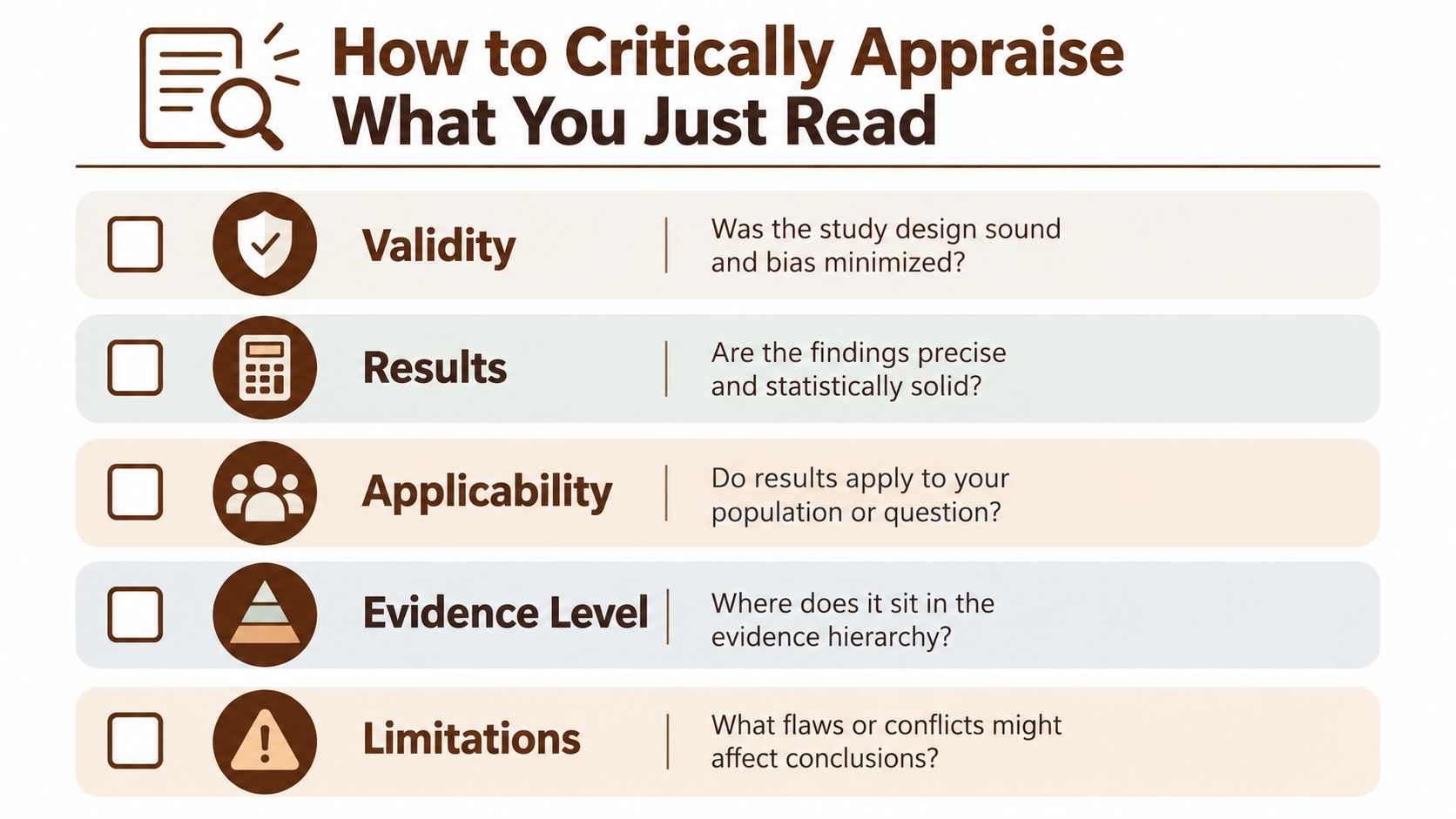
You can use a practical checklist:
- Validity: Could bias or confounding explain the finding?
- Results: Are the analysis and uncertainty presented clearly?
- Applicability: Does the study population resemble your situation?
- Evidence level: Is this one study, a synthesis, or part of a wider body of evidence?
- Limitations: What did the authors acknowledge, and what did they leave out?
For readers building this habit, strategies to improve analytical reading skills can complement paper-specific appraisal. The same questions matter when evaluating research connected to a product category, such as cell energy supplements, because an ingredient claim still needs to be matched to the study population, dose, outcome, and design.
If you're considering a routine involving Rhodiola Rosea, don't let a familiar ingredient name replace appraisal. Identify exactly what the cited evidence examined and whether it supports the particular use being discussed.
Spotting Statistical Pitfalls and Overstated Conclusions
You don't need advanced statistical training to detect many warning signs. You do need to compare the paper's claims with the way the researchers collected and analyzed the data.
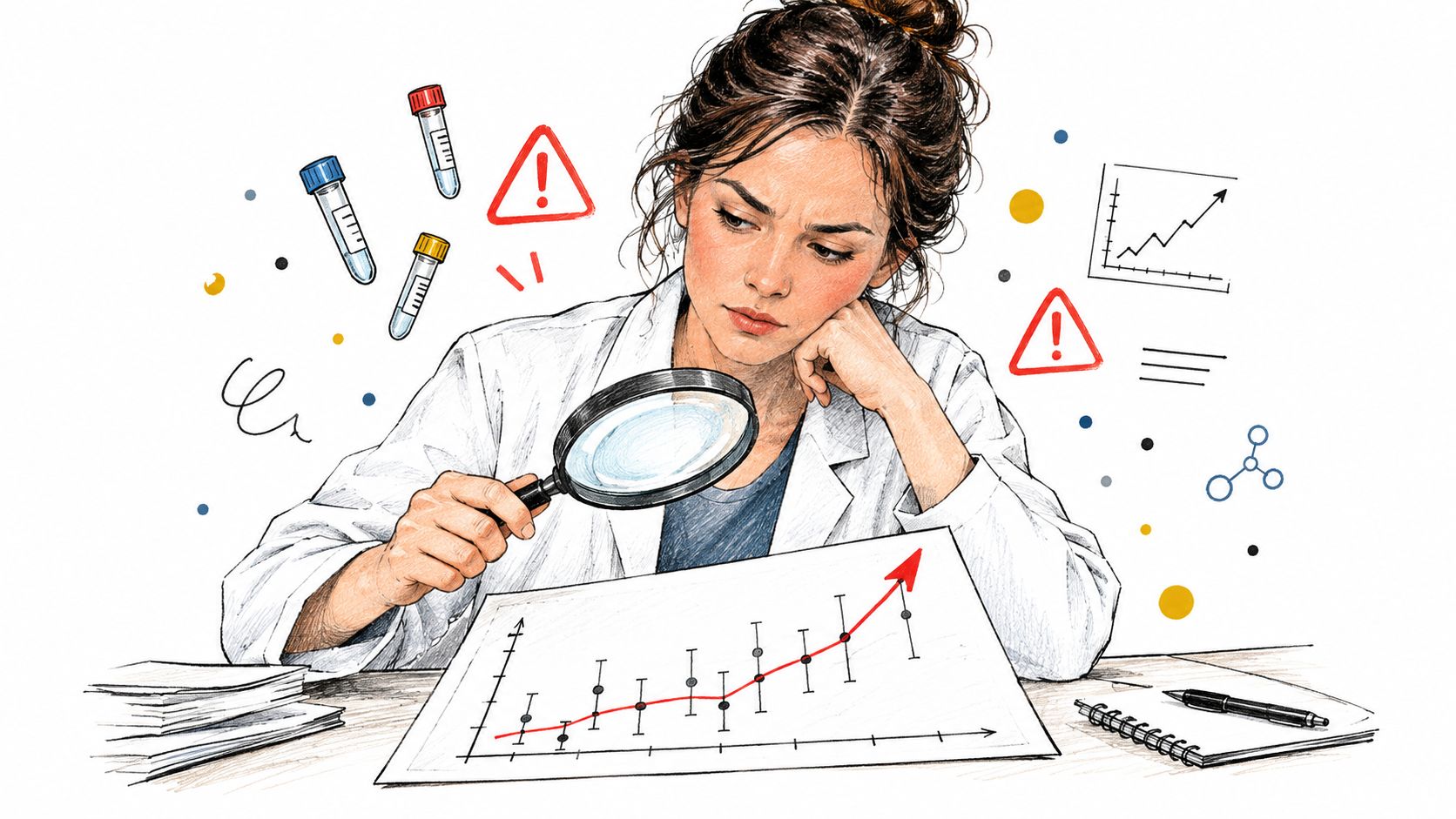
Start with the controls and units of analysis. Inadequate controls can make a comparison uninterpretable. Small samples can produce unstable findings. Inflated units of analysis occur when researchers treat repeated measurements or parts of a sample as though they were independent participants, which can make confidence look stronger than it is.
Other problems require a closer match between methods, figures, and claims. Watch for circular analysis, sometimes called double-dipping, where the same data help select and test the finding. Look for multiple comparisons that weren't adjusted, because testing many possibilities can produce apparently interesting results by chance. Also check whether the authors use standard error when they need standard deviation to describe dispersion. These issues are among the statistical mistakes highlighted in expert guidance on reading research findings from Trisha Greenhalgh's statistics discussion.
Run a consistency check
Compare four locations:
- Abstract: Does it describe the result more strongly than the paper does?
- Methods: Was the analysis appropriate for the question and data?
- Figures and tables: Do they show the pattern claimed in the text?
- Discussion: Does the interpretation stay within the study's limits?
Be especially cautious when authors change “associated with” into “caused.” A causal verb requires a design and analysis that can support causation. If the data only show that two variables appeared together, preserve that distinction in your notes.
Practical rule: When the abstract sounds more certain than the figures, methods, and limitations, trust the detailed evidence first and investigate the mismatch.
Turning Papers Into Actionable Insights Without Misreading Them
A good paper doesn't automatically produce a good decision. Before acting, place its finding in the broader research context and define what would change your mind.
Start by writing a short evidence statement with four parts: the population studied, the exposure or intervention, the measured outcome, and the strength of the conclusion. This prevents you from carrying a narrow result into a broader claim. “This study found an association in this population” is often more accurate than “this works.”
Then compare papers rather than collecting isolated conclusions. Look for differences in methods, participants, outcome definitions, follow-up, and limitations. Citation tracking can reveal which earlier work the authors relied on and which later papers challenge or extend the finding. Guidance on evaluating research gaps recommends mapping the gap, comparing methods and limitations, and checking whether the evidence base supports the stated claim in this independent review.
Use a decision threshold
Your response should match the evidence and the stakes.
- Act cautiously when the finding is relevant, the design is appropriate, the result is reasonably precise, and the potential downside is limited.
- Wait and investigate when the study is interesting but isolated, the population differs from yours, or important uncertainty remains.
- Seek professional advice when the decision involves treatment, interactions, significant risk, or a condition that requires individualized care.
This rule is useful for research about supplements, recovery practices, longevity routines, and ingredients such as NAD+ precursors. A paper may explain a biological pathway without demonstrating a meaningful outcome in people. Product descriptions and scientific studies also serve different purposes, so read each for what it establishes. A broader science-based guide to healthy aging supplements can help you organize ingredient questions, but it shouldn't replace examination of the underlying evidence.
Keep a compact reading record: the paper's question, design, population, main result, key limitation, and your confidence in applying it. That record lets you revisit the evidence without relying on memory or the author's most memorable phrase. The fastest reliable reader isn't the person who skips scrutiny. It's the person who directs scrutiny to the parts that determine whether a finding deserves action.
REVETIX offers dietary supplements and topical products focused on longevity, cellular energy, performance, and healthy aging, including oral and topical formats. Visit REVETIX to review the product range alongside the evidence questions outlined above, then make decisions based on the research, your circumstances, and appropriate professional guidance.