


NMN supplements are usually sold by one number: the milligrams printed on the front of the bottle. That number is easy to compare, easy to advertise, and often too incomplete to guide a good buying decision. A capsule with a larger NMN quantity isn't automatically a better formulation if the label doesn't tell you the chemical form, testing standard, delivery system, or purpose of the additional ingredients.
The more useful question is not, “How much NMN is in this product?” It is, “What happens to the entire formula after I swallow it?” NMN has produced measurable changes in blood NAD-related measures in controlled human research, but that doesn't prove every product delivers the same result, and it doesn't establish that more NMN means greater long-term benefit. The ingredient deck deserves the same scrutiny as the headline dose.
Table of Contents
- The Problem with Chasing High NMN Dosages
- Active Compounds and the Beta-NMN Standard
- Methyl Donors and the Methylation Bottleneck
- Synergistic Additions in Longevity Complexes
- Excipients and Bioavailability Enhancers
- Delivery Formats and Absorption Pathways
- Safety Profiles and Regulatory Realities
- A Practical Framework for Label Auditing
The Problem with Chasing High NMN Dosages
A high NMN number creates a false sense of precision. It tells you the declared quantity of one ingredient, but not whether the material is correctly identified, stable through shelf life, accurately measured, or supported by a delivery system suited to the product's intended use.
Human research gives consumers a useful boundary, not a reason to chase the largest serving. A 2016 study tested 100, 250, and 500 mg of oral NMN in men and reported no harmful effects during the observation period. A later multicenter trial used 300, 600, or 900 mg per day for 60 days in 80 healthy middle-aged adults, with no clinically relevant differences from placebo across a broad set of physiological and laboratory measures. These findings support short-term tolerability within the tested conditions, not a conclusion that the highest dose is the most effective choice. The published overview of these human trials provides the relevant study context.
Dose is only one part of exposure
The amount printed on a label is not the same as the amount that reaches a biological target. Absorption can be influenced by the chemical form, particle characteristics, capsule materials, food intake, manufacturing quality, and the way the product releases its contents. Those factors don't prove that a particular delivery system is superior, but they do explain why milligrams alone are an incomplete comparison.
A cautious buyer should also distinguish between pure NMN per serving and the total weight of a complex. A label may display the combined weight of NMN and several co-ingredients, while the actual NMN quantity appears elsewhere in the Supplement Facts panel. Treating the total complex as the NMN dose can lead to a materially wrong comparison.
Practical rule: Compare the declared NMN amount, chemical designation, testing documentation, and serving instructions before comparing the front-label number.
For a straightforward explanation of how serving size and dose claims can differ, see this guide to NMN supplement dosage. The useful conclusion is not that every low-dose product works or that every high-dose product fails. It is that a credible formula should make its active amount and rationale easy to verify.
Active Compounds and the Beta-NMN Standard
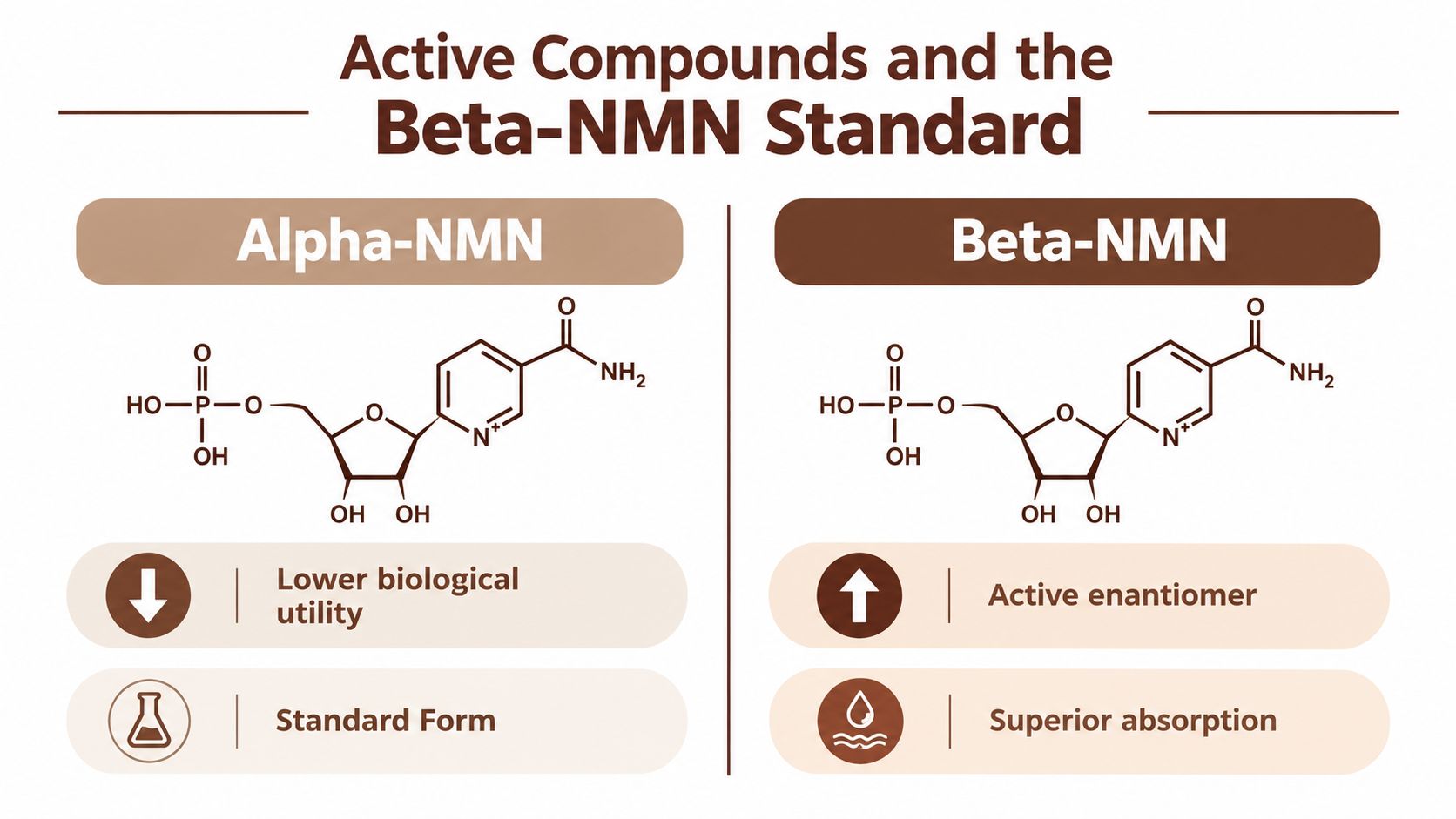
The first serious label question is identity. Nicotinamide mononucleotide isn't a single marketing concept. A specification should identify the material clearly enough for a laboratory to distinguish the intended compound from related substances, degradation products, or an inaccurately labeled substitute.
The product information supplied for this topic identifies β-NMN as the form used in the REVETIX formula and describes the material as third-party tested for purity and potency. That is a useful label signal, but a consumer shouldn't stop at a front-panel statement. A certificate of analysis should connect the batch number to an identity method, an assay result, and contaminant testing.
What the evidence actually establishes
The verified human evidence establishes that oral NMN has been studied in people and that several short-term trials reported increased blood NAD concentrations with acceptable tolerability. It doesn't establish, from the information available here, a head-to-head clinical outcome comparison between alpha-NMN and beta-NMN. That distinction matters. A formulation page may describe β-NMN as the research-validated form, but the consumer still needs batch-level documentation rather than relying on a chemical name alone.
A useful certificate of analysis should answer practical questions:
- Identity: Does the test confirm NMN rather than merely reporting a generic powder identity?
- Assay: Does the measured amount correspond to the declared active quantity?
- Purity: Are related substances and degradation products controlled within a stated specification?
- Contaminants: Has the batch been screened for relevant microbial, heavy metal, solvent, or other contamination risks?
- Traceability: Does the document identify the tested lot and the laboratory responsible for the result?
These checks are more informative than phrases such as “pharmaceutical grade” when those phrases aren't supported by a defined specification. They also help separate a formula designed around ingredient control from one that treats NMN as a commodity powder.
The NMN Supplement product snapshot describes a β-NMN capsule formula, third-party purity and potency testing, and manufacture in a GMP-certified facility. Those are formulation and quality claims, not proof of a guaranteed clinical outcome. A scientifically literate buyer should still ask whether the available documentation is batch-specific and whether the label clearly separates NMN from every other active.
Methyl Donors and the Methylation Bottleneck
The methylation discussion is often presented with more certainty than the available consumer evidence supports. NMN participates in NAD-related metabolism, and the body must process the resulting metabolites through several pathways. That biochemical fact alone doesn't prove that every NMN user develops a methyl-donor deficiency, experiences fatigue, or needs a methylation supplement.
The responsible formulation question is narrower: does the product contain a defensible reason for adding TMG or methylated B vitamins, and can the label show enough detail to evaluate that choice? Trimethylglycine, often called TMG or betaine, is commonly included in multi-ingredient longevity formulas. Its presence may reflect an attempt to support methyl-group availability, but its inclusion doesn't demonstrate that a specific user has a bottleneck or that the combination improves an outcome.
Separate pathway logic from outcome evidence
A formulation scientist should distinguish three levels of reasoning:
- Biochemical plausibility: An ingredient participates in a pathway that could be relevant to NMN metabolism.
- Formulation rationale: The manufacturer combines the ingredients to address a possible metabolic constraint.
- Clinical validation: A controlled human study shows that the combination improves a defined outcome.
The first level can justify investigation. It cannot substitute for the third. If a label includes TMG, the quantity should be disclosed rather than hidden inside an indistinct proprietary blend. The same applies to folate, vitamin B12, or other methylated nutrients. More ingredients don't automatically create a more complete formula.
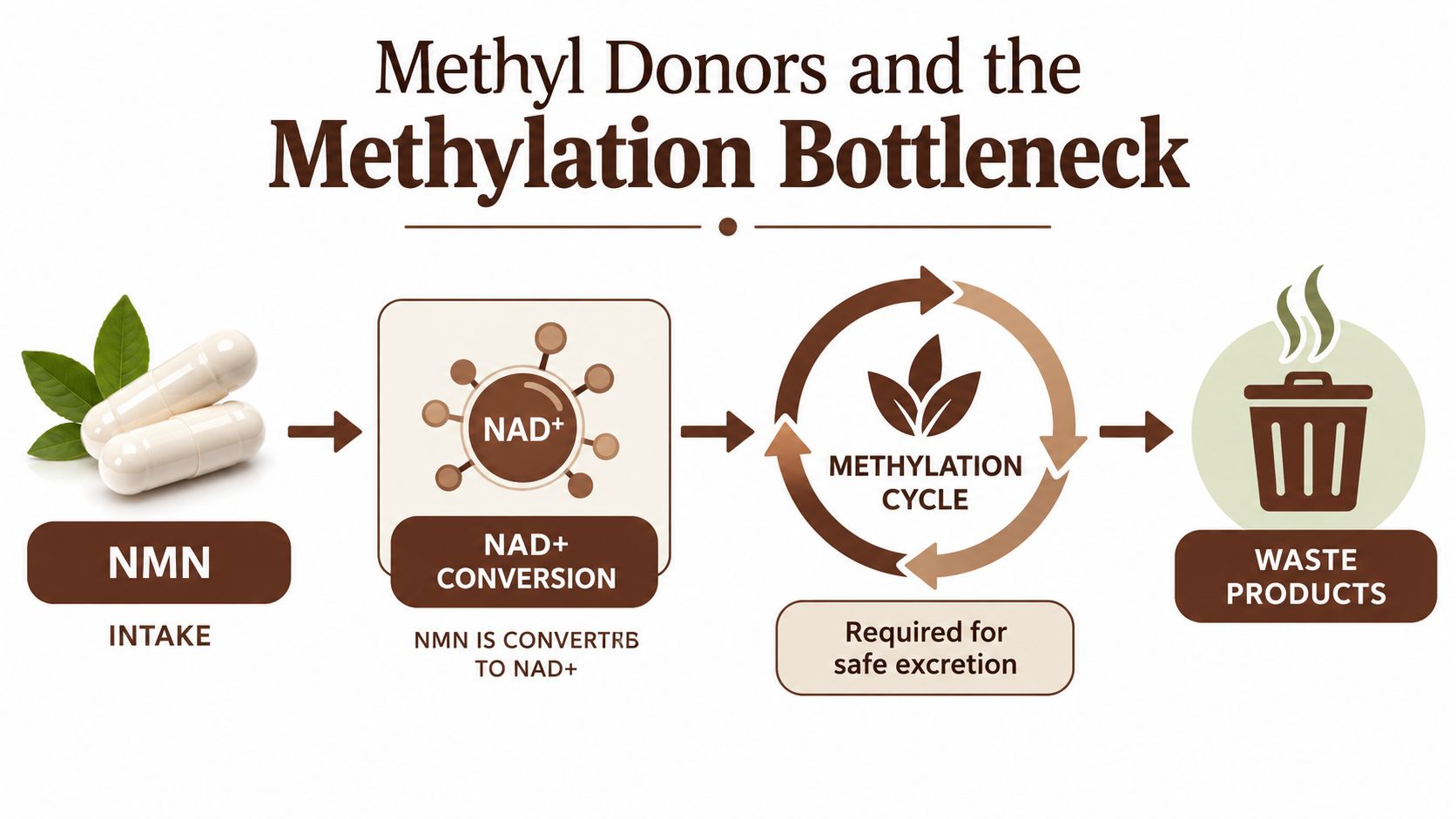
A complex formula can also make troubleshooting harder. If a user changes NMN, TMG, B vitamins, caffeine, and an adaptogen at the same time, a later symptom or perceived benefit can't be assigned confidently to one ingredient. A simpler formula may be more useful for a person who wants to test NMN itself, while a combined formula may appeal to someone who values convenience and accepts less precise attribution.
The REVETIX Astaxanthin – Ultra Antioxidant & Longevity Support product listing is a separate catalog item and doesn't, by the supplied information, establish a role for astaxanthin in correcting an NMN-related methylation issue. That is the kind of distinction a label audit should preserve. An antioxidant, a methyl donor, and an NAD precursor aren't interchangeable just because they appear in the same longevity category.
Synergistic Additions in Longevity Complexes
A multi-ingredient formula can be rational, redundant, or merely crowded. The difference depends on whether each addition has a defined role, a disclosed amount, and a benefit that matters to the intended user.
Recent product coverage shows NMN paired with resveratrol, hydroxytyrosol, ergothioneine, vitamin D3, spermidine, TMG, creatine, and Rhodiola or ginseng. This roundup of NMN products illustrates the breadth of current formula design, but a list of ingredients doesn't prove synergy. It only shows that manufacturers are combining compounds associated with longevity, antioxidant defense, energy, or stress-related positioning.
Three ways to judge a blend
Complementarity asks whether the ingredients address different biological or practical goals. NMN is positioned as a precursor in NAD-related metabolism. Creatine has a different role in energy buffering, while an adaptogen is marketed around stress resilience. Different roles can make a blend conceptually coherent, but they don't establish that the combination performs better than the ingredients separately.
Redundancy asks whether several ingredients make the same broad claim without adding a measurable benefit. A formula may contain multiple antioxidants, yet the label may provide no way to determine why each one is present or which outcome it is expected to influence. More antioxidant names can increase perceived sophistication without improving decision quality.
Dose adequacy asks whether the formula provides meaningful quantities of each active. A long ingredient list may distribute the serving across so many compounds that the label becomes a catalog rather than a properly designed intervention. Without disclosed quantities, consumers can't distinguish a deliberate combination from a token inclusion.
A “longevity complex” is a category description, not evidence of synergy.
The most useful label includes a short rationale for every active and makes it possible to track total exposure across products. Vitamin D3, TMG, creatine, and botanical ingredients can also appear in other supplements, so duplicate intake is a practical concern. A consumer who already uses separate products may unknowingly turn a convenient blend into an unnecessarily complicated stack.
For readers comparing formulas by their intended role rather than by ingredient count, this overview of a cell energy supplement provides a useful category reference. The analytical principle remains the same: a co-ingredient earns its place through a clear purpose, transparent dosing, and evidence appropriate to the claim being made.
Excipients and Bioavailability Enhancers
The “Other Ingredients” panel tells you how the product is built, but it doesn't automatically tell you how well it works. Excipients can help a powder flow through manufacturing equipment, hold a capsule together, protect it from moisture, or control its physical behavior. Calling every excipient a harmful filler is as inaccurate as assuming every named delivery technology improves absorption.
Read the panel in four passes
First, identify the capsule or dosage form. A hard capsule, powder, tablet, liquid, and lozenge impose different manufacturing and release constraints. The label should make the format clear, and the serving instructions should match that format.
Second, separate functional excipients from marketing language. A phospholipid, lipid carrier, or other delivery component may have a formulation purpose, but the name alone doesn't prove improved NMN exposure. The manufacturer should ideally provide stability, dissolution, or bioavailability data relevant to the finished product.
Third, look for unnecessary complexity. Artificial colors, flavor systems, and multiple flow agents may not be unsafe, but they can make the formulation harder to interpret. A short, transparent excipient list is easier to audit than a proprietary mixture.
Finally, ask whether the claim matches the evidence. Terms such as “liposomal,” “enhanced absorption,” and “maximum uptake” are not substitutes for human pharmacokinetic data. A delivery claim should specify what was tested, in which product, and against what comparator.
What “clean label” can and can't tell you
A formula described as free from artificial fillers or unnecessary additives may appeal to consumers who want a minimal ingredient deck. It doesn't, by itself, demonstrate superior absorption or a better clinical outcome. Conversely, the presence of an excipient such as magnesium stearate doesn't prove that the product inhibits dissolution or creates an inflammatory burden. Those claims require product-specific testing.
The more defensible standard is function plus documentation. Ask what each non-active ingredient does, whether its amount is appropriate for that function, and whether the finished product remains stable through its stated shelf life. A clean label is helpful, but a transparent specification is more meaningful.
Delivery Formats and Absorption Pathways
A capsule, a sublingual product, and a patch aren't merely different containers for the same idea. They create different exposure questions, and consumers often confuse a theoretical pathway advantage with demonstrated delivery performance.
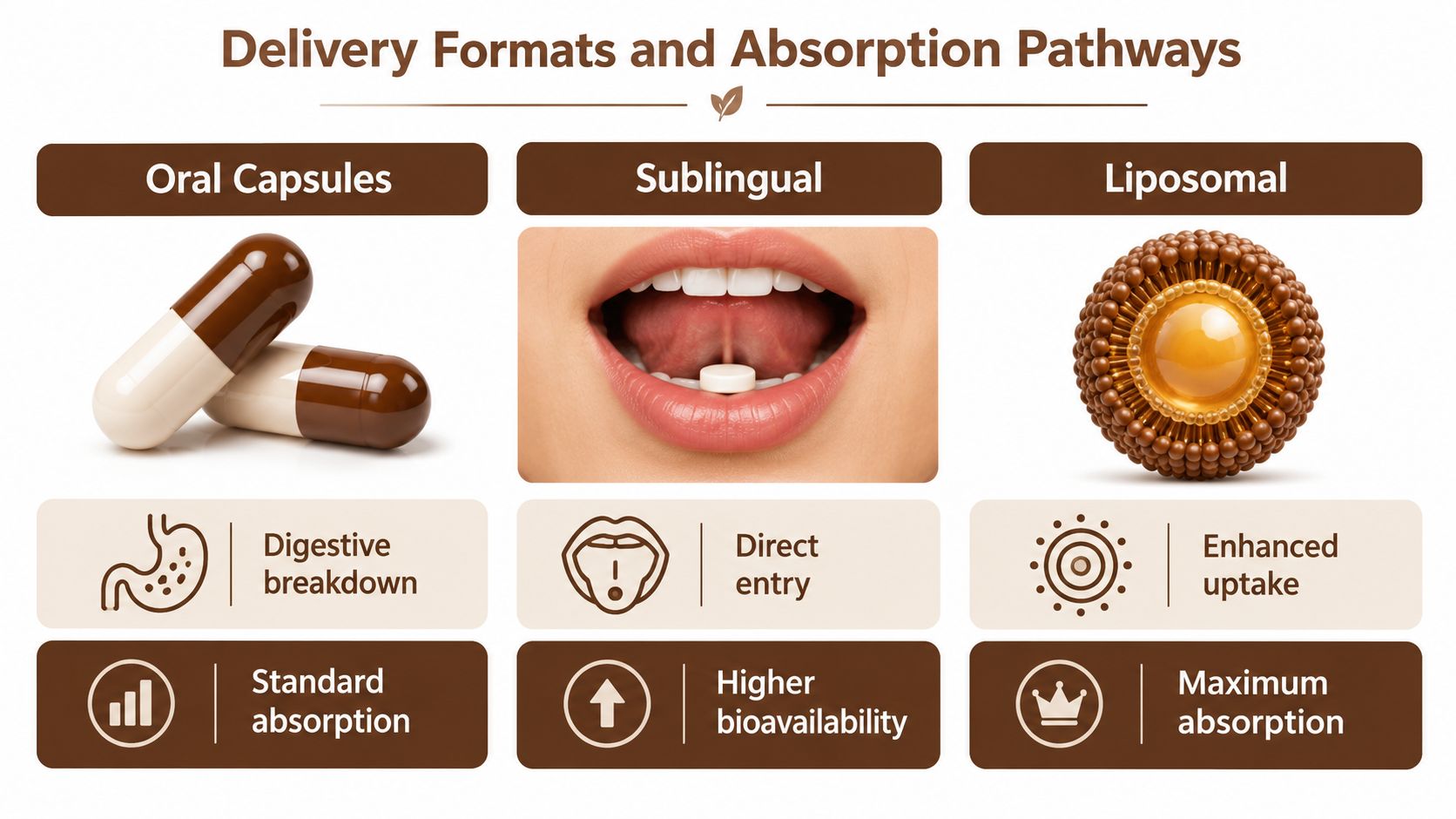
An oral capsule is the most familiar format. Its contents encounter the gastrointestinal environment before absorbed material reaches systemic circulation. That makes dissolution, stability, intestinal transport, and downstream metabolism relevant. It also makes the finished product, rather than the raw powder alone, the correct object of evaluation.
Compare the format, not the slogan
Oral capsules are convenient, familiar, and easy to dose consistently. Human NMN research has used oral supplementation, including the 60-day randomized trial described in the clinical literature. The existence of oral human data supports the relevance of the format, but it doesn't mean every capsule has identical exposure.
Sublingual powders or lozenges are designed to contact oral mucosal tissue. That creates a plausible rationale for reducing reliance on gastrointestinal processing, but a plausible route isn't proof of higher NMN bioavailability. A credible comparison would need to measure exposure from the finished sublingual product against an appropriate oral comparator.
Transdermal patches seek delivery through the skin, often with a controlled-release positioning. Skin permeability, adhesive design, active stability, loading, and patch contact all affect performance. A patch claim should therefore be supported by finished-product data rather than by the general idea of time release.
Evidence filter: “Bypasses the gut” describes a route. It doesn't establish how much active reaches circulation or whether the exposure improves a meaningful outcome.
Food instructions also deserve attention. “With or without food” is a practical direction, not proof that food has no effect on exposure. Morning use may suit a person's routine, but claims about an ideal circadian dosing window should be treated cautiously unless the product and timing have been studied directly.
For a format-focused comparison of NAD patches and capsules, look for distinctions between route, release behavior, convenience, and evidence. The best format is the one whose manufacturing quality and supporting data match the user's actual need, not the one with the most advanced-sounding delivery language.
Safety Profiles and Regulatory Realities
NMN has moved beyond a niche longevity ingredient into a clinically studied supplement component, but the human evidence remains bounded. A 60-day randomized trial using 300, 600, and 900 mg per day reported increased blood NAD concentrations and no serious safety signal across the tested range. Additional studies reported no abnormalities in physiological or laboratory tests after 12 weeks of oral use, while a separate four-week study using 1,250 mg per day reported no severe adverse events. These findings describe short-term study conditions, not a guarantee of safety for chronic high-dose use. The human evidence review explains the limits and scope of those observations.
The practical evidence base clusters around 100 to 1,250 mg per day, with repeated-dose studies generally lasting three to 12 weeks. That range should be treated as a description of published research, not a dosing recommendation. Long-term safety, pregnancy and lactation, medication interactions, and complex combinations remain areas where consumers should avoid confident assumptions.
Regulation can change the buying question
U.S. policy has also shifted. In 2025, the FDA concluded that NMN isn't excluded from the definition of a dietary supplement, reversing earlier uncertainty about its lawful use in the U.S. market. FDA-related filings have separately described intended use up to 500 mg daily, divided into one or two servings, as safe as a dietary ingredient. That makes 500 mg per day a risk-managed reference point for product positioning, not a universal prescription. The regulatory summary sets out that change.
Regulatory status doesn't certify every product's purity, potency, or clinical value. Manufacturers still need disciplined identity testing, assay verification, and batch-level contaminant screening. General guidance on quality control for sterile supplies can help readers understand the broader principle of controlled materials, documented processes, and release testing, even though supplement capsules and sterile supplies aren't interchangeable categories.
People who are pregnant, nursing, taking prescription medication, managing a chronic illness, or combining several NAD-related products should seek individual medical advice before use. Stop treating a short tolerability study as permission for indefinite self-experimentation.
A Practical Framework for Label Auditing
A good NMN label can be screened quickly if you read it in the right order. Start with the active, then assess the evidence trail, then inspect the supporting ingredients and delivery system. Don't begin with the front-label dose.
The two-minute label sequence
1. Find the actual NMN amount. Confirm whether the declared figure is pure NMN or the total weight of a complex. If a proprietary blend conceals the amounts, you can't compare the formula properly or track duplicate ingredients.
2. Confirm the chemical designation. Look for a clear β-NMN or equivalent specification, then check whether the manufacturer can provide a batch-linked certificate of analysis. A marketing phrase such as “premium grade” isn't a substitute for identity and assay data.
3. Inspect the testing claim. “Third-party tested” is useful only when the documentation identifies the laboratory, lot, methods, and results. Prioritize identity, potency, purity, and contaminant controls.
4. Read every active below NMN. TMG, vitamin D3, creatine, resveratrol, botanical extracts, and antioxidants each imply a different formulation goal. Ask what role each ingredient serves and whether the amount is disclosed.
5. Check for overlap. Compare the product with everything else you take. A complex may duplicate vitamins, methyl donors, botanicals, or other NAD-related ingredients without making that obvious on the front label.
6. Evaluate the delivery claim. Capsules have oral human-use evidence, while sublingual, liposomal, and transdermal formats need product-specific support for claims of enhanced uptake. Route of administration is not the same as proven superiority.
7. Match the formula to the question. Choose a simpler product if you want to assess NMN in isolation. Choose a complex only if you understand that several variables will change at once and you're comfortable evaluating the combined routine.
The strongest label is not the one with the longest ingredient list. It's the one that lets you verify what is present, why it is present, and how the manufacturer knows the batch meets specification.
Finally, keep your expectations aligned with the evidence. Human trials support short-term biological activity and tolerability under defined conditions. They don't prove that NMN extends lifespan, prevents disease, or produces a noticeable energy effect for every user. Track your routine carefully, change one major variable at a time, and involve a qualified healthcare professional when health conditions or medications are part of the picture.
REVETIX offers an NMN capsule built around β-NMN, along with other oral and topical products for consumers comparing different delivery and ingredient strategies. Visit REVETIX to review the available formulations and assess them using the label-auditing framework above.