


A human NMN trial picture can't be reduced to one magic number. Published studies have tested oral doses from 100 mg to 2,000 mg per day, while a 2024 review found that 250 mg per day was the most common regimen, appearing in four of eight randomized controlled trials that included 342 middle-aged or older adults over periods from 14 days to 12 weeks. The review in Nutrients makes the central point clear: 250 mg is a reference point created by early clinical research, not a universal standard.
That distinction matters. A defensible approach to NMN supplement dosage starts by mapping the doses humans have tested, then asks what each dose was designed to measure, how long it was used, and whether the result was a biomarker change, a safety finding, or a meaningful clinical outcome. The evidence supports a cautious middle range for many adults, but it doesn't establish that a higher dose produces proportionally greater benefits.
Table of Contents
- Why NMN Supplement Dosage Has No Single Answer
- What NMN Does and Why Dose Matters
- The Range of Doses Used in Clinical Research
- Why 250 mg per Day Became the Reference Dose
- What Higher Dose Trials Actually Tested
- Timing, Titration, and How to Take It
- Safety Limits and Reported Tolerability
- Dose Adjustments for Different Adults
- How Delivery Format Affects Practical Dosing
- Building Your Personal Dosing Framework
- Quick Reference for NMN Supplement Dosage
- What the Evidence Still Cannot Answer
Why NMN Supplement Dosage Has No Single Answer
Human trials have tested NMN doses from 100 mg to 2,000 mg per day, while a systematic review summarized oral regimens of approximately 150 mg to 1,200 mg per day without serious adverse effects in its included studies. The systematic review of human NMN research shows why one universal recommendation is difficult: researchers used different doses, participant groups, outcomes, and study durations.
The measured outcome defines what “enough” means. A dose that raises whole-blood NAD+ may not improve insulin sensitivity, walking performance, sleep, or recovery. Study length also changes the interpretation. A short safety trial can indicate temporary tolerability, but it cannot establish whether the same exposure is suitable for sustained daily use.
Individual biology may affect response. Age, body composition, metabolic health, activity level, and baseline NAD+ status could all matter. Current studies do not provide a validated method for adjusting NMN by body weight or blood NAD+ concentration.
Practical rule: Treat a published dose as a studied exposure, not a promise of the same outcome for every person.
NMN is sold as a dietary supplement rather than a pharmaceutical treatment, so no standardized FDA-approved dose resolves the question. A useful dosing guide therefore maps the full human-tested range, uses 250 mg per day as a reference point rather than a rule, and gives mid-range regimens the most weight where clinical evidence is strongest. It must also separate tolerability evidence from efficacy evidence, since an amount participants tolerated is not automatically an amount proven to deliver a meaningful benefit.
What NMN Does and Why Dose Matters
Nicotinamide mononucleotide, or NMN, is a precursor to NAD+, a coenzyme involved in cellular energy metabolism and other biological processes. The dose is the input that determines how much precursor reaches the body, but the relationship between intake, NAD+ concentration, and a clinical outcome has several steps.
In human studies, oral NMN has increased whole-blood NAD+ across several tested doses. However, a higher blood biomarker does not necessarily translate into a proportionally larger improvement in a functional endpoint. The available evidence therefore supports a two-stage interpretation: dose can influence precursor exposure and NAD+ biology, while the downstream clinical response remains less predictable.
Readers who want broader context on the biology can review what NMN is, its uses, safety considerations, and its relationship with NAD+. For a separate comparison of the underlying evidence base, compare NAD+ research documentation from Bulk Aussie Peptides, while keeping in mind that product marketing and clinical evidence aren't interchangeable.

A product such as the NMN Supplement can be assessed against this framework by checking its stated form, serving size, testing information, and directions rather than assuming that a larger label amount is automatically better. The relevant analytical question is whether the product's daily amount aligns with human-tested exposure and whether the user's goal matches an endpoint researchers have measured.
The Range of Doses Used in Clinical Research
Human NMN trials have tested a broad range of daily amounts, from 250 mg to 1,250 mg in the studies summarized here. Grouping those amounts into tiers clarifies what researchers have examined. These are practical categories, not formal clinical classifications.
| Dose Tier | Daily Dose | Example Trial | Primary Outcome | Duration |
|---|---|---|---|---|
| Lower | 250 mg | Randomized human studies summarized in the 2024 review | Safety, NAD+ and selected metabolic or functional measures | 14 days to 12 weeks |
| Mid-range | 300 mg to 600 mg | Randomized dose-ranging studies | Whole-blood NAD+, metabolic or physical-performance outcomes | Short-term study periods |
| Higher | 900 mg to 1,250 mg | Dose-ranging and safety studies | NAD+ exposure and tolerability | Up to 60 days in dose-ranging research, and up to 4 weeks in a safety study |
The lower tier centers on 250 mg per day, which appeared most often in the reviewed randomized trials. Those studies mainly assessed tolerability, biological markers, and selected functional outcomes. The recurrence of this dose makes it a useful comparison point, although it does not establish superiority for every goal.
The mid-range offers the most informative dose comparison. One randomized, placebo-controlled trial assigned 80 healthy middle-aged adults to 300 mg, 600 mg, or 900 mg once daily for 60 days. The published dose-ranging trial found that NMN was well tolerated across the tested groups. Its results still apply to that study population, duration, and set of outcomes, rather than proving that one dose is best for all adults.
Higher-dose research mainly defines the boundaries of short-term exposure. A separate safety study tested 1,250 mg once daily for up to four weeks in 31 healthy adults. That finding can inform tolerability discussions, but it offers limited guidance about prolonged use or whether the added amount improves a meaningful clinical outcome.
The practical conclusion is narrower than the full research range. Human evidence reaches into higher doses, while repeated use of mid-range amounts provides a more grounded basis for general comparison. No single trial has compared every amount from 100 mg through 2,000 mg in the same participants and with identical endpoints, so dose recommendations still require cautious interpretation across studies.
Why 250 mg per Day Became the Reference Dose
Across the eight randomized controlled trials summarized in the 2024 review, 250 mg per day appeared in four studies, making it the most frequently tested single dose. The review's trial summary places these trials within durations ranging from 14 days to 12 weeks. That repeated use explains why 250 mg is a reference point, while the evidence does not establish it as the best dose for every outcome.
The reference value comes from recurrence and tolerability, not a head-to-head win. The reviewed trials were not designed to compare 250 mg directly with 100 mg, 500 mg, or 1,000 mg in the same participants using identical endpoints. A recurring dose therefore offers a clearer basis for comparison than an amount tested only once, but it cannot determine individual response.
| Study / Source | Year | Dose Tested | Duration | Key Finding |
|---|---|---|---|---|
| Randomized trials summarized in the 2024 review | 2024 review | 250 mg most common | 14 days to 12 weeks | Common human reference dose with reported tolerability |
| Human dosing review | Published review | 100 mg to 2,000 mg across studies | Varies by trial | Demonstrates broad clinical exposure range |
| Human safety and dose-ranging review | Published review | Roughly 150 mg to 1,200 mg summarized | Short-term studies | No serious adverse effects reported in included trials |
The broader human-tested range matters. Studies have examined amounts from 100 mg to 2,000 mg, while another review summarized roughly 150 mg to 1,200 mg in short-term research. Those ranges show what has been studied, not a dosing ladder that proves higher intake produces greater benefit. For most adults using the evidence as a practical guide, the mid-range remains easier to justify than an aggressive dose selected from limited exposure data.
For formulation teams, 250 mg is also straightforward to communicate and compare across products. It sits near the lower end of the commonly discussed 250 mg to 500 mg practical band. Guidance on dosing and safety for sleep supplements may also help readers assess timing and tolerability questions that arise with daily supplement routines.
The conclusion is specific: 250 mg is a useful benchmark because human trials used it repeatedly. It is a reference dose, not a universal prescription.
What Higher Dose Trials Actually Tested
Higher-dose research addresses two narrower questions: whether larger amounts are tolerated and whether they produce stronger biological signals. It does not establish that increasing NMN consistently improves real-world outcomes. That distinction matters when a trial dose is mistaken for a recommended daily target.
One randomized, placebo-controlled trial assigned 80 healthy middle-aged adults to 300 mg, 600 mg, or 900 mg once daily for 60 days. The human review describing this study reports tolerability across all three groups. The broader evidence does not show a consistent clinical advantage for the highest amount. NAD+ changes and functional outcomes can also move on different tracks, so a stronger biomarker response does not automatically indicate better performance or health.
A separate safety study evaluated 1,250 mg once daily for up to four weeks in 31 healthy adults. This extends the documented short-term exposure range, while leaving long-term maintenance questions unresolved. Controlled-study tolerability supports further investigation, not a general recommendation to use 1,250 mg daily.
| Trial | Year | Doses Tested | Duration | Outcome |
|---|---|---|---|---|
| Randomized placebo-controlled dose-ranging trial | Published human research | 300 mg, 600 mg, 900 mg daily | 60 days | Tolerability and NAD+-related outcomes |
| Safety study in healthy adults | Published human research | Up to 1,250 mg daily | Up to 4 weeks | Short-term tolerability assessment |
| Human clinical evidence synthesis | Review | Roughly 150 mg to 1,200 mg daily | Short-term trials | No serious adverse effects reported in included studies |
The practical conclusion is narrower than “more is better.” Higher amounts can help researchers map tolerability and dose response, but they do not prove better glucose handling, aerobic capacity, or long-term health. For most adults, this supports treating mid-range dosing as the more defensible default while viewing high-dose protocols as limited evidence rather than a target.
A separate product should not be used to justify changing NMN intake. Rhodiola Rosea has different ingredients and intended uses, so its inclusion in a supplement routine provides no evidence for increasing NMN.
For discussion of a high-label amount, see NMN at 1,000 mg. Interpret that approach through the same distinction: short-term tolerability is evidence of exposure, not proof of long-term benefit.
Timing, Titration, and How to Take It
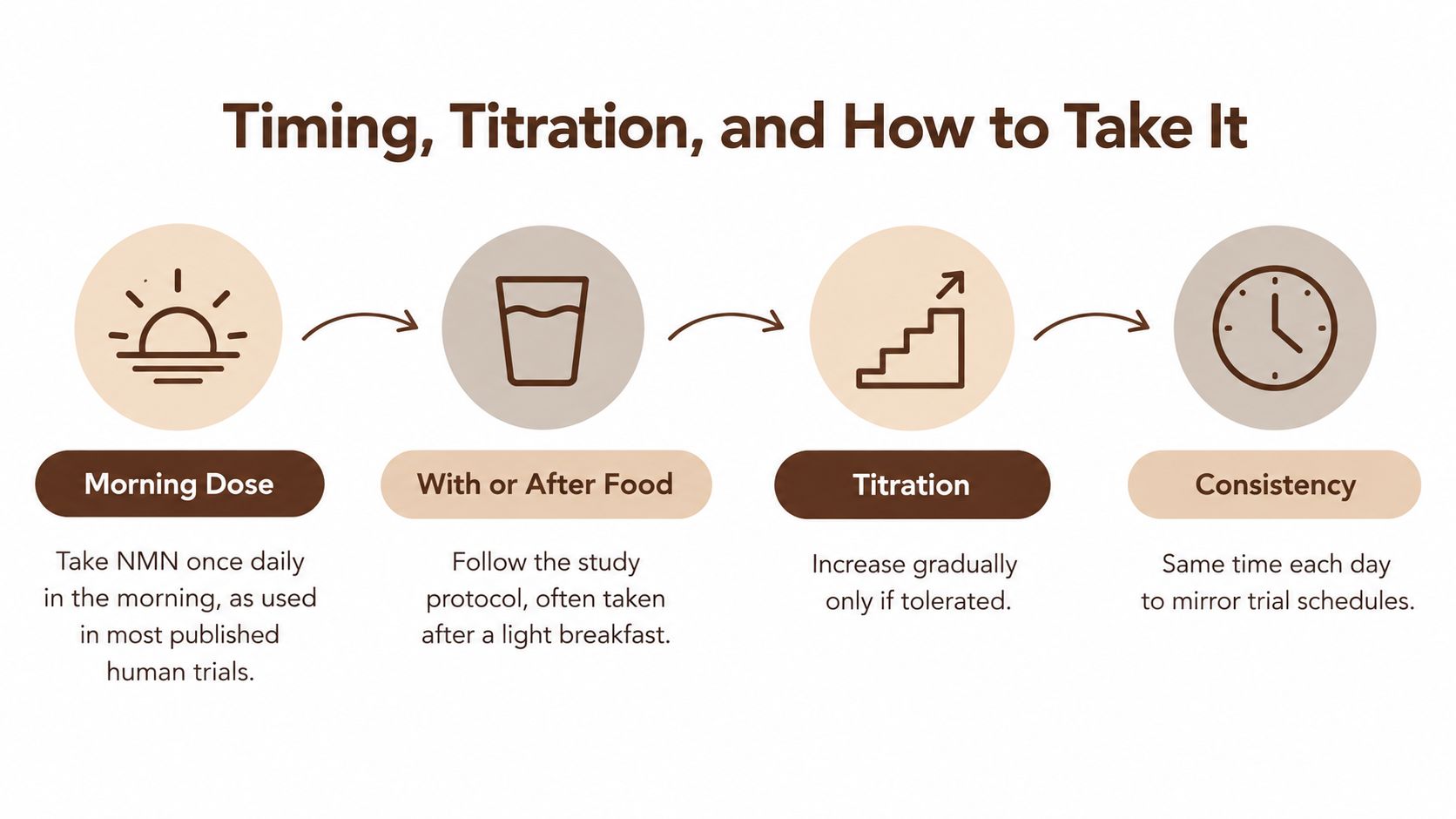
The most reproducible human protocols use once-daily oral dosing, but timing alone hasn't been shown to create a universal advantage. A practical routine should prioritize consistency, tolerability, and faithful comparison with the schedules used in research.
Start with the amount you intend to evaluate, rather than creating a loading phase unsupported by the clinical literature. If you're sensitive to supplements, a lower starting amount can help you identify gastrointestinal discomfort or other unwanted effects before increasing exposure. Any escalation should be gradual and should stop when the intended goal is met or symptoms appear.
A practical routine
- Choose a consistent time: Morning dosing is a reasonable default because many human studies used it.
- Use food according to tolerance: Taking NMN with or after a light meal may be more comfortable for people with a sensitive stomach.
- Avoid automatic escalation: A larger serving makes sense only when a clearly defined goal remains unmet and the next step is medically appropriate.
- Split only for comfort: Dividing a daily amount can be a practical response to digestive discomfort, but it isn't established as more effective than one daily serving.
A product such as Himalayan Shilajit Gold Gummies belongs to a different supplement category, so combining it with NMN shouldn't be used to justify changing the NMN dose. Add one variable at a time when possible. That makes it easier to identify which product affects tolerance or subjective response.
The practical upper boundary is uncertain because higher-dose studies are short. Keep the routine stable long enough to assess it, and speak with a clinician before moving beyond the better-replicated mid-range.
Safety Limits and Reported Tolerability
Human trials have tested NMN doses from roughly 150 mg to 1,200 mg per day, with generally favorable short-term tolerability. A review of human NMN dosing and safety found no serious adverse effects in its included trials. That supports cautious optimism, not a conclusion that any dose is safe indefinitely.
The main constraint is follow-up time. Reviewed studies lasted 14 days to 12 weeks, while a dedicated safety trial assessed 1,250 mg daily for up to four weeks. These periods may reveal some immediate problems, but they cannot establish whether prolonged use at higher doses affects liver function, kidney function, metabolic regulation, or other clinically important outcomes.
| Study / Dose | Duration | Participants | Reported Adverse Events |
|---|---|---|---|
| Randomized NMN trials | 14 days to 12 weeks | 342 middle-aged or older adults across eight reviewed trials | No serious adverse effects reported in the review |
| Higher-dose safety study | Up to 4 weeks | 31 healthy adults | Reported as well tolerated |
| Broader human evidence synthesis | Short-term study periods | Healthy adult trial populations | No serious adverse effects reported in included trials |
The evidence also comes from selected populations. Healthy adult participants do not represent people with chronic kidney disease, active cancer, complex medical conditions, or medication regimens excluded from the research. Their results should not be transferred automatically to those groups.
NMN has no universally accepted regulatory upper tolerable intake level. Mild symptoms reported by supplement users may occur, but inconsistent products, dosing patterns, and other health factors make their frequency and relationship to dose difficult to determine.
The full tested range therefore describes research exposure, not a recommended dosing ladder. Mid-range doses remain the more defensible reference for many adults because they have been studied more consistently than the highest exposures, while the available higher-dose trials were brief.
Short-term tolerability shows that a study group completed a protocol. It does not establish that the same dose is suitable for long-term use by every adult.
Dose Adjustments for Different Adults
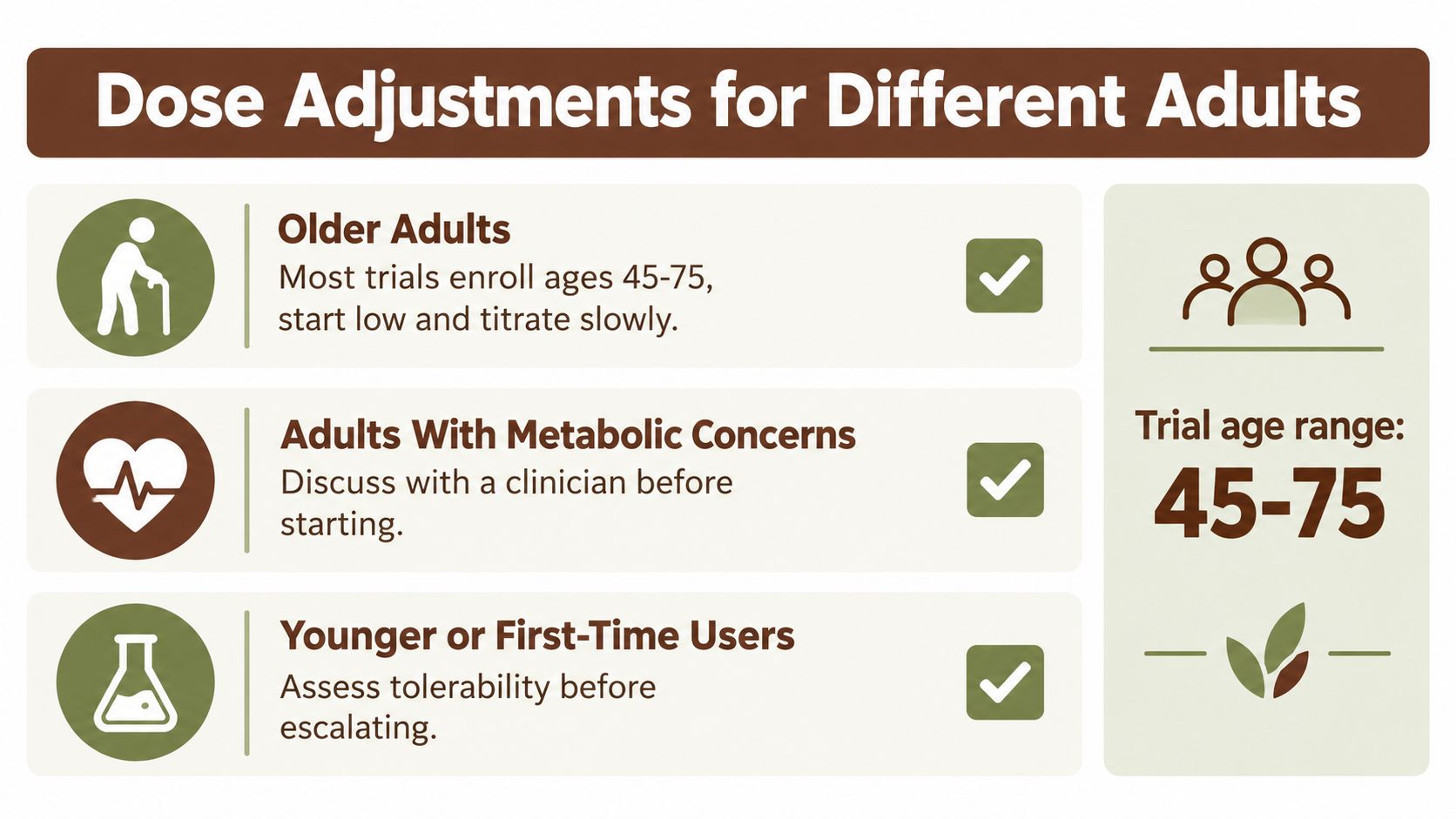
The same NMN amount may carry different practical implications across populations, yet subgroup-specific evidence remains limited. Human research has concentrated on middle-aged and older adults, while younger healthy adults are less represented. That makes conservative interpretation more appropriate than age-based claims about a precise “correct” dose.
Older adults have contributed substantially to the available research, and a lower reference amount can be a sensible starting point when the goal is to mirror the most frequently tested exposure. Adults with metabolic concerns should be more cautious, because NMN research has examined metabolic endpoints, but that doesn't make NMN a substitute for prescribed treatment or monitoring.
Groups that need a conservative frame
- Older adults: Begin with the best-established reference dose and adjust only after assessing tolerance.
- Women: Don't assume results transfer evenly between sexes, because sex-stratified efficacy and tolerability data remain limited.
- Athletes: Exercise studies have tested mid-to-higher doses, but a biomarker response isn't the same as a reliable performance improvement.
- People taking medication: Discuss NMN with a prescriber, particularly when treatment affects glucose regulation, blood pressure, or related metabolic pathways.
- Younger adults: Avoid extrapolating confidently from older-adult trials. The evidence gap is meaningful.
Body composition and baseline NAD+ status may matter biologically, but current studies don't provide a validated adjustment calculator. Until they do, the safest framework is to prioritize lower exposure, introduce one change at a time, and track a specific outcome rather than chasing a higher number.
How Delivery Format Affects Practical Dosing
Oral capsules have the clearest human dosing record. Most published exposure data concerns swallowed NMN, so capsule labels can be compared relatively directly with the amounts used in trials. That doesn't guarantee identical absorption between brands, but it gives the reader a defensible reference point.
Sublingual tablets and powders are often marketed around faster or greater absorption. However, comparative claims about substantially higher absorption require direct pharmacokinetic evidence, and sparse sublingual efficacy research means a 100 mg sublingual serving can't automatically be treated as equivalent to a 250 mg oral trial dose.
Topical NMN is even harder to compare. Human transdermal dose-response curves aren't established well enough to translate a cream's labeled amount into the systemic exposure documented in oral studies. A topical product may be intended for localized use, but that doesn't make its NMN amount interchangeable with an oral serving.
Compare like with like: Match oral products to oral trials, and don't increase exposure simply because a different delivery format sounds more efficient.
For a broader product-evaluation checklist, learn how to choose an NMN supplement using formulation and quality factors. The dosing question should remain separate from marketing language. First establish the actual amount, form, testing information, and intended route. Then compare it with the evidence.
Building Your Personal Dosing Framework
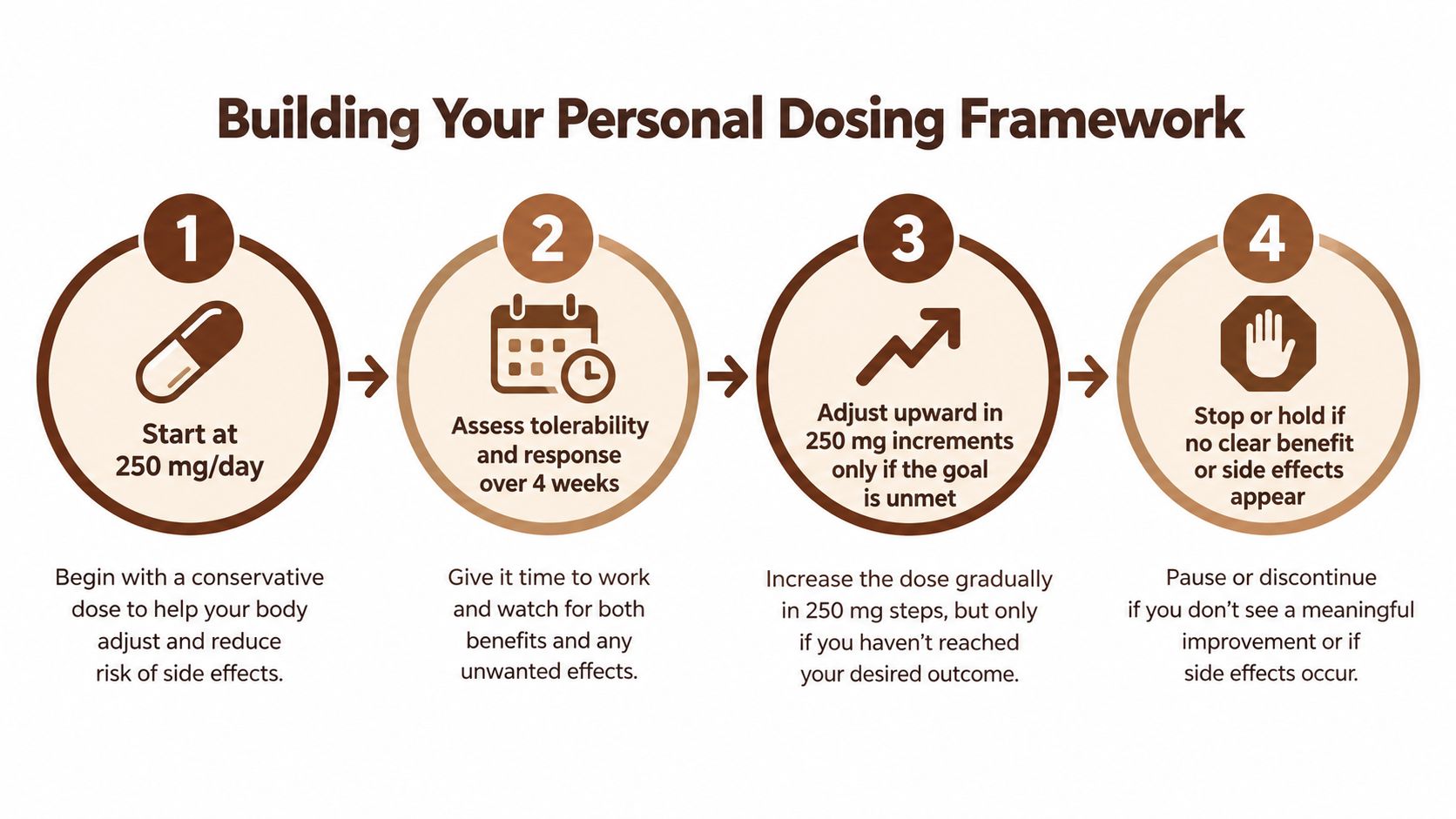
A useful framework should limit expectation-driven escalation while leaving room to respond to individual tolerance and goals. Human studies span a broad range, but mid-range dosing remains the most defensible starting point for many adults.
- Start with 250 mg per day. This recurring reference dose appears across randomized human research and provides a practical baseline, rather than proof that it is optimal for every person.
- Define the outcome before changing the dose. Track one or two measures, such as perceived energy, training recovery, or a clinician-selected metabolic marker. A general wish for “more” does not show that the dose is inadequate.
- Adjust only if the goal remains unmet. Research has examined 300 mg, 600 mg, and 900 mg, yet has not established consistent superiority for the highest tested amount. The full human-tested range includes doses from 100 mg to 2,000 mg, with important differences in study duration and endpoints.
- Hold or reduce the dose if symptoms appear. Persistent discomfort makes the protocol unsuccessful, regardless of a possible biomarker effect.
Above 500 mg per day, duration and endpoint limitations deserve greater attention. That boundary is a practical evidence marker, not a confirmed safety cutoff. People with chronic conditions or prescription medications should discuss dose changes with a clinician instead of treating published safety findings as personal clearance.
Quick Reference for NMN Supplement Dosage
Use the table below as a navigation aid, not as a prescription. The dose range comes from human trials, while the practical interpretation depends on the outcome, duration, and population examined in the clinical dose range, timing guidance, and adult-group discussion.
| Parameter | Evidence-Backed Value |
|---|---|
| Common reference dose | 250 mg per day |
| Doses tested in human studies | 100 mg to 2,000 mg per day |
| Higher-dose range examined | 300 mg, 600 mg, 900 mg, and up to 1,250 mg per day |
| Practical middle range | 250 mg to 500 mg per day |
| Short-term high-dose exposure | Up to 1,250 mg per day for up to 4 weeks in a safety study |
| Typical reviewed trial duration | 14 days to 12 weeks |
| Common study schedule | Once-daily oral dosing |
| Main caution | Short trials don't establish long-term high-dose safety |
Morning use is a reasonable default because many protocols use it, but consistency and tolerance matter more than treating timing as a guaranteed enhancer. People who are pregnant, receiving cancer treatment, taking prescription medication, or managing a chronic condition should seek medical advice before starting.
What the Evidence Still Cannot Answer
Human research still can't identify the optimal NMN dose beyond 12 weeks, prove that blood NAD+ testing improves personal outcomes, or establish whether older or metabolically affected study results generalize to younger healthy adults. It also hasn't resolved whether combinations with resveratrol, trimethylglycine, or other precursors change the amount of NMN a person needs. Any sustained use above 500 mg per day remains an extrapolation from short studies, not a proven long-term protocol.
REVETIX offers an NMN supplement positioned around β-NMN and daily NAD+ precursor support, with product information describing third-party testing and a morning serving routine. If you want to compare the formulation with the evidence-based dosing framework in this article, visit REVETIX and review the product details before deciding whether it fits your routine.