


You finish dinner and feel that familiar question coming on. Was it the pasta, the salad, the stress, or the supplement you started last week? By bedtime, your stomach feels full, your jeans feel tighter, and you're scrolling through labels that promise “microbiome balance” without telling you what result to expect by morning.
That's where many get stuck with healthy gut supplements. The language on the bottle focuses on strains, CFUs, enzymes, blends, and “flora support.” Many don't care about those details first. They care about outcomes. They want easier bowel movements, less bloating after certain meals, more predictable regularity, or less discomfort after eating.
That outcome-first approach matters because the evidence is specific. A 2026 consumer survey reported that people cared more about clearly communicated functional results than technical details like CFUs, strains, or microbiome mechanics, which helps explain why gut supplement shopping often feels confusing when labels lean on jargon instead of symptom guidance (consumer survey coverage). And if you're also thinking about broader wellness goals, this kind of practical, evidence-based decision making shows up in other areas too, such as this guide to healthy aging supplements.
Table of Contents
- Introduction to Healthy Gut Supplements and What They Can Realistically Do
- Understanding Probiotics Prebiotics Fiber and Digestive Enzymes
- How to Match Healthy Gut Supplements to Your Symptoms and Goals
- How to Use Healthy Gut Supplements for Best Results and Timing
- Safety Timing and Common Mistakes to Avoid With Gut Supplements
- Your Next Steps for Choosing Healthy Gut Supplements With Confidence
Introduction to Healthy Gut Supplements and What They Can Realistically Do
You finish a normal dinner, then spend the next two hours guessing. Is the problem slow bowel movements, gas after high-fiber foods, lactose from dessert, or the probiotic you added three days ago? That uncertainty is why “gut health” advice so often falls flat. The label may sound broad, but the symptoms are usually specific.
Healthy gut supplements work more like a toolbox than a single fix. A fiber supplement can help change stool form and regularity. An enzyme may help when one food repeatedly causes trouble. A probiotic may help for certain symptom targets, but not because the bottle promises “balance.” The first job is matching the tool to the result you want.
Start with the result you want
A practical question is: What problem are you trying to solve this week? Constipation, post-meal bloating, irregularity after travel, and discomfort after dairy do not point to the same category. Shoppers focused on symptom relief often prioritize outcomes over strain counts, and that instinct is usually right.
Clinical shortcut: If you can name the symptom, when it shows up, and the usual trigger, you are already closer to a useful supplement choice.
That matters because popular marketing claims do not always match measured outcomes. In healthy adults, a 2026 quantitative synthesis of randomized controlled trials found that probiotic supplementation did not produce statistically significant changes in gut microbiota diversity measures such as Shannon, Chao1, observed OTUs, and Simpson's index (quantitative synthesis and synbiotic review). In plain terms, a probiotic is not a reliable way to get a “more diverse microbiome” result on its own.
What supplements can do well
A better starting frame is function, timing, and symptom pattern.
- Probiotics may help with some symptom-specific digestive goals, depending on the strain and the problem being targeted.
- Prebiotics feed microbes already living in the gut and may fit people whose goal is gradual support rather than immediate relief.
- Fiber supplements are often the most practical match for stool consistency, infrequent bowel movements, or routine regularity.
- Digestive enzymes make the most sense when symptoms show up after identifiable foods, such as dairy or certain high-carbohydrate meals.
The comparison is simple. If your issue is traffic flow, adding more cars is not the same as changing the road. Some supplements change what reaches the colon. Others help process the meal before it gets there.
What supplements usually cannot do
Supplements do not replace the basics of digestion. Low fluid intake, very low dietary fiber, large swings in meal timing, and persistent food triggers can keep symptoms going even with a well-chosen product.
They also do not work on the same clock. Enzymes may help at the meal they are taken with. Fiber often needs days of steady use. Some prebiotics and probiotics require patience, and some never match the symptom you hoped they would address.
That is the same practical mindset used in other evidence-based supplement decisions, including this guide to healthy aging supplements with science-based ingredient matching. Clear goals first. Then the right tool.
Understanding Probiotics Prebiotics Fiber and Digestive Enzymes
The fastest way to waste money on gut products is to treat them like they're interchangeable. They aren't. Each category acts on a different part of the digestive process.
Four tools with four different jobs
Probiotics are live microbes. Their effects tend to be strain-specific, not class-wide. That means the word “probiotic” alone doesn't tell you enough.
Prebiotics are compounds, often fermentable fibers, that feed beneficial microbes already present in the gut. They don't add new bacteria. They support the ones you already have.
Fiber supplements add bulk, hold water, and in some cases also ferment in the colon. For many adults with sluggish bowel habits, fiber is the most practical starting point.
Digestive enzymes help break down certain foods. They don't “heal the microbiome,” but they may reduce symptoms when meals containing specific ingredients repeatedly cause trouble.
For readers who want a simple background explainer on probiotics for gut health, it can help to review the basic probiotic-prebiotic distinction before comparing labels.
Which Healthy Gut Supplement Type Fits Which Goal
| Supplement Type | How It Works | Best For | What Not to Expect |
|---|---|---|---|
| Probiotics | Adds selected live microbes | Some symptom-linked digestive goals, depending on strain and indication | A universal microbiome reset |
| Prebiotics | Feeds beneficial gut bacteria already present | People wanting to support gut ecology through fermentation support | Immediate relief after one dose |
| Fiber | Adds bulk, holds water, may ferment depending on type | Hard stools, irregularity, low-fiber diets | Fast food-trigger relief at a single meal |
| Digestive enzymes | Helps break down specific food components | Symptoms linked to identifiable trigger foods | Broad changes in gut diversity |
Where people get confused
Many shoppers assume a more complex label means a better product. It often doesn't. A long strain list may still be poorly matched to your symptom. A gummy may be convenient, but convenience isn't the same thing as evidence for your particular goal. Market reporting from 2025 to 2026 shows strong interest in probiotics and rapid growth in gummies and chewables, while independent reviews also note that not all biotic products have been validated and outcomes remain inconsistent across studies. The same review trend noted that prebiotics consistently increased beneficial bacteria and short-chain fatty acid production, while synbiotic effects were mixed and strain-specific (market and review summary).
That's also why a product like Himalayan Shilajit Gold Gummies belongs in a different conversation. Its stated role is daily energy, balance, and mineral support through shilajit, ashwagandha, and minerals. That may matter for general wellness, but it isn't the same as choosing a supplement for constipation, food-triggered bloating, or bowel regularity.
How to Match Healthy Gut Supplements to Your Symptoms and Goals
You eat yogurt for breakfast, add a probiotic gummy at lunch, and stir a fiber powder into water at night. A week later, you still feel bloated and your bowel pattern has not changed. That usually does not mean you chose the wrong category for the internet. It means you have not matched the supplement to the symptom endpoint yet.
Start with the result you want to change. Stool frequency is a different goal from stool softness. Food-triggered bloating is a different problem from low-fiber irregularity. Gut supplements work more like tools than tonics. A screwdriver is useful, but not for every repair.

If constipation and hard stools are the main issue
Focus on what “better” means before you shop. Are you trying to go more often, pass stool more easily, or reduce straining?
A 2024 meta-analysis in adults with functional constipation found that probiotic-containing products improved stool frequency by a weighted mean difference of 0.93 bowel movements per week, improved stool consistency by 0.38 units, and improved constipation symptoms. Results varied widely across studies and products, with high heterogeneity for stool frequency at I² = 84.5% (BMJ Open meta-analysis).
That is useful, but it is not a guarantee. In clinic terms, this points to a modest average benefit with uneven real-world results. If your stools are small, dry, and infrequent, soluble fiber often deserves attention early because it targets stool form directly. A probiotic may still help, but it is usually a better choice when the label is specific and your goal is clearly defined.
If bloating follows specific foods
Timing and trigger matter more than a broad “gut health” promise.
Bloating after dairy suggests a different mechanism than bloating after beans, onions, or a large fiber supplement. In the first case, an enzyme such as lactase may fit the problem better because the symptom appears when a specific food component is not broken down well. In the second case, adding more fermentable prebiotic fiber can intensify gas before it helps, especially if you increase too fast.
Keep a short symptom diary for a few days. Note the meal, the trigger food, and how quickly symptoms show up. Fast symptoms after one repeatable food point more toward a digestion issue. Slower, day-to-day irregularity points more toward fiber pattern, stool hydration, or bowel rhythm.
Probiotics still have a role in some bloating patterns, but strain names on a label are not the same as symptom proof. A broad review of probiotic trials found benefits in some gastrointestinal conditions and no benefit in others, which is why matching the product to the condition matters more than buying the longest strain list (review of probiotic efficacy across GI conditions).
If irregularity comes with a low-fiber diet
This pattern often responds best to fiber first, then a prebiotic only if needed.
The logic is simple. If the bowel does not have enough bulk and water-holding material to work with, adding bacteria alone may not change much. Fiber changes the physical characteristics of stool. That is often the missing piece in people eating very few plants, relying on convenience foods, or skipping meals.
Read labels closely. “Fiber blend” tells you far less than the actual fiber type. Soluble bulking fibers and highly fermentable fibers can feel very different in the gut, even when both sit under the word fiber.
A related issue comes up with magnesium, because some people use it for bowel support rather than mineral replacement. If you are comparing forms, this guide to magnesium glycinate vs citrate vs malate explains why the form can change the effect you notice.
If you want a practical way to choose
Use this checklist before you buy:
-
Pick one endpoint
Choose the main outcome you want to improve, such as bowel frequency, stool softness, post-meal bloating, or dairy tolerance. -
Match the category to the pattern
Fiber fits low-bulk irregularity. Enzymes fit repeatable food triggers. Probiotics fit some symptom patterns, but only when the product is specific enough to judge. -
Read past marketing language
Terms like “reset,” “balance,” and “advanced flora” do not tell you what symptom should change or how you would measure success. -
Choose one variable at a time
If you start a probiotic, enzyme, and fiber powder together, you cannot tell which one helped or which one caused gas.
Stress can still shape symptoms in the background by changing meal pace, appetite, and bowel habits. That does not turn stress support into a gut treatment, but it helps explain why symptoms sometimes cluster during busy weeks. One example is Rhodiola Rosea, which is described as a daily adaptogenic capsule for calmer stress response, focus, steady energy, and balanced mood.
A short video can help reinforce the symptom-matching mindset before you buy:
How to Use Healthy Gut Supplements for Best Results and Timing
A good choice can still disappoint if you use it inconsistently, start too aggressively, or take it at the wrong moment for your goal. The routine matters.
Start low and give your gut time
Most tolerance problems happen because people start with a full dose on day one. That's especially common with fiber and prebiotic products. If gas or cramping follows, they assume the supplement “doesn't work,” when issue may be speed.
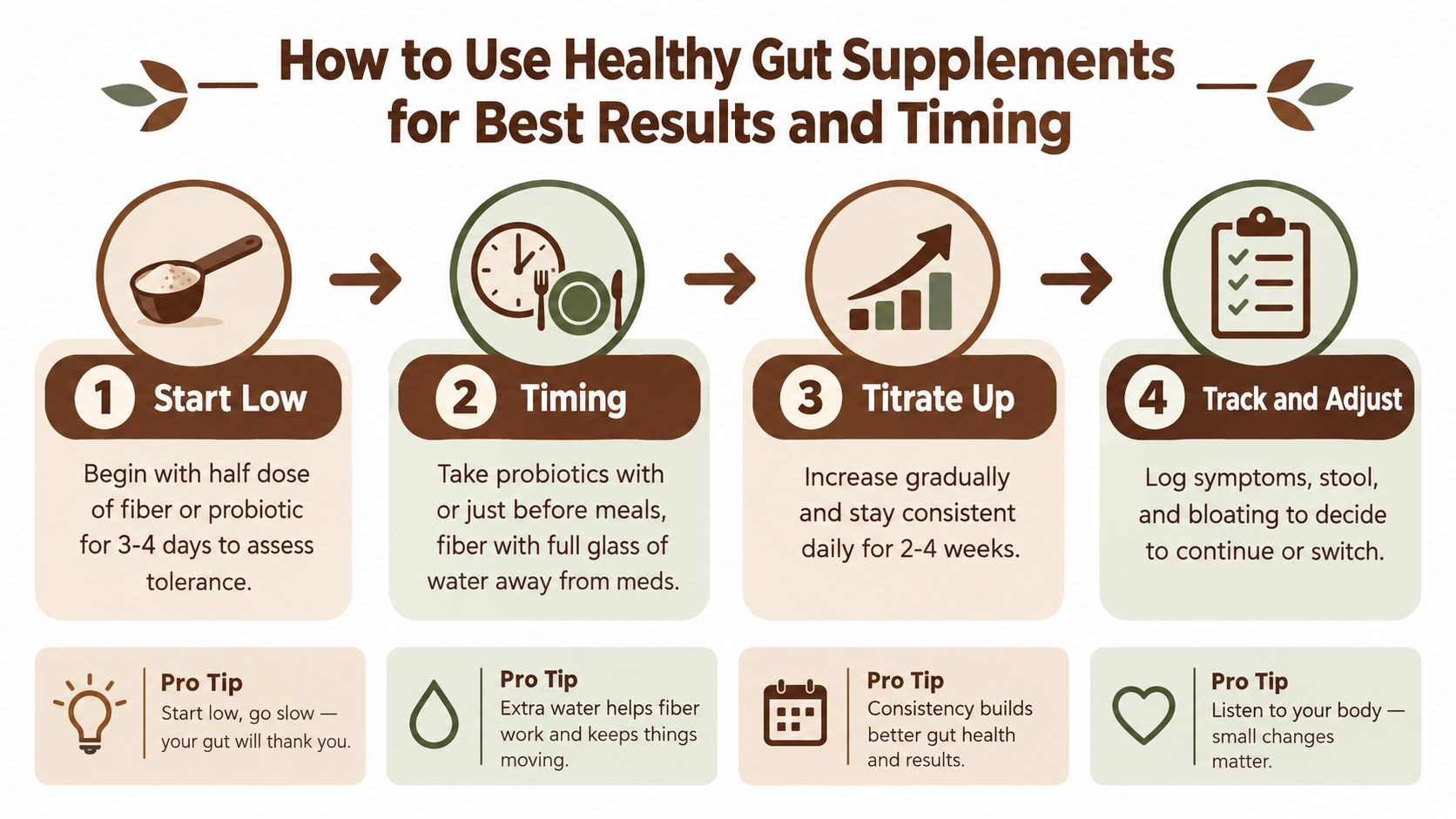
A steadier approach works better:
- Begin below the full serving if the product tends to ferment or bulk the stool.
- Increase gradually only if tolerance is good.
- Stay consistent daily long enough to judge the result fairly.
Match timing to the category
Different supplement types work best in different moments.
- Fiber usually fits best with plenty of water and some separation from medications.
- Digestive enzymes belong with the meal that triggers symptoms, not randomly later in the day.
- Prebiotics are often easier to tolerate when introduced with attention to meal pattern and symptom timing.
- Probiotics are often taken consistently at the same time each day, with many people preferring to pair them with meals for routine and tolerance.
Practical rule: Use daily supports daily. Use meal-specific supports only when the trigger meal is present.
Track outcomes, not just compliance
If you're taking a supplement faithfully but never define success, it's hard to know whether to continue. Use a simple log with a few plain measures:
- Bowel movement pattern such as frequency and ease
- Stool form such as hard, normal, or loose
- Bloating timing such as after lunch, after dairy, or at night
- Meal triggers such as beans, large fatty meals, or rushed eating
This doesn't need to be complicated. A notes app works.
Think carefully about stacking products
Some combinations make sense. Fiber plus a targeted probiotic may be reasonable when regularity is the main goal. Enzymes can sit alongside other products because they're usually tied to specific meals.
What usually doesn't help is adding three new gut products at once. If symptoms improve or worsen, you won't know which one mattered. Capsules, powders, chewables, and gummies can all improve adherence if they fit your routine, but convenience shouldn't replace symptom matching.
Safety Timing and Common Mistakes to Avoid With Gut Supplements
You start a new gut supplement on Monday because bloating has been showing up after dinner. By Thursday, you feel more gas, switch to a probiotic gummy, then add enzymes over the weekend. Two weeks later, you have a shelf full of products and no clear answer.
That pattern is common. The biggest risk with gut supplements is often not toxicity. It is confusion. If the supplement does not match the symptom, or if you change products too quickly, you can miss both benefit and a sign that something else needs evaluation.

Mistakes I see most often
One mistake is treating probiotics as a general reset. That usually leads to vague expectations and vague results. A better question is narrower. Are you trying to improve stool consistency, reduce antibiotic-associated diarrhea risk, or test whether a defined product helps bloating?
Another mistake is assuming a stronger label means a stronger effect. More CFUs, more strains, and longer ingredient panels do not reliably map to better symptom relief. The useful match is between product type and endpoint. Fiber may help hard stools. An enzyme may help only when a certain meal causes symptoms. A probiotic should be chosen for a specific digestive goal, not for marketing volume.
A third mistake is misreading early side effects. Prebiotics and some fibers can cause temporary gas or fullness at the start, especially if the dose rises too fast. That does not always mean the product is wrong. It may mean the starting dose was too high for your current tolerance.
Who should pause before self-treating
Some symptoms should change the plan right away. New bleeding, unexplained weight loss, fever, repeated vomiting, severe pain, or symptoms that keep getting worse deserve medical assessment before another supplement trial. Gut supplements can support symptom management. They do not rule out infection, inflammatory disease, medication side effects, or structural problems.
Timing safety matters too. Fiber can interfere with how some medications are absorbed if taken at the same time. That is less dramatic than an allergic reaction, but it matters in real life because it changes whether the medication works as intended. The same scheduling question comes up in many supplement routines, including discussions about stomach tolerance and spacing in this guide to buffered vitamin C and supplement timing.
If you are immunocompromised, have a central venous catheter, or are recovering from major illness or surgery, probiotic use deserves a clinician's input rather than a trial-and-error approach.
Timing mistakes that create false failures
A good rule is to match the clock to the mechanism. Enzymes work at the meal they are meant to help digest. Fiber and prebiotics usually need a slower buildup and enough fluid. Probiotics are often judged over weeks, not days.
Here is where people get tripped up. They take an enzyme after symptoms have already peaked, use fiber inconsistently, or expect a capsule aimed at regularity to fix pain after one restaurant meal. That is like using the right tool at the wrong part of the job. The tool may be reasonable. The timing makes it look ineffective.
Keep expectations narrow and useful
Broad promises about “gut balance” are hard to measure and easy to oversell. Safer decisions come from picking one symptom goal and watching that endpoint closely. Easier bowel movements. Less post-meal bloating with a known trigger. Fewer loose stools during a defined period. Those outcomes can be tracked.
As noted earlier, research on broad microbiome changes in otherwise healthy adults is mixed. That is why symptom-linked decisions are more reliable than buying the product with the biggest promise. Choose one category, set one target, and give it a fair, well-timed trial before deciding it failed.
Your Next Steps for Choosing Healthy Gut Supplements With Confidence
A confident decision usually starts with less shopping and more clarity. Pick one symptom. Write down when it happens, how often, and what seems to trigger it. Then choose the supplement category that fits that pattern.
If your main issue is hard stools and inconsistent bowel movements, start by looking at fiber and regularity-focused options. If symptoms reliably follow a specific food, think enzymes before broad-spectrum blends. If you still want a probiotic, look for a product tied to a defined digestive goal, not just a long ingredient panel.
Keep your expectations concrete. Better stool frequency. Easier passage. Less discomfort after certain meals. Those are useful outcomes. “Support for microbiome balance” is too vague to guide a purchase or judge success.
It also helps to keep one foot in food-based strategies. Some people exploring digestive support like to learn about soothing plant foods alongside supplements, and this article on why you should eat aloe vera is one example of that broader wellness conversation. Use those ideas as context, not as a replacement for a symptom-specific plan.
The most reliable process is simple. Match the tool to the symptom, give it a fair trial, and track what changes.
REVETIX offers supplements focused on energy, resilience, and daily wellness routines, which can matter alongside digestive habits when you're building a realistic self-care plan. If you want to explore that broader picture with products such as adaptogens, mineral support, and longevity-focused formulas, visit REVETIX.