


You take a 1,000 mg vitamin C tablet on an empty stomach, expecting a simple boost to your daily routine. Within an hour, your stomach cramps, heartburn appears, or your stools turn loose. That reaction can make you wonder whether vitamin C itself is the problem, or whether the supplement form is working against you.
Buffered vitamin C is often chosen in this situation because mineral ascorbates are less acidic than pure ascorbic acid and may feel gentler for acid-sensitive users. But gentler on the stomach doesn't automatically mean better absorbed. The key distinction is tolerability: buffering changes the chemical environment and may improve comfort, while the vitamin C component still uses the same saturable intestinal transport system. The Linus Pauling Institute's vitamin C overview explains this basic difference between mineral ascorbates and ascorbic acid.
The practical question, then, isn't “Which form is strongest?” It's which form can you take consistently, at a dose your gut can handle, without believing exaggerated bioavailability claims. The sections below walk from the chemistry behind stomach upset to buffered alternatives, absorption limits, mineral trade-offs, and a split-dose strategy.
Table of Contents
- When Vitamin C Upsets Your Stomach
- What Buffered Vitamin C Actually Means
- Buffered Vitamin C vs Ascorbic Acid
- The Absorption Question Most Articles Skip
- How to Dose Buffered Vitamin C Without Side Effects
- Forms You Will See on the Shelf
- Safety, Interactions, and Who Should Be Cautious
- Choosing the Right Option for Your Routine
When Vitamin C Upsets Your Stomach
A large serving of ordinary ascorbic acid can create two separate problems. First, it's an acidic compound, so a concentrated dose may aggravate acid-related discomfort in a sensitive stomach. Second, when more vitamin C reaches the intestine than the body can absorb at once, the unabsorbed portion can contribute to gastrointestinal symptoms through an osmotic effect.
That combination helps explain why someone may experience cramping, reflux, nausea, bloating, or loose stools after a large single dose. The issue isn't necessarily that vitamin C is harmful for that person. The dose, the empty stomach, and the acidic form may exceed their current tolerance.
Why the dose matters
The NIH Office of Dietary Supplements fact sheet for vitamin C notes that absorption is about 70% to 90% at 30 to 180 mg per day, but falls to less than 50% above 1 g per day. As absorption becomes less efficient, more of the dose remains in the digestive tract, where it can cause trouble.
A single bolus is usually harder to tolerate than smaller servings spread through the day. That's why taking a large tablet all at once may cause symptoms even when smaller amounts feel completely comfortable.
Practical rule: If a vitamin C dose repeatedly causes digestive symptoms, reduce the serving before assuming you need a more exotic product.
Buffered vitamin C may help because mineral ascorbates are less acidic. Calcium ascorbate and sodium ascorbate still deliver vitamin C, but their mineral salt structure generally produces a less acidic preparation. This can reduce acidity-related irritation for some people, although it won't eliminate every dose-related digestive effect.
The wider gut context
Vitamin C isn't the only supplement that can affect digestive comfort. If you're also trying to understand how food, bacteria, fiber, and supplements interact in your routine, probiotics for gut health explained offers useful background. It's still important to evaluate vitamin C on its own, because adding several products at once makes it difficult to identify the cause of symptoms.
The main lesson is straightforward: tolerability is the strongest reason to consider buffered vitamin C. Absorption deserves a separate, more careful answer.
What Buffered Vitamin C Actually Means
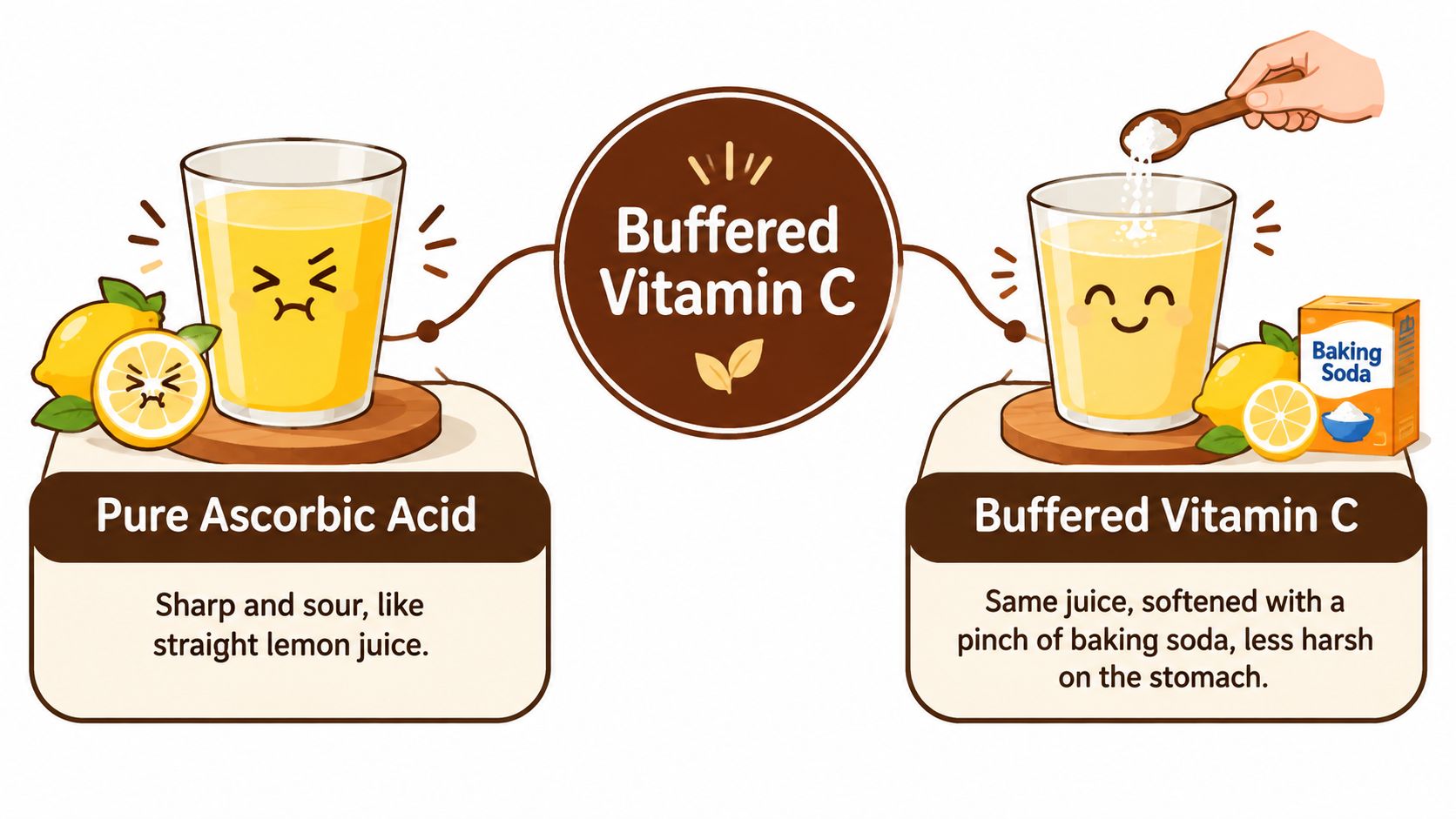
Think of pure ascorbic acid like straight lemon juice. It has the same useful ingredient you want, but its sharp acidity can be unpleasant when concentrated. A buffered preparation is more like that lemon juice softened with a pinch of baking soda. The active ingredient remains, but the chemical environment becomes less acidic.
In supplement terms, buffering usually means combining ascorbic acid with a mineral to create a mineral ascorbate. Common examples include calcium ascorbate and sodium ascorbate. The Linus Pauling Institute's explanation of vitamin C identifies these mineral ascorbates as less acidic than pure ascorbic acid and generally better suited to users who experience acid-related gastrointestinal discomfort.
What changes and what doesn't
The pH and mineral partner change. The vitamin C component still enters the body as ascorbate and uses the same intestinal uptake mechanisms. Buffering doesn't turn vitamin C into a different vitamin, and it doesn't make each milligram more potent.
That distinction matters because labels and marketing often use terms such as “pH-neutral,” “gentle,” or “advanced absorption” together. The first two may describe a real tolerability feature. The third requires stronger evidence than the form alone provides.
A buffered product can therefore be useful when ordinary ascorbic acid causes heartburn or stomach irritation. It may also make a daily routine easier to maintain because you're less likely to skip a supplement that leaves you uncomfortable. But if you already tolerate ordinary ascorbic acid, there's no automatic reason to switch solely for better absorption.
The same principle applies when comparing unrelated wellness products. For example, the PDRN Volufiline NAD+ BALM is a topical targeted balm designed for the appearance of facial volume, firmness, hydration, and smoother-looking skin. Its topical purpose is separate from the digestive and absorption questions surrounding oral vitamin C.
The useful translation: Buffered means less acidic, not magically more vitamin C.
Buffered Vitamin C vs Ascorbic Acid
The simplest comparison separates acidity, stomach comfort, absorption, and mineral exposure. Pure ascorbic acid is the direct acid form. Buffered vitamin C uses a mineral ascorbate, which generally reduces acidity but introduces another mineral that must fit your health needs.
| Attribute | Ascorbic Acid | Buffered Vitamin C |
|---|---|---|
| Chemical form | Pure ascorbic acid | Mineral ascorbate, such as calcium or sodium ascorbate |
| Acidity | More acidic | Less acidic |
| Main practical advantage | Straightforward vitamin C source | Often gentler for acid-sensitive users |
| Absorption mechanism | Uses saturable intestinal transport | Uses the same fundamental vitamin C transport system |
| Main trade-off | May aggravate reflux or gastric irritation | Adds a mineral load and doesn't remove dose-related GI symptoms |
| Best fit | People who tolerate the acid form | People whose routine is limited by acidity or stomach comfort |
The NIH vitamin C fact sheet describes a dose-dependent absorption pattern. At lower daily intakes, the body absorbs a larger share. At higher intakes, transport becomes saturated and the absorbed proportion declines. That pattern applies to the vitamin C component, regardless of whether the label says ascorbic acid or mineral ascorbate.
What the human data actually show
Human pharmacokinetic findings don't support a blanket claim that every buffered product is better absorbed. A study involving 20 healthy volunteers found that 500 mg of neutralized calcium ascorbate produced 128% greater bioavailability than synthetic vitamin C over 10 hours, while another comparative study reported that 500 mg of calcium ascorbate increased plasma dehydroascorbic acid and altered neutrophil function during the first 8 hours. These findings suggest that some specific buffered formulations may affect early systemic handling at higher doses, but they don't prove that buffered vitamin C universally outperforms ordinary ascorbic acid.
Those findings come from the comparative research summarized in this human vitamin C pharmacokinetic review. The evidence is interesting, but it's narrower than the broad marketing statement that buffered vitamin C is always more bioavailable.
For most readers, the decision is practical. Buffered vitamin C wins when acidity makes regular vitamin C difficult to use. It doesn't automatically win when the only goal is getting more vitamin C into the bloodstream.
The Absorption Question Most Articles Skip
Your intestine doesn't absorb an unlimited amount of vitamin C from one serving. Vitamin C uptake depends on transport systems that become saturated, so increasing the size of one dose eventually produces a smaller increase in absorbed vitamin C.
The NIH vitamin C guidance reports that absorption remains relatively high at 30 to 180 mg per day, then drops to below 50% above 1 g per day. This is why a large tablet can deliver less efficient absorption than several smaller servings, even if the total daily amount is identical.
A useful mental model is a narrow doorway. If you send a small group through, everyone gets inside. If you send a crowd at once, the doorway reaches its limit and the rest have to wait outside. Buffered vitamin C may make the approach more comfortable, but it doesn't widen the intestinal doorway.
Why splitting changes the calculation
Suppose you're considering 500 mg. Taking the whole amount in one serving may be less efficient than dividing it, especially if you're sensitive to digestive symptoms. A smaller serving gives the transport system a better opportunity to handle the vitamin C before the next serving arrives.
That's also why discussions of absorption should distinguish form from schedule. A buffered product may be easier on your stomach, while a split-dose routine may do more to improve the proportion absorbed across the day.
If you're comparing absorption questions across supplements, keep each ingredient's mechanism separate. The discussion of liposomal glutathione, absorption, and uses concerns a different compound and delivery approach, so it shouldn't be used as proof that mineral ascorbates bypass vitamin C transport limits. Similarly, the NMN Supplement is a separate product category involving an NAD+ precursor, not a buffered vitamin C formulation.
A better question than “Which form absorbs best?” is “Which serving size can my body absorb and tolerate repeatedly?”
How to Dose Buffered Vitamin C Without Side Effects
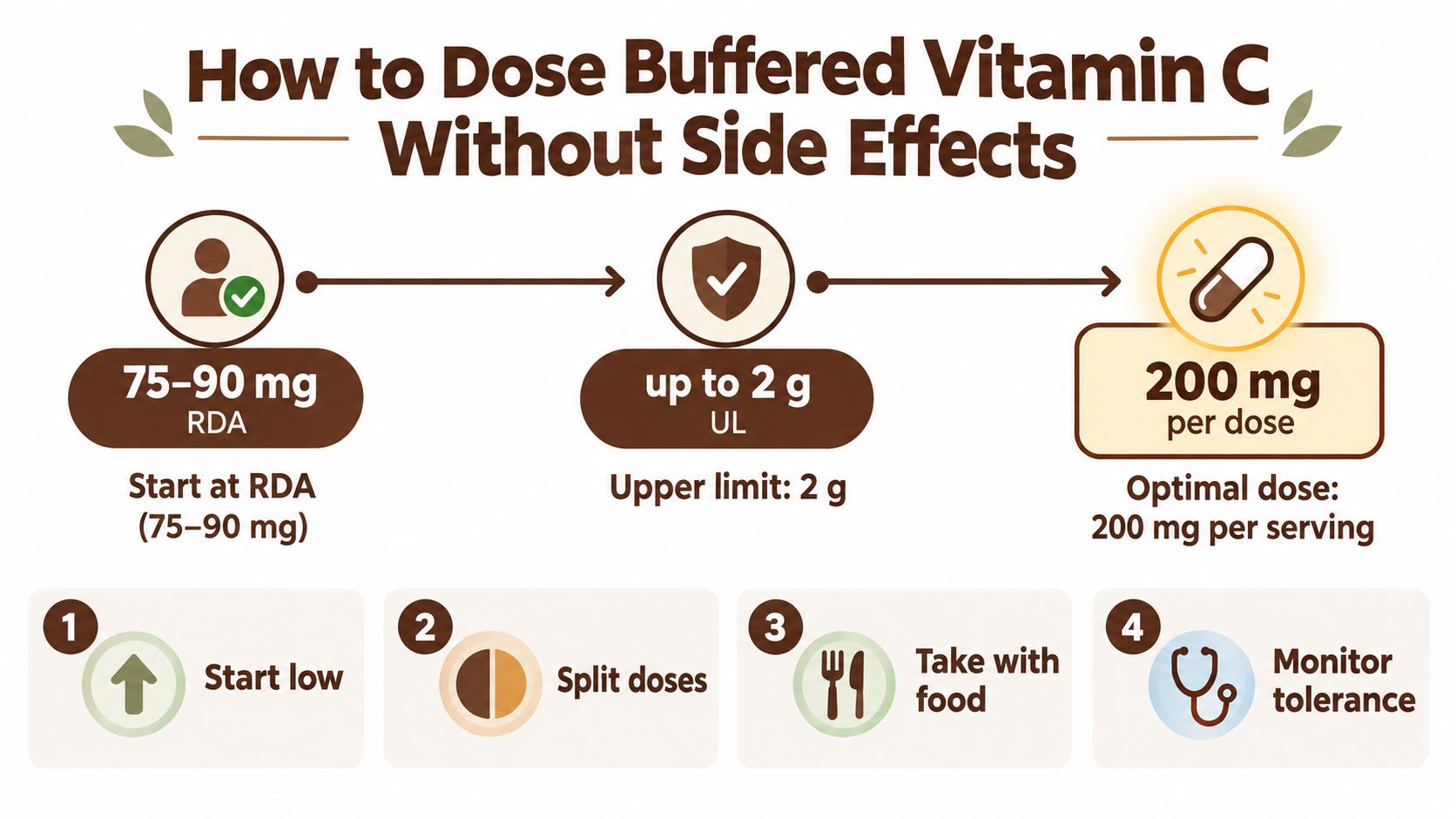
Start with your actual nutritional need rather than jumping immediately to a gram-level protocol. The adult recommended intake is 75 to 90 mg, and the tolerable upper intake level is 2 g, according to the NIH vitamin C fact sheet. Those figures describe broad intake guidance, not a personal prescription.
The next step is to think in servings, not just daily totals. Because absorption becomes less efficient as doses rise, a divided routine may be more comfortable and more efficient than taking the entire amount at once.
A practical schedule
If your goal is 1.5 g per day, an example schedule would be:
- Morning: 500 mg with breakfast.
- Midday: 500 mg with lunch.
- Evening: 500 mg with dinner.
This isn't a guarantee that the routine will suit everyone. It illustrates the central principle: divide a large daily target instead of taking it as one 1.5 g bolus.
The recent review of oral vitamin C tolerability describes dose-related symptoms including diarrhea, abdominal cramping, bloating, nausea, reflux, and gastric irritation. It also notes that large single boluses are more likely to cause problems than smaller divided doses. Buffered vitamin C may soften acidity-related discomfort, but it can't remove the effects of unabsorbed vitamin C remaining in the gut.
How to adjust your routine
Begin with a modest serving and increase gradually only if your body remains comfortable. If symptoms appear, step back to the last well-tolerated amount rather than pushing through diarrhea or cramping.
Taking the supplement with food may help people whose symptoms are driven by stomach irritation. Be cautious about adding several new supplements at the same time, because you won't know which product caused a reaction. Persistent reflux, severe abdominal pain, or ongoing diarrhea deserves medical attention rather than continued dose experimentation.
Forms You Will See on the Shelf
“Buffered vitamin C” isn't one single ingredient. The label may identify a mineral ascorbate, and that mineral changes the practical trade-offs.
| Form | Mineral per 1 g Vitamin C | Best For | Cautions |
|---|---|---|---|
| Calcium ascorbate | About 90 to 100 mg elemental calcium | People who want a calcium-containing form | Consider total calcium intake and kidney-stone history |
| Sodium ascorbate | About 125 mg sodium | People who tolerate sodium and want a less acidic form | May not suit low-sodium diets or fluid-restricted users |
| Magnesium ascorbate | About 50 to 60 mg magnesium | People whose routines already include magnesium | Account for total supplemental magnesium and digestive tolerance |
| Ester-C | Mineral ascorbate with threonate metabolites | People interested in a branded buffered format | Claims about extended retention have limited evidence |
The mineral amount can matter as much as the vitamin C amount. A sodium ascorbate product may be comfortable for your stomach but less suitable if you're carefully limiting sodium. Calcium ascorbate may fit one person's intake pattern and be a poor choice for another person with a history of calcium oxalate stones.
Ester-C is often marketed around retention, but the evidence base for that positioning is limited. A product name alone shouldn't substitute for checking the actual ingredient panel and deciding whether the added mineral fits your diet and medical history.
Read the label beyond the front panel
Look for the amount of actual vitamin C per serving, not only the total weight of the compound. Then check the mineral contribution, serving size, added ingredients, and whether the product uses a powder or capsule format.
If you're comparing ordinary and buffered products by cost or convenience, affordable Nutridom vitamin C supplements can serve as one example of a vitamin C product listing to evaluate alongside other options. The important comparison is the amount of vitamin C you receive, the form you can tolerate, and the schedule you'll realistically follow.
For readers comparing magnesium forms in other parts of a supplement routine, this guide to magnesium glycinate, citrate, and malate may help keep the mineral question separate from the vitamin C decision.
Safety, Interactions, and Who Should Be Cautious
Buffered vitamin C can reduce acidity, but it doesn't make high-dose supplementation risk-free. The main added issue is the mineral attached to the ascorbate, while high vitamin C intake itself may be unsuitable for people with particular kidney, iron, or medication concerns.
| Population | Primary Concern | Buffered Form to Watch | Precaution |
|---|---|---|---|
| History of calcium oxalate stones | Kidney stone risk and mineral handling | Calcium ascorbate, as well as high-dose vitamin C generally | Ask a clinician before using high doses |
| Iron overload or hemochromatosis | Vitamin C can affect iron handling | Any form | Use only with professional guidance |
| End-stage renal disease or dialysis | Reduced ability to manage mineral and metabolite loads | Calcium, sodium, and magnesium ascorbate | Consult the renal care team |
| Low-sodium diet or fluid restriction | Added sodium | Sodium ascorbate | Check the sodium amount per serving |
| People taking prescription medicines | Possible medication-specific interactions | Any form | Review the product with a pharmacist or clinician |
The NIH vitamin C guidance should be the starting point for understanding dose limits and health considerations. People with kidney-stone history, iron overload, advanced kidney disease, or strict sodium restrictions shouldn't treat buffering as a safety bypass.
Medication timing also deserves individual review. Vitamin C may interact with treatment plans involving warfarin, lipid-lowering medicines, or chemotherapy, and antioxidant timing during cancer treatment can be clinically complex. Don't change a medication schedule or add high-dose vitamin C without asking the prescribing clinician.
Mineral load is easy to overlook
At a 1,000 mg dose, sodium ascorbate contributes about 125 mg of sodium, as described in the verified evidence for buffered vitamin C. That amount may be relevant if you're tracking sodium carefully, even though the product is marketed primarily as a vitamin C supplement.
Calcium and magnesium forms create their own questions. Count them alongside minerals from food, fortified products, antacids, and other supplements. If you're considering more than 500 mg daily, or if you have a chronic condition or take prescriptions, discuss the switch with a qualified healthcare professional.
Choosing the Right Option for Your Routine
You can make the decision quickly by separating tolerance from absorption.
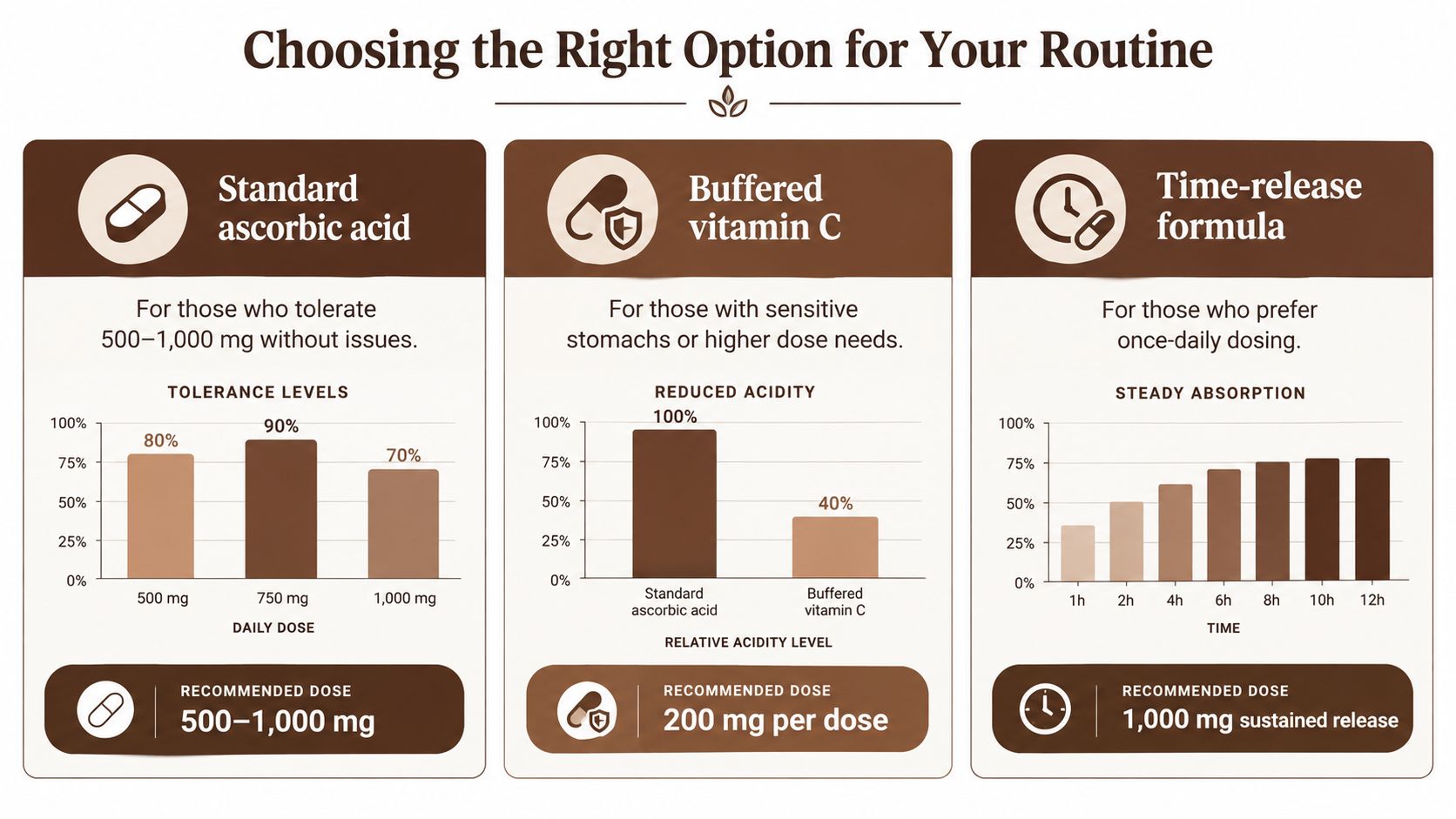
If ordinary ascorbic acid causes no symptoms at a moderate or higher serving, there's no clear clinical reason to switch just because a label says “buffered.” You're already using a form your stomach accepts, and the same intestinal transport limits still matter.
If regular vitamin C causes reflux, nausea, cramping, or loose stools, a mineral ascorbate is a reasonable option to consider. Start conservatively, take it with food, and divide the amount across the day. The goal is not to find the most impressive label. It's to find a preparation that lets you maintain a sensible routine.
Match the form to the person
Use these decision points:
- Comfort first: Choose buffered vitamin C when acidity, rather than vitamin C itself, appears to trigger your symptoms.
- Schedule second: If you're taking a larger daily amount, split it instead of relying on one concentrated serving.
- Mineral awareness: Check calcium, sodium, or magnesium contributions against your diet and medical needs.
- Label accuracy: Compare the actual vitamin C amount per serving, not just the total compound weight.
- Consistency matters: A lower dose you tolerate may be more useful than a larger dose you repeatedly abandon.
A buffered product won't solve every digestive problem. If symptoms continue after reducing the serving and taking it with food, stop experimenting and seek medical advice. The cell energy supplement guide covers a separate category of wellness products, so it shouldn't be used to justify escalating vitamin C.
Simple rule: Match the form to your stomach, then match the dose to your schedule.
REVETIX offers supplements and topical products focused on cellular energy, longevity, performance, and skin-focused routines, including products such as NMN and NAD+-oriented topical options. If you're building a broader wellness routine alongside a carefully tolerated vitamin C plan, visit REVETIX to review the available categories and product information.