


Most advice about full spectrum ashwagandha extract starts with a simple conclusion: broader is better. That conclusion is convenient, but it skips the questions that matter more to your body and your routine. How much of the extract has been identified, how consistently is it manufactured, and how much of its withanolide content reaches the bloodstream?
“Full spectrum” describes an extraction philosophy, not a guaranteed clinical outcome. A broad chemical profile can preserve compounds that may be useful, but it can also include a large amount of material that hasn't been characterized well. The most useful way to judge an extract is to connect its composition with batch consistency, validated testing, human pharmacokinetics, and clinical evidence.
Table of Contents
- The Truth About Full Spectrum Ashwagandha Extract
- Understanding Extraction Types and Standardization
- Bioavailability and Human Pharmacokinetics
- Clinical Benefits for Stress and Cortisol Regulation
- Delivery Formats and Synergistic Formulations
- Safety Boundaries and Special Populations
- How to Evaluate Supplement Labels and Quality
The Truth About Full Spectrum Ashwagandha Extract
A full spectrum extract usually aims to retain a wider range of compounds found in the source plant rather than isolating one constituent. That sounds desirable, especially for a botanical traditionally valued as a whole root. But chemical breadth and proven superiority aren't the same thing.
A 2026 review cited by HerbalGram notes that a full review suggested standard active ashwagandha extracts may contain 70% to 95% uncharacterized material (HerbalGram's review of ashwagandha). "Uncharacterized" doesn't mean harmful or useless. It means researchers and manufacturers haven't fully identified, measured, or linked that material to a specific effect.
What the label doesn't tell you
A broad extract may contain multiple withanolides and other plant constituents, yet the label might disclose only the plant name and total extract weight. That leaves several practical questions unanswered:
- Composition: Which plant part was used, and which compounds were measured?
- Consistency: Does each batch have a comparable chemical profile?
- Standardization: Is a marker compound, such as total withanolides, controlled within a defined range?
- Exposure: Has the finished formulation been studied in people, or has only the raw ingredient been analyzed?
A full spectrum label can therefore be a useful starting point, but it shouldn't end the evaluation. A product that preserves more compounds may offer a broader chemical profile, while a more narrowly standardized extract may offer better reproducibility. Neither description, by itself, proves that one product will deliver a better experience.
Practical rule: Treat “full spectrum” as a description of what the manufacturer intends to preserve, not as a certificate of quality or effectiveness.
Why standardization matters
Standardization gives manufacturers a measurable target. Withanolides are a family of naturally occurring compounds used as important markers in ashwagandha testing, but a disclosed percentage still doesn't tell you everything about absorption or clinical performance.
The strongest formulation question is therefore not “Does this say full spectrum?” It's “Can the manufacturer show what is characterized, how it is measured, and whether the finished product behaves predictably in humans?” That shift moves the conversation away from marketing language and toward quality control.
Understanding Extraction Types and Standardization
Think of ashwagandha extraction like coffee preparation. Brewing the whole ground bean produces a complex drink containing many compounds. Isolating caffeine produces a much narrower ingredient with a more defined chemical identity. Neither approach is automatically superior, because the right choice depends on the intended use, the desired consistency, and the evidence behind the final preparation.
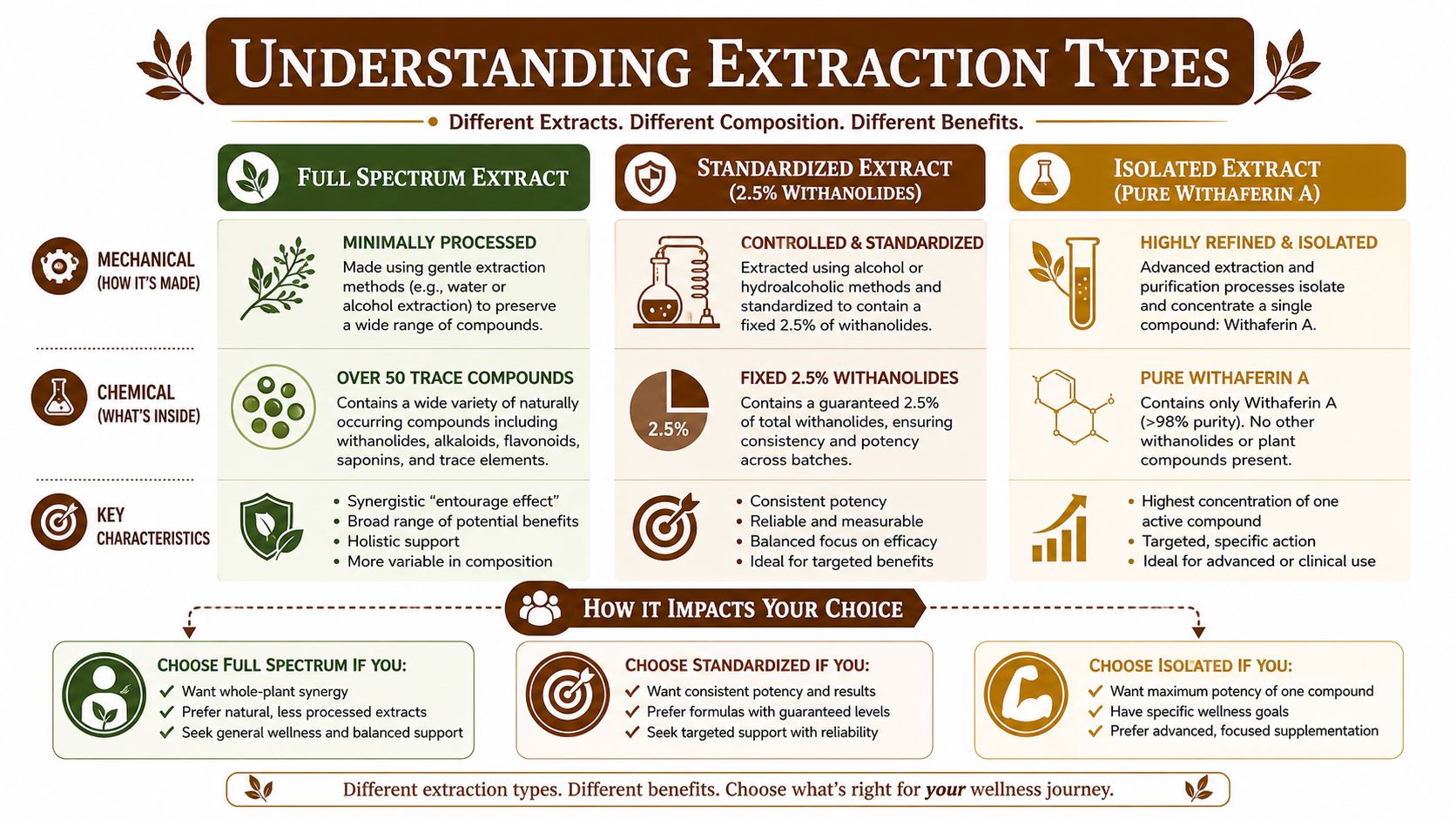
A full spectrum extract attempts to retain a broad selection of plant constituents. A standardized extract is adjusted or selected to provide a defined level of measured markers, often total withanolides or a specified withanolide profile. An isolated extract focuses on a particular compound rather than the wider botanical matrix.
The categories can overlap. A product may be described as full spectrum while also being standardized to a marker level. That combination can make the label more informative than a product that lists only “ashwagandha extract” and a total weight.
The role of withanolides
Withanolides are steroidal lactones naturally found in ashwagandha. Manufacturers commonly use laboratory methods such as high-performance liquid chromatography, or HPLC, to identify and quantify selected compounds. The result may appear on a label as a percentage, such as a product standardized to 2.5% withanolides, or as a named withanolide-glycoside profile.
One NIH-reviewed trial used tablets standardized to 2.5% withanolides, with 500 mg per tablet and 5 mg of piperine (the NIH-reviewed ashwagandha extract literature). Other extracts described in the verified literature have been standardized to 35% withanolide glycosides, 40% total withanolides, or more than 5% total withanolides. These percentages aren't interchangeable because they may refer to different chemical groups and different extraction technologies.
A label that says “30:1,” for example, describes the relationship between the starting plant material and the finished extract. It doesn't automatically tell you the withanolide concentration, the absorbed dose, or whether the extract matches a clinical trial.
Choosing a practical format
If you want to compare a conventional capsule with a product such as a soy-free ashwagandha supplement, check the extract identity, plant part, standardization, and testing information rather than comparing capsule weight alone. A gummy format can be easier to take, but palatability doesn't replace composition and quality data.
The same principle applies to combination products. Himalayan Shilajit Gold Gummies are described in the supplied product information as a gummy blend containing shilajit, ashwagandha, and minerals. That makes the complete ingredient panel and the testing of the finished blend important, because you're evaluating a formula rather than an isolated ashwagandha extract.
Bioavailability and Human Pharmacokinetics
The percentage printed on an ashwagandha label describes concentration in the product. Bioavailability describes what becomes available to the body. Those are related, but they aren't identical.
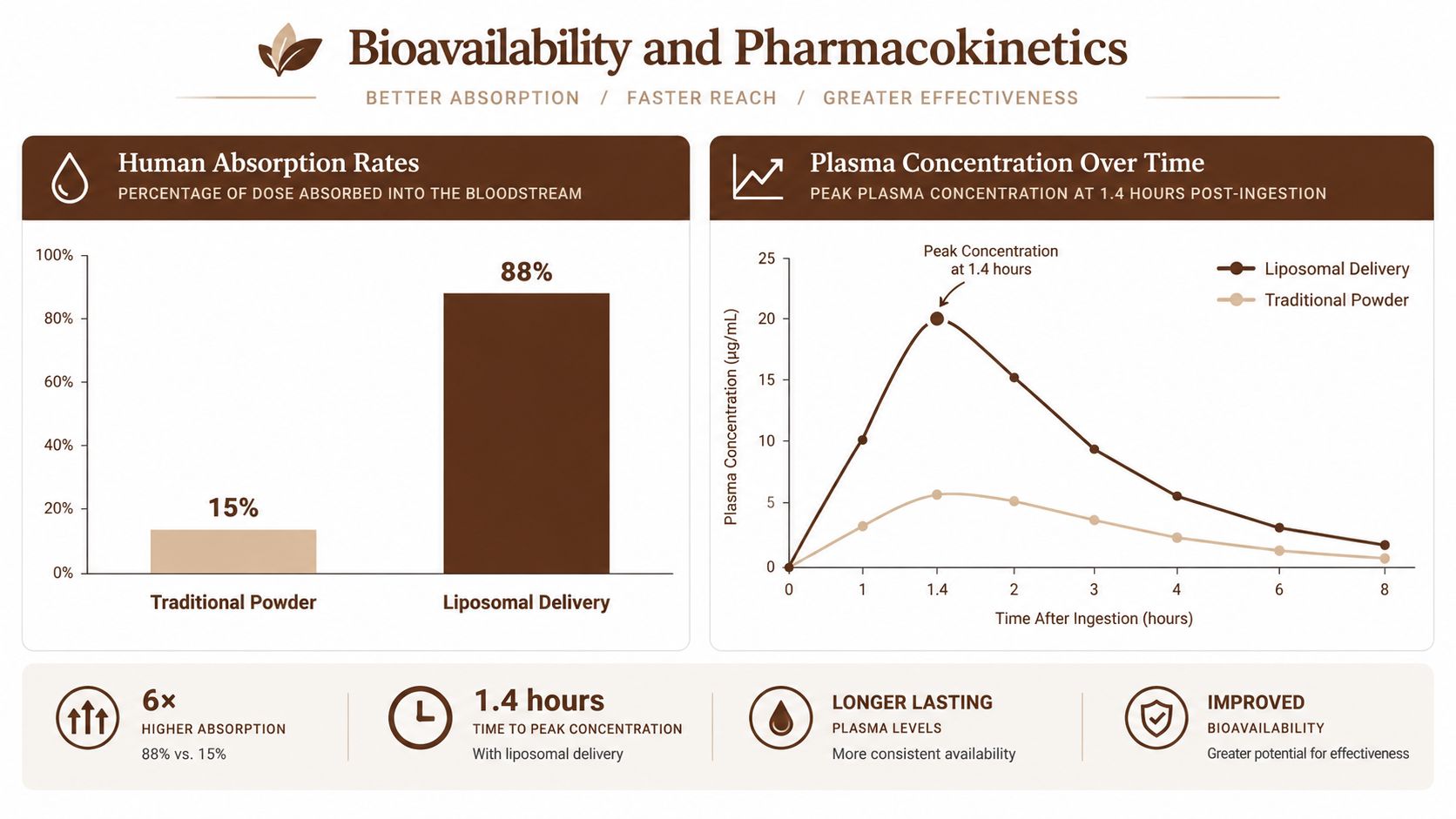
Human pharmacokinetic research makes this distinction clear. In a randomized, double-blind, four-way crossover study involving 16 healthy adults, an extract standardized to 35% withanolide glycosides reached significantly higher maximum plasma concentrations and a longer half-life than extracts standardized to 2.5% to 5% withanolides or 10% withanolide glycosides. When investigators compared plasma exposure per milligram administered, the 35% extract was reported as 280.74 times more bioavailable than the 2.5% extract (the human pharmacokinetic study and related extract analysis).
Reading AUC without the jargon
Researchers often use area under the curve, or AUC, to represent total exposure over a period of time. You can think of it as the amount of a compound present in the bloodstream across the full measurement window, rather than a single snapshot.
Maximum concentration tells you how high the level rises. Half-life describes how long the compound remains measurable before the level declines. AUC adds another piece of the puzzle by showing the overall exposure. For a supplement formulator, these measures are often more informative than the number of milligrams listed on the front of a bottle.
The research also shows why a lower labeled percentage isn't automatically weak. A separate 2025 crossover study in 20 healthy adults found that a novel extract standardized to 1.5% produced significantly higher total plasma withanolides than 500 mg and 600 mg reference products at most measured time points. The formulation's absorption behavior mattered more than the percentage alone.
What to ask about a formulation
Piperine, glycoside composition, extraction conditions, particle characteristics, and other formulation decisions can change exposure. That doesn't mean every absorption enhancer is appropriate for every person, and it doesn't mean a laboratory result guarantees a particular clinical benefit. It means the finished product should be judged as a delivery system, not just as a pile of plant material.
A functional medicine guide from Lifeworks Integrative Health can provide additional context for readers comparing ashwagandha formulations with black pepper. Keep the distinction clear: an ingredient combination may influence absorption, but the relevant evidence should come from the specific finished formulation.
For the same reason, a product such as Liposomal Glutathione belongs to a separate delivery-format discussion. “Liposomal” describes a delivery approach, not proof that a full spectrum ashwagandha extract has the same absorption characteristics.
Clinical Benefits for Stress and Cortisol Regulation
The best-established clinical conversation around ashwagandha concerns stress-related outcomes and cortisol, but the evidence belongs to specific extracts, doses, study designs, and populations. Results from one preparation shouldn't automatically be transferred to every capsule labeled ashwagandha.
A 2013 randomized, double-blind, placebo-controlled trial evaluated a high-concentration full spectrum ashwagandha root extract in adults experiencing stress over 60 days. By Day 60, the treatment group showed significant improvements across all stress-assessment scales, and serum cortisol fell significantly compared with placebo, with a reported p-value of 0.0006. The study described adverse effects as mild and comparable between groups (the full clinical trial report).
That finding supports a measured conclusion. A standardized full spectrum root extract can produce meaningful changes in tested stress and cortisol endpoints under controlled conditions. It doesn't prove that every full spectrum product will produce the same result, nor does it establish that a broader chemical profile is always better than a targeted extract.
What users may reasonably expect
Stress scores and cortisol are different kinds of outcomes. A questionnaire captures how participants experience stress. A blood measurement captures a biological marker at particular points in time. When both move in a favorable direction, the result is more informative than either measure alone, but it still doesn't answer every question about sleep, anxiety, mood, or long-term health.
Recent reviews continue to discuss potential benefits for stress, anxiety, and related outcomes, while also emphasizing heterogeneity, publication bias, and limitations in study quality. That means consumers should be cautious with sweeping promises, especially when a product has not been tested in a trial of its own.
A clinical result belongs to the extract and protocol that produced it. The plant name on a different label isn't enough to assume equivalence.
Daily consistency may matter for people evaluating an extract, because a one-time subjective response tells you less than a sustained, clearly monitored routine. However, consistency should never mean ignoring new symptoms or taking a product indefinitely without considering personal health conditions.
For readers comparing adaptogens by intended use, the Peptoro peptide adaptogen research offers a broader comparison framework. A separate discussion of Rhodiola rosea versus ashwagandha may also help clarify why the choice should follow the person's goal, tolerance, and overall formula rather than a single “strongest adaptogen” claim.
Delivery Formats and Synergistic Formulations
The most convenient format is not automatically the most effective. A capsule usually makes the serving size and ingredient list easy to inspect. Powder can suit people who already mix supplements into drinks, but taste, texture, and inaccurate scooping may reduce consistency. Gummies are easier to take and often more palatable, yet sweeteners and added ingredients can leave less room for a meaningful amount of extract.
Transdermal patches and creams require a separate standard of evidence. Avoid assuming that an ashwagandha product applied to the skin produces the same systemic exposure as an oral extract. Unless human pharmacokinetic data exist for the finished topical product, results from oral preparations cannot be transferred directly.
Comparing the practical trade-offs
| Format | Main advantage | Main question to ask |
|---|---|---|
| Capsules | Defined serving and simple storage | Is the extract standardized and independently tested? |
| Powder | Flexible use and familiar preparation | Can you measure the serving and verify the active profile? |
| Gummies | Easy use and pleasant taste | How much ashwagandha and how much added material does each serving contain? |
| Topical products | Alternative to oral use | Has the finished product shown meaningful absorption in humans? |
Combination formulas make quality assessment more demanding. Shilajit, minerals, and ashwagandha may be placed in one product for people seeking daily energy and stress support, but evidence for one ingredient does not validate the entire blend. Review each active ingredient, its dose, its form, and any available testing.
The Himalayan Shilajit Gold Gummies product information presents a single-serving gummy format. Because several ingredients share that serving, request the Supplement Facts panel and batch-testing documentation. Confirm the ashwagandha extract identity, dose per gummy, and whether the listed material is characterized beyond a broad plant name.
The best delivery format is one you can use consistently while verifying the dose, extract identity, and safety of the whole formula.
Delivery technology should remain separate from ingredient identity. The discussion of liposomal coenzyme Q10 shows why a formulation's transport system and its active compound require separate evaluation. For ashwagandha, prioritize human absorption data for the finished product over a delivery claim alone. A polished format cannot compensate for an uncharacterized extract or an undisclosed dose.
Safety Boundaries and Special Populations
“Natural” describes an origin, not a safety guarantee. A broader extract may contain more chemically diverse material, but that doesn't remove the need for screening, especially when the product is used daily or combined with medication.
A 2026 critical review states that evidence remains limited in special populations, including pregnant women, older adults, and people with chronic disease. The same body of recent review literature warns about important risks for pregnant people, individuals with thyroid disorders, and those with liver or kidney dysfunction, and it reports multiple cases of liver damage (the critical review of ashwagandha safety).
Situations that require extra caution
- Pregnancy: Avoid self-directed use. Safety evidence in pregnancy is limited, and recent reviews identify pregnancy as a population requiring particular caution.
- Thyroid conditions: Discuss the product with a clinician before use, particularly if you have a thyroid disorder or take thyroid medication.
- Liver or kidney problems: Don't assume that a full spectrum product is appropriate. Existing dysfunction can change how the body handles supplements, and liver injury has been reported in the recent safety literature.
- Chronic disease: Ask a physician or pharmacist to review the complete formula, especially when prescription treatment is involved.
- Medication use: Sedatives, thyroid medicines, immune-modifying medicines, and other chronic therapies warrant a professional interaction check rather than guesswork.
The appropriate response to a possible adverse reaction is to stop and seek medical advice, particularly if symptoms suggest liver or thyroid problems. Don't increase the serving just because the first few days produce no noticeable effect, and don't use a complex blend to conceal uncertainty about the dose.
Why “cycle” advice needs context
People often recommend cycling adaptogens, but the safest routine depends on the extract, the reason for use, the duration, and the person's health status. Cycling isn't a substitute for medical review, and it doesn't make an unsuitable product appropriate for pregnancy, thyroid disease, liver dysfunction, kidney dysfunction, or significant chronic illness.
A responsible label should make it possible to identify the extract and serving rather than encouraging users to chase a stronger sensation. If the manufacturer can't explain what was tested, how it was standardized, or who should avoid it, the product doesn't provide enough information for confident long-term use.
How to Evaluate Supplement Labels and Quality
Start with the ingredient panel, not the front-of-pack promise. A trustworthy label should help you identify the plant material, extraction type, serving size, marker standardization, and other active ingredients. “Full spectrum” can be meaningful, but only when the manufacturer explains what that phrase represents in the finished product.
Use this checklist before buying:
- Identify the plant material. Look for the botanical name and the plant part used. If the label merely says ashwagandha without describing the material, ask the manufacturer for clarification.
- Find the standardization. Check whether the label discloses total withanolides, withanolide glycosides, or another measurable marker. A ratio alone doesn't answer this question.
- Separate extract weight from active content. A large milligram number may describe the total extract rather than the amount of characterized compounds.
- Ask for testing documents. Look for a batch-specific certificate of analysis and testing for identity, potency, contaminants, and heavy metals.
- Check the analytical method. Validated HPLC or LC-MS/MS methods can provide more useful information than a vague statement that the product was “lab tested.”
- Review the entire formula. Assess every herb, mineral, enhancer, sweetener, and delivery aid, especially if you take prescription medication.
- Check manufacturing details. Clear contact information, batch identification, and manufacturing standards make it easier to investigate a problem or verify consistency.
The buyer's decision rule: Prefer the product whose composition, testing, and human evidence you can actually evaluate, not the product with the most impressive wording.
A label-reading framework used for another supplement category, such as this guide on how to choose an NMN supplement, can be adapted here. The same discipline applies: separate the stated amount from the measurable active, distinguish marketing language from verification, and match the product to your own health context.
The practical conclusion is straightforward. A full spectrum ashwagandha extract may be a reasonable option, but “full spectrum” isn't the final quality judgment. Look for characterized material, reproducible standardization, human exposure data, transparent testing, and a safety profile appropriate for you.
REVETIX offers dietary supplements and topical products in formats that include capsules, gummies, creams, and patches, with products featuring ingredients such as ashwagandha, shilajit minerals, Rhodiola rosea, NMN, NAD+, and glutathione. Visit REVETIX to review the available formulations and compare their ingredient information with the quality checklist above.