


You're standing in the pet food aisle, holding two bags that look almost identical. One says “natural,” the other has a long ingredient list with names you can't pronounce, and both promise healthy nutrition. That's where most dog owners get stuck, because a dog food additive can sound either reassuring or suspicious depending on the word on the label.
The confusion makes sense. Some additives are there to protect fat from going rancid, some help a food meet nutrient targets, and some make a formula more appealing so a dog will eat it. The problem is that people often lump all of those together, then mix them up with processing contaminants or packaging residues that aren't the same thing at all.
A calmer way to look at it is this, purpose, dose, and regulatory path matter more than whether a word sounds natural or synthetic. If you learn what an additive is doing, where it appears on the label, and whether it fits the rules for that use, the label stops feeling like a warning sign and starts reading like a map.
Table of Contents
- Introduction Why Dog Food Additives Confuse Every Owner
- What a Dog Food Additive Really Is and Why It Is Added
- The Main Types of Dog Food Additives and What Each One Does
- How Dog Food Additives Are Regulated for Safety in the United States
- Common Misconceptions About Dog Food Additives and What Evidence Shows
- How to Read Labels and Choose Safer Dog Food Additives
- Conclusion Making Confident Choices About Dog Food Additives
Introduction Why Dog Food Additives Confuse Every Owner
A shopper lifts a pouch of kibble, scans the ingredient statement, and pauses at words like “mixed tocopherols,” “citric acid,” or “potassium chloride.” The label rarely explains whether those names help the food stay stable, support nutrition, or improve taste. That gap is what makes many owners wonder if an unfamiliar term is a warning sign.
The confusion is understandable, because pet food ingredients now form a large commercial category. The global pet food ingredients market was valued at USD 37.8 billion in 2025 and is projected to reach USD 64.5 billion by 2035 (Global Market Insights). Within that broader market, functional additives occupy a separate role. They help complete dog foods do their job, even though they are not the main source of calories.
A calmer reading starts with three buckets, nutrition, preservation, and sensory function. One additive may protect fats from turning rancid, another may supply minerals, and another may make the food smell and taste acceptable to a dog. Processing contaminants and packaging residues are different issues, and they should not be folded into the same conversation as ingredients that are intentionally added for a purpose.
Dose, purpose, and regulatory pathway matter more than whether a label sounds natural or synthetic. A term that looks technical can still point to a useful function, while a familiar-sounding ingredient can still be irrelevant or used at the wrong level. Once you learn to ask what the additive is for and how it fits into the formula, the label becomes easier to read and much less alarming.
What a Dog Food Additive Really Is and Why It Is Added
A dog food additive is not the same as the main ingredient that supplies calories. Bread offers a useful comparison. Flour and oats provide the bulk, while salt, yeast, and vitamin fortification adjust texture, shelf life, and nutrient balance. Dog food works the same way.
Function first, not mystery first
Additives are used because a complete and balanced pet food has to do several jobs at once. It has to stay safe on the shelf, stay appealing enough for a dog to eat, and deliver nutrients that may not be present in enough quantity in the raw ingredients alone. Those ingredients are grouped by role, such as vitamins and minerals, enzymes, probiotics and prebiotics, flavors and colorants, and preservatives, because each one serves a different purpose in the formula.
A useful comparison is a pantry shelf where flour and rice provide calories while salt and yeast adjust texture and shelf life. Nobody expects the salt to be the main meal. It has a job, and that job matters when it is used correctly.
Practical rule: judge an additive by what problem it solves, not by how technical the name looks.
That lens matters because the same compound can serve different functions in different formulas. One ingredient may be added to help nutrient balance in a diet, while another keeps fat from oxidizing during storage. The difference is not cosmetic. It changes how the food performs in practice, from the factory line to the bowl.
You will sometimes see supplement-style products borrow this language too, including items such as Himalayan Shilajit Gold Gummies, which are described as combining minerals and adaptogenic ingredients for human wellness routines. That kind of product language shows how often brands frame ingredients by function rather than chemical identity.
Why dose matters as much as identity
A safe additive is not only about the name, it is about the amount and purpose. A small amount of a nutrient can be helpful, while the wrong use level can be inappropriate for a specific species or formulation. That is why the label conversation has to move past “what is it called?” and into “why is it there?”
Processing contaminants and packaging residues belong in a different conversation. They are not the same as ingredients that are intentionally added to do a job. That distinction helps separate a functional additive from an unwanted byproduct, which is where much of the confusion starts.
The Main Types of Dog Food Additives and What Each One Does
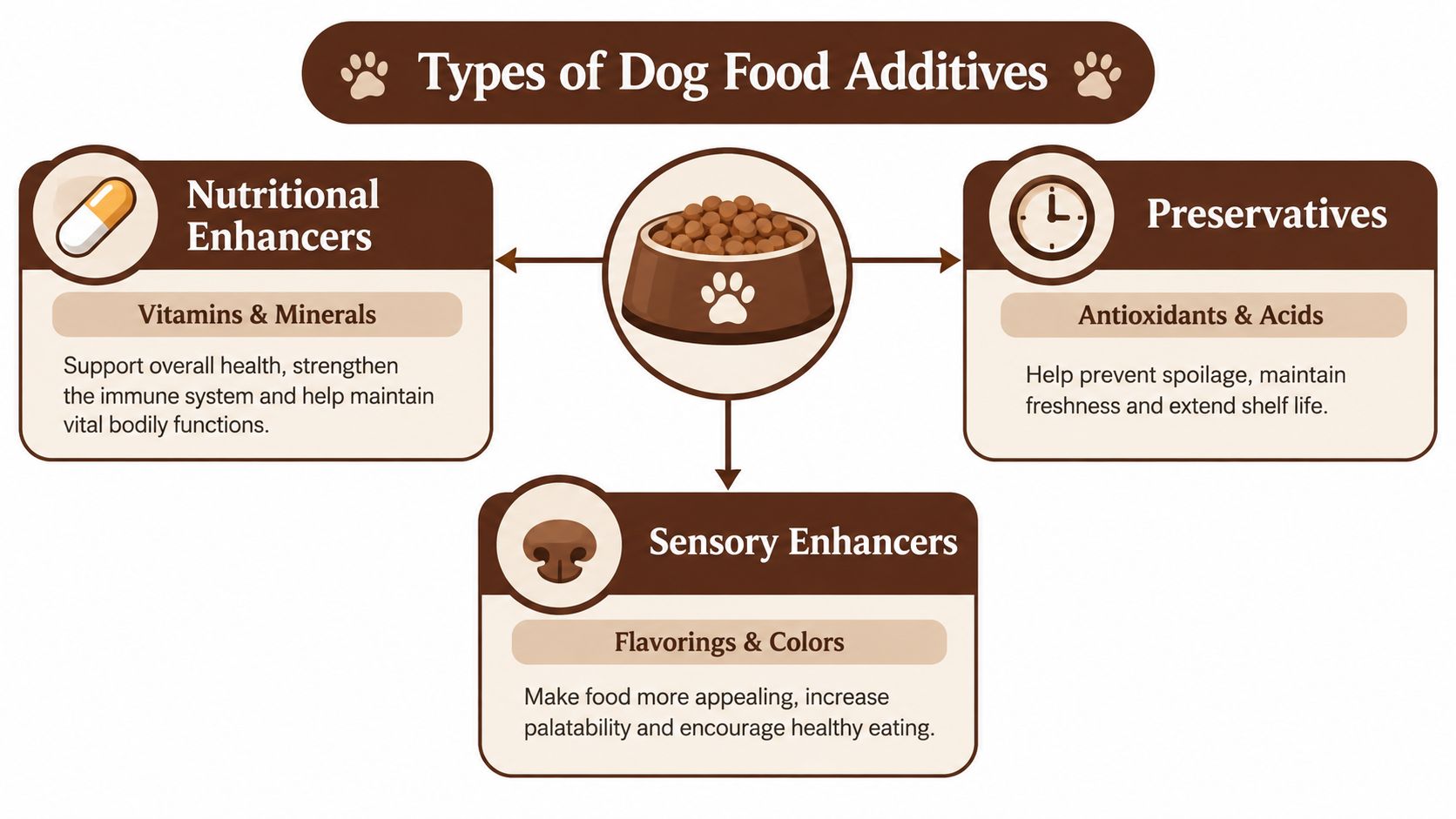
A label can list several additive types, but they usually fall into three jobs. Some build the nutrient profile, some keep the food from going stale, and some help a dog accept the meal. Once you see those roles separately, the list is easier to read.
Nutritional enhancers
Vitamins and minerals are the clearest example. They are added to help the finished food meet its intended nutrient profile, especially when ingredient batches naturally vary. If a diet is meant to be complete, this category matters because the dog eats the finished formula, not the raw ingredients on paper.
That is also why a product such as NMN Supplement can be described in human wellness terms while pet food follows a different standard. In dog food, a vitamin or mineral additive exists to support the stated diet, not to impress with a familiar-sounding ingredient list.
Some products also highlight longevity-focused nutritional support, which shows how brands use the same general idea in a different context. In pet food, the question is still whether the added nutrient has a clear role in the formula.
Preservatives that protect freshness
Preservatives are often the group owners worry about most. Antioxidant preservatives slow the oxidation of fats, which matters in kibble and other foods that contain more fat. Antimicrobial preservatives help reduce the chance that a food spoils too quickly after opening or during storage.
If cooking oil has ever smelled stale, the problem is familiar. A food can look balanced on the label and still lose quality if the fats are not protected.
Sensory enhancers that affect acceptance
Flavors and palatability enhancers help a dog accept the food. Dogs do not read ingredient panels, so the food still has to smell and taste appealing enough to eat. Colorants change appearance, mostly for human perception rather than canine need. That does not make every colorant harmful, but it does show that the purpose is cosmetic, not nutritional.
Quick distinction: if an ingredient changes the nutrient profile, it serves a different job from one that protects shelf life or improves smell.
Here is a simple comparison:
| Additive group | Main job | What owners should ask |
|---|---|---|
| Nutritional enhancers | Fill nutrient gaps | Does the formula still meet the dog's needs without overdoing one nutrient? |
| Preservatives | Slow spoilage and rancidity | Is the food especially fat-rich or shelf-stable? |
| Sensory enhancers | Improve acceptance | Is the food relying on taste tricks instead of a solid base formula? |
That is more useful than trying to sort every additive into “good” or “bad” by name alone. A better question is whether the ingredient supports the food's purpose without creating a separate problem.
How Dog Food Additives Are Regulated for Safety in the United States
A safe additive is not only a question of chemistry, it is also a question of legal pathway. In the United States, that framework has developed over time. Congress amended the FD&C Act in 1958 to require FDA review and approval of food additives before marketing, and FDA guidance tied to the Food Safety Modernization Act, enacted in 2011, says GMPs apply to all animal feeds and pet foods (FDA).
The three legitimate pathways
A dog food additive generally has to fit one of three routes. It can be approved as an animal food additive, be generally recognized as safe for the intended use, or fall under AAFCO-defined ingredient pathways. If it does not fit, the food containing it can be considered unsafe and adulterated under FDA regulation (AAFCO).
The key point is that safety is judged by intended use, not by chemical identity alone. The same compound can be acceptable in one formulation and unlawful in another if the dose, species, or technical purpose changes. That is why documentation matters so much for manufacturers.
How manufacturing controls fit in
FDA's 2024 guidance for AAFCO-defined ingredients says FDA generally does not intend to initiate enforcement action for ingredients listed in the 2024 AAFCO Official Publication, provided the ingredient is not otherwise an unapproved food additive or safety concern. That shows the system is not just about a single approval stamp. It also depends on recognized ingredient definitions and manufacturing standards.
The practical result is straightforward. A company has to show that an additive is safe for the intended animal-use condition, that the label identity is right, and that the food is made under controls that keep the finished product consistent.
| Pathway | What It Means | Key Requirement | Example Implication |
|---|---|---|---|
| Approved animal food additive | Formal FDA approval for use in animal food | Approval for the intended use | The additive cannot just be popular, it has to be authorized |
| GRAS | Generally recognized as safe for the intended use | Evidence of safety and proper intended use | A compound may be fine in one diet and not another |
| AAFCO-defined ingredient | Ingredient fits a recognized AAFCO definition | Label identity and acceptable use under the framework | Enforcement is tied to the listed ingredient and safety context |
That same species-and-use logic is why a product like REVETIX Astaxanthin – Ultra Antioxidant & Longevity Support can be discussed as a human supplement ingredient, while pet food additives have to clear a different regulatory path before they can appear in a dog's bowl.
Common Misconceptions About Dog Food Additives and What Evidence Shows
The biggest myth is that synthetic equals dangerous and natural equals safe. That's too blunt to be useful. A recent systematic review and meta-analysis covering 60 additive studies and 39 preservative studies found pooled risk differences near zero and Bayes factors supporting no adverse effects within regulatory limits (PubMed). That doesn't prove every additive is harmless in every setting, but it does push the conversation toward dose and context instead of fear.
What the evidence actually asks you to look at
The question is not whether a name sounds artificial. It's whether the additive is approved for that use, whether the exposure stays within regulatory limits, and whether the food is formulated in a way that makes the additive appropriate. In plain terms, a preservative in a fat-rich kibble has a different role than the same ingredient used elsewhere.
The risk question changes when the dose changes.
That's why public debates often miss the point. A food can contain an ingredient people dislike while still being built within safety boundaries. The opposite can happen too, where a “natural” label distracts from poor formulation, weak quality control, or contamination from the manufacturing process.
Additives are not the only thing people should worry about
A second confusion is mixing up functional additives with processing contaminants. Recent reporting on 79 dog foods found dry kibble had the highest levels of arsenic, lead, cadmium, and mercury, with acrylamide and a plastic-related phthalate detected mainly in dry foods (CNN). That doesn't mean every kibble is unsafe, but it does show that the more actionable risk may sometimes come from processing or packaging rather than from the additive list people focus on first.
That's why the label conversation has to be broader than “no synthetic ingredients.” A preservative listed clearly on a bag is often easier to evaluate than a contaminant that enters through heat processing or packaging contact. If you want a useful mental shortcut, compare the ingredient panel with the production story, not just the marketing words.
For a broader ingredient-safety lens, the healthy aging supplements a science-based guide to key ingredients offers a useful reminder that evidence, dose, and intended purpose matter more than buzzwords in any product category.
How to Read Labels and Choose Safer Dog Food Additives
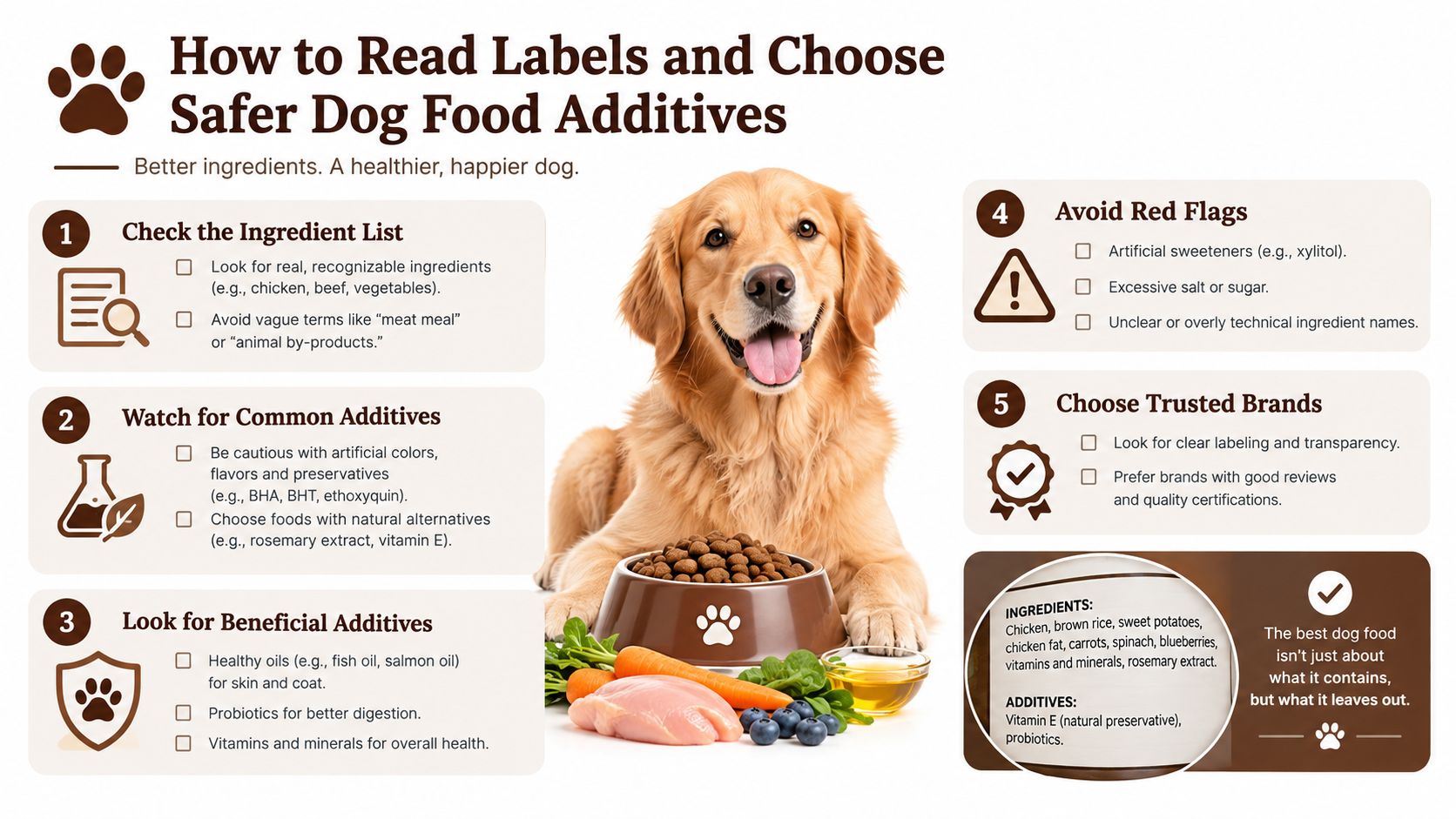
A bag can sound reassuring on the front and still leave you guessing once you turn it over. The ingredient statement is the part that tells you what the formula uses and whether the additive list is clear enough to interpret.
A two-minute scan that actually helps
Start by locating the additive names in the ingredient list and asking what each one is doing. A preservative should read like a preservative, a flavoring should read like a flavoring, and a nutrient-support ingredient should fit the food's stated purpose. If the label relies on broad wording, you have less to judge.
Then compare two foods with a similar format. In fat-containing diets, for example, a clearly described preservation system is easier to assess than a product that never explains how freshness is protected. That does not automatically make one food better, but it does make the label more transparent.
Complete and balanced matters too. Additives should support that promise, not stand in for it. If a formula seems to need a lot of sensory help to look appealing, the label deserves a closer look.
Questions worth asking before you buy
- What job is this additive doing? If the purpose is hard to explain, the label may be too vague.
- Is the ingredient listed specifically? Clear naming gives you more to work with than catch-all wording.
- Does the product explain its preservation system? That matters more in fats and moisture-rich foods.
- Is this a medical or sensitive-diet product? If yes, talk to your veterinarian before changing foods.
For a practical label-reading companion outside pet food, the guide to reading dog supplement labels shows how much you can learn from ingredient order, naming, and dosage context when a brand is transparent.
When to get veterinary input
If your dog has a known sensitivity, a history of food reactions, or a medical diet, additive choice should not be guesswork. The right additive for one dog may be a poor fit for another, depending on health status and diet goals. That is especially true when the food is meant to manage a condition rather than feed a healthy pet.
The same habit applies if you are comparing human wellness labels. The cell energy supplement is a useful example of how to look past branding and focus on the ingredient's role.
Conclusion Making Confident Choices About Dog Food Additives
A dog food additive is only confusing when it's treated like one giant category. Once you separate nutrition, freshness, and palatability, the label becomes much easier to read. Once you add the regulatory lens, you can see why purpose, dose, and intended use matter more than whether a name sounds natural or synthetic.
The most useful rule is simple. Look for clear ingredient naming, a credible preservation system, and a food that fits your dog's needs without leaning on marketing language alone. If the label feels vague, that's a signal to slow down, not to panic.
The bigger lesson is that not every concern on a pet food label comes from an additive. Some risks live in processing, storage, or packaging, which is why owners do better when they read broadly and ask better questions. That habit protects you from both fear-based marketing and overconfident claims.
Keep this standard in mind the next time you buy food, complete, balanced, clearly labeled, and appropriate for your dog's life stage and health needs. That's the kind of label literacy that turns anxiety into informed choice.
If you want products designed with ingredient clarity and formulation purpose in mind, explore REVETIX. The brand's lineup includes human supplements and topical products built around specific actives, so it's a practical place to compare how ingredient purpose and label transparency show up in a different wellness category.