


What if the difference between two anti wrinkle cream Q10 jars isn't the brand name on the front, but whether the formula can move coenzyme Q10 past the skin barrier and into living tissue? That question matters because Q10 isn't just a decorative “anti-aging” add-on, it's a cell ingredient with a job, and its results depend heavily on how it's delivered.
Table of Contents
- What Q10 Actually Does Inside Your Skin
- What an Anti Wrinkle Cream with Q10 Can and Cannot Do
- What the Clinical Studies on Q10 Creams Actually Show
- How Formulation Decides Whether Q10 Reaches the Dermis
- How to Read an Anti Wrinkle Cream Q10 Label Like a Formulator
- Common Misconceptions Shoppers Should Drop
- Realistic Timelines and Expected Outcomes
- Choosing the Right Q10 Cream for Your Skin Goals
What Q10 Actually Does Inside Your Skin
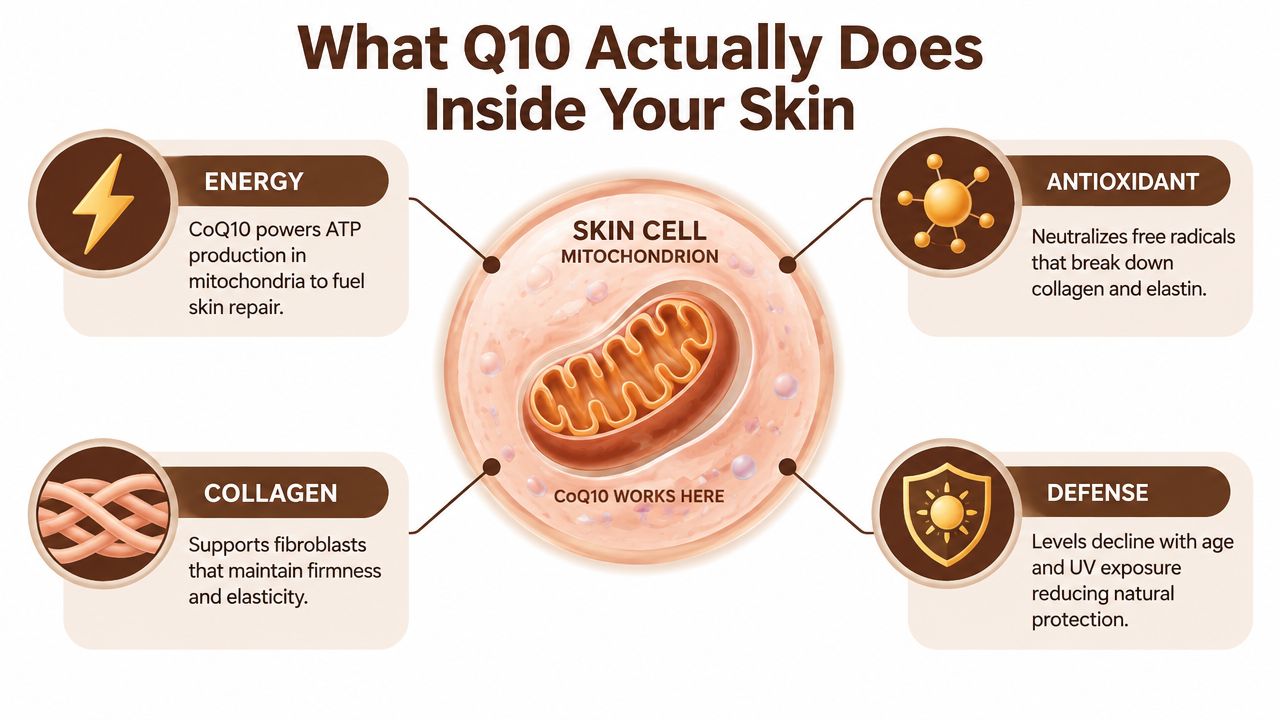
Coenzyme Q10, often shortened to CoQ10 or called ubiquinone, sits at the center of skin cell energy production and antioxidant defense. Beiersdorf says its Q10 skincare work started in the 1990s, and that NIVEA was the first brand to introduce Q10 skin care cream in 1998. That timeline matters because it shows Q10 did not appear as a passing trend, it became part of a mainstream anti-aging category and has been studied in skin products for decades. The same company also says its Q10 products have been tested on over 60,000 study participants. Beiersdorf's Q10 innovation timeline
Why skin cells care about Q10
Inside skin, Q10 acts as a redox-active mitochondrial cofactor and a lipid-phase antioxidant. In plain English, it helps cells manage energy transfer and helps protect lipids and cell structures from oxidative stress. That matters because skin aging is not only about what you see on the surface, it also reflects how well cells keep up their repair work.
Fibroblasts, the cells that support firmness through collagen and elastin, need energy to do that job well. When oxidative stress rises or Q10 levels fall, the skin's repair system works less efficiently. The peer-reviewed literature cited in the skin-aging review notes that skin Q10 levels decline with age and UV exposure, which is why topical Q10 is framed as a way to partly restore what time and sun exposure take away. Skin penetration and aging review
The catch is delivery. Q10 is useful only if the formula carries it past the outer barrier into viable skin layers. If it stays on the surface, it still belongs in the cream, but its role is closer to a supportive add-on than a true cellular ingredient.
That distinction explains why two jars can look similar and perform very differently. The ingredient has a clear biological role, yet the formula decides whether it can do that job inside skin.
What an Anti Wrinkle Cream with Q10 Can and Cannot Do
A good anti wrinkle cream Q10 can support the skin, but it can't do everything the marketing copy implies. The strongest case for Q10 is as an antioxidant-supportive ingredient, not a deep wrinkle eraser. Independent review literature says CoQ10 can penetrate the epidermis, reduce oxidative stress, and improve wrinkle-related measures, while also stressing that formulation details matter and that the evidence base is still limited compared with the language used in ads. Independent review on topical CoQ10
The benefits that make sense
In practice, Q10 is most believable when it's sold as a cream that helps skin look a little smoother, less tired, and more resilient. That usually means it may help with fine lines linked to dehydration and oxidative stress, and it may support a healthier-looking surface over time. The clinical literature also includes human trials and formulation studies showing wrinkle-related improvement, but the magnitude is generally modest, not dramatic.
That's why Q10 sits differently from stronger resurfacing ingredients. It doesn't rebuild lost facial volume, and it doesn't replace procedures for deeper lines. If a product page promises immediate transformation, that's a warning sign, not a strength.
For readers comparing options, a separate resource like age-related wrinkle remedies can help place Q10 alongside other approaches instead of treating it like the only answer. And if you're also sorting through supplement-style content, the internal guide on healthy aging supplements and key ingredients is a useful adjacent read.
A product such as NAD+ Cream belongs in this broader conversation as a topical moisturizing option, but that doesn't make it a wrinkle remover by default. The question is whether its formula supports delivery, tolerance, and consistent use.
Bottom line: Q10 can help a routine feel more supportive and less irritating, but it's not a substitute for retinoids, sunscreen, or in-office treatment when those are the better tools.
What the Clinical Studies on Q10 Creams Actually Show
What do the human studies on topical CoQ10 really show? The peer-reviewed evidence is encouraging, but it is easy to read too much into it. One cited double-blind study reported that a 1% Q10 cream used for 5 months reduced wrinkle score grade. Another clinical trial found improved wrinkle outcomes after 12 weeks with a formula containing water-soluble CoQ10. The research summary also describes a Q10-loaded skin formulation tested in 25 healthy female volunteers, with skin penetration, hydration, and anti-wrinkle activity. Clinical CoQ10 skin studies review
The pattern across these studies is more useful than any single headline. The benefits showed up with consistent use over weeks or months, not overnight. The formula also mattered, because these trials used defined delivery vehicles rather than a random cream base. And the outcomes were practical ones, like wrinkle scores, wrinkle depth, or smoothness, which are much closer to what shoppers can expect than broad “younger-looking skin” promises.
A few study details help explain why two Q10 jars can behave differently:
| Study | Concentration | Duration | Key Finding | Notes for Buyers |
|---|---|---|---|---|
| Double-blind topical Q10 trial | 1% | 5 months | Reduced wrinkle score grade | Longer use mattered |
| Water-soluble CoQ10 clinical trial | Not stated in verified data | 12 weeks | Improved wrinkle outcomes | Vehicle and delivery likely important |
| Q10-loaded skin formulation | Not stated in verified data | Not stated in verified data | Good penetration, hydration, anti-wrinkle activity in 25 volunteers | Small human study, useful but limited |
| Oral CoQ10 dose-response study | 0 mg, 50 mg, 150 mg daily | 6 and 12 weeks | Measured periorbital wrinkle area | Shows how rigorously Q10 can be studied, but it isn't topical data |
For a buyer, the takeaway is straightforward. Q10 creams can help, but the size of the effect depends on the formula, the duration, and the person using it. A jar that includes CoQ10 is only the starting point. The question is whether that formula can carry the ingredient into skin layers where it has a chance to do useful work.
How Formulation Decides Whether Q10 Reaches the Dermis
Why can one anti wrinkle cream q10 feel promising on paper and still act like a simple moisturizer? Because Q10 is a lipophilic molecule, and skin is built to keep many substances out. The question is not only whether coenzyme Q10 is present, but whether the formula can move it past the outer barrier and into the layers where skin cells can use it.
The penetration literature shows that topical CoQ10 can reach beyond the stratum corneum into viable skin layers, yet the vehicle changes the result in a meaningful way. In one ex vivo study, most of the applied CoQ10 penetrated skin within hours from a hydrophilic cream, and earlier human-skin work found that CoQ10 in an ethanol base reached the living epidermis and even the dermis. Skin penetration and formulation review That is why two jars with the same headline ingredient can behave very differently.
The three levers that change performance
First, vehicle. Oils, silicones, and water-in-oil emulsions can hold a lipophilic ingredient better than a weak aqueous base, so the active stays where the skin can absorb it.
Second, encapsulation. The delivery-system review shows that carriers such as lipid nanocapsules and liposomal systems can shift CoQ10 toward the epidermis and superficial dermis, the zone where fibroblast support becomes more plausible. Delivery systems review It works less like sprinkling ingredient on the surface and more like placing it into a carrier that helps it pass the gate.
Third, concentration and stability. A Q10 cream only performs if enough active survives manufacturing, storage, and application. Opaque or air-restrictive packaging helps, and a formula with pre-solubilized Q10 usually tells you more than a product that lists the ingredient without explaining how it is carried.
A practical example from another topical delivery format is Liposomal Glutathione, which reflects the same basic idea, the carrier can matter as much as the ingredient name.
Practical rule: two creams can list Q10 and still perform very differently if one protects the molecule and the other leaves it sitting in an ordinary base.
How to Read an Anti Wrinkle Cream Q10 Label Like a Formulator
A Q10 label gives away more than the front claim. Start by finding ubiquinone or ubiquinol in the ingredient list. Their position only gives a rough clue, but it still helps you judge whether the formula likely contains enough of the active to matter.
Then look for the delivery system. Q10 is lipophilic, so a cream needs a vehicle that can carry it through the formula and toward skin layers where it can do more than sit on the surface.
What to look for first
- Position matters: if Q10 sits near the end, the amount may be small.
- Form matters: ubiquinone is usually the steadier cream form, while ubiquinol can oxidize more easily.
- Support matters: antioxidant partners such as vitamin E or vitamin C can signal a formula built as a system, not as a single-ingredient promise.
- Packaging matters: jars let in more air and light than opaque or air-restrictive packaging.
- Claims matter: if the page promises only glow and softness, but gives no clue about concentration or delivery, the formula is doing less talking than the marketing.
A useful comparison point is REVETIX anti-aging moisturizing cream, because it gives shoppers a concrete example of how a moisturizer can be evaluated as a formula, not just by a headline claim. That is the habit to build here. Ask how the ingredient is carried, protected, and positioned in the list. Those details often separate a basic moisturizer from a better-built Q10 cream.
Common Misconceptions Shoppers Should Drop
Q10 gets wrapped in a lot of oversimplified claims. The first myth is that it erases deep wrinkles the way a retinoid can. It doesn't. The second is that a higher percentage automatically means better results, but delivery and stability can matter more than raw concentration.
Another common mistake is assuming oral CoQ10 gives the same skin result as a topical cream. The research brief here includes oral dose-response studies, but topical and oral routes are not interchangeable in how they reach skin tissue. A fourth misconception is that natural ubiquinone is always superior to synthetic. The skin doesn't care about marketing language, it cares about whether the active is stable, absorbable, and usable in the formula.
Two more claims to be skeptical of
Instant tightening is usually a texture effect, not proof of genuine anti-wrinkle performance. Silicone, film formers, and dehydration can create that feeling. And Q10 cannot replace daily broad-spectrum sunscreen, because UV exposure is one of the drivers of Q10 depletion in skin in the first place. The ingredient can support defense, but it can't undo ongoing sun damage on its own.
If a product sounds like a shortcut around sunscreen, retinoids, or realistic timelines, it's probably overselling itself.
Realistic Timelines and Expected Outcomes
What should you expect from anti wrinkle cream Q10? Usually, gradual change rather than a dramatic reset. Human studies point to wrinkle-related improvements after steady use over weeks to months, which matches how antioxidant skincare tends to work. Clinical CoQ10 skin studies review
What tends to show up first
Early changes are often easier to feel than to prove in a photo. Skin may feel smoother, look less dull, and hold moisture better, especially when the formula is well made and the rest of the routine supports it. Some studies also found that hydration, dermis thickness, and TEWL did not change significantly, so results can be selective rather than universal. Q10 skin study PDF
| Timeframe | Realistic Visible Change | Underlying Reason | Confidence Level |
|---|---|---|---|
| A few weeks | Slightly better comfort, softer feel | Surface hydration and barrier support | Moderate |
| Around 8 to 12 weeks | More consistent smoothness, subtle fine-line softening | Antioxidant support builds with regular use | Moderate |
| Several months | Modest wrinkle-score improvement in some users | Sustained delivery and ongoing use matter | Moderate |
| Deep wrinkles or laxity | Limited change | Q10 is not a structural remodeling ingredient | Low |
The form of the cream matters here. A well-designed vehicle can help Q10 reach living skin layers, while a weak one may leave it mostly on the surface, like a nutrient locked in the wrapper instead of inside the food.
Q10 fits best as part of a routine built around cleanser, sunscreen, and a stronger corrective active when appropriate. It makes the most sense for maintenance, early photoaging, and supportive antioxidant care. For pronounced volume loss or deep expression lines, expectations should stay modest.
Choosing the Right Q10 Cream for Your Skin Goals
Start with the goal, not the jar. Q10 can support prevention, mild softening, or a routine built around antioxidants, but the result depends on whether the formula can carry the ingredient past the surface. Two creams can list Q10 and still perform very differently, like two umbrellas that look alike but one leaks in rain.
If your goal is prevention, a well-made Q10 cream can fit. If you want modest fine-line softening, formulation details matter even more. For deep crease correction, a different ingredient class usually deserves first place.
A simple buyer framework
- Define the job. Prevention, fine-line softening, and deeper correction call for different tools.
- Match the texture. Light emulsions suit some skin types, richer creams suit others.
- Check the formula. Look for Q10 form, signs of delivery support, and whether the cream is built for stability.
- Fit it into the routine. Day formulas should work with SPF, while night formulas should support repair without adding irritation.
For shoppers comparing anti-aging without irritation, anti-aging without irritation is a useful lens because barrier comfort can determine whether a cream stays tolerable enough to use consistently. For a broader comparison of moisturizers, the guide to best anti-aging moisturizing cream can help you sort texture, ingredient mix, and positioning.
The decision rule is simple. Choose Q10 when you want supportive antioxidant care, pair it with stronger actives when visible correction is the aim, and keep expectations modest if your main concern is deep structural change. REVETIX offers topical and supplement formats that fit broader longevity routines, including a moisturizing cream option, so shoppers can compare a Q10-style skincare approach against other cellular-energy-focused products at REVETIX.