


Which anti stress supplement matches the kind of strain you're feeling, rather than the one that's trending? After a rough week, it's understandable to want a capsule that makes the pressure ease. But a supplement can't change a deadline, caregiving load, or workplace conflict. At most, the right ingredient may support a specific part of your response, such as mood, relaxation, or sleep, and the fit depends on your health and the product's formulation.
That distinction matters because “stress” can mean an acute spike of tension, ongoing pressure that interferes with recovery, or exhaustion that calls for broader support. Those patterns aren't interchangeable, and neither are the products sold under one broad label. Start by naming the change you want: fewer tense evenings, steadier mood, or better recovery after a demanding day.
Table of Contents
- What an Anti Stress Supplement Actually Does
- How Stress Works Inside Your Body
- The Main Ingredient Families and How Each One Works
- The Most Researched Ingredients and What the Evidence Shows
- How to Choose a Quality Formulation
- Safety, Interactions, and When to See a Clinician
- A Practical Four-Week Trial Protocol
- Choosing the Right Anti Stress Supplement for You
What an Anti Stress Supplement Actually Does
Acute stress is the immediate response to a demand, such as a difficult meeting or an unexpected problem. It can sharpen attention for a while, then ease when the situation passes. Chronic stress is different: pressure persists, recovery gets squeezed, and sleep or mood may suffer. Burnout can involve deeper exhaustion and reduced capacity, and a supplement shouldn't be treated as a substitute for addressing the conditions behind it.
An anti stress supplement doesn't remove the source of pressure. Depending on its ingredients, it may support normal nervous-system function, relaxation, or mood, but results vary and shouldn't be assumed to treat a mental health condition. That's why “calming” and “stress support” aren't precise descriptions by themselves. A clear product label should identify its ingredients and amounts so you can assess what it's intended to support.
A useful first step is to describe your pattern in everyday terms. Do you feel keyed up in the moment, worn down across the day, or unable to settle at bedtime? A product aimed at relaxation may not suit someone seeking daytime alertness, while an energizing formula may be a poor fit if jitteriness is already the problem.
Practical rule: Choose around the symptom you want to support, not the broad promise on the front of the bottle.
Stress can also reflect problems that need more than a supplement. If work pressure or burnout is affecting daily life, a resource such as Be Your Best Self Thrive Counseling on can help you think through the role of counseling and other support. A supplement may be one small part of a plan, not the plan itself.
How Stress Works Inside Your Body
Think of the hypothalamic-pituitary-adrenal, or HPA, axis as part of your body's thermostat for the stress hormone cortisol. When your brain detects a demand, this system helps coordinate a response. Cortisol isn't always harmful: it helps the body mobilize energy and respond to challenges. The aim isn't to eliminate it, but to maintain a response that can rise when needed and settle afterward.
A thermostat analogy makes the difference clearer. If the system is repeatedly activated and doesn't get enough time to reset, ordinary demands can feel harder to manage. That doesn't mean a supplement can reliably reset the HPA axis or lower cortisol for everyone. It means the stress response involves several connected systems, and any ingredient claim should be judged by what was studied and in whom.
Neurotransmitters help carry messages between nerve cells. GABA is often described as a brake because it helps restrain excessive nervous-system activity. Serotonin contributes to mood regulation, while norepinephrine supports alertness and attention. These systems interact; no single ingredient can be assumed to switch one on or off in a simple, predictable way.
That's why both calming and alertness-supporting ingredients may be discussed in stress products. A person who feels tense at night has a different goal from someone who feels drained during the day. The ingredient family can provide a clue about the intended pathway, but the label, evidence, and personal risk profile still matter.
The Main Ingredient Families and How Each One Works
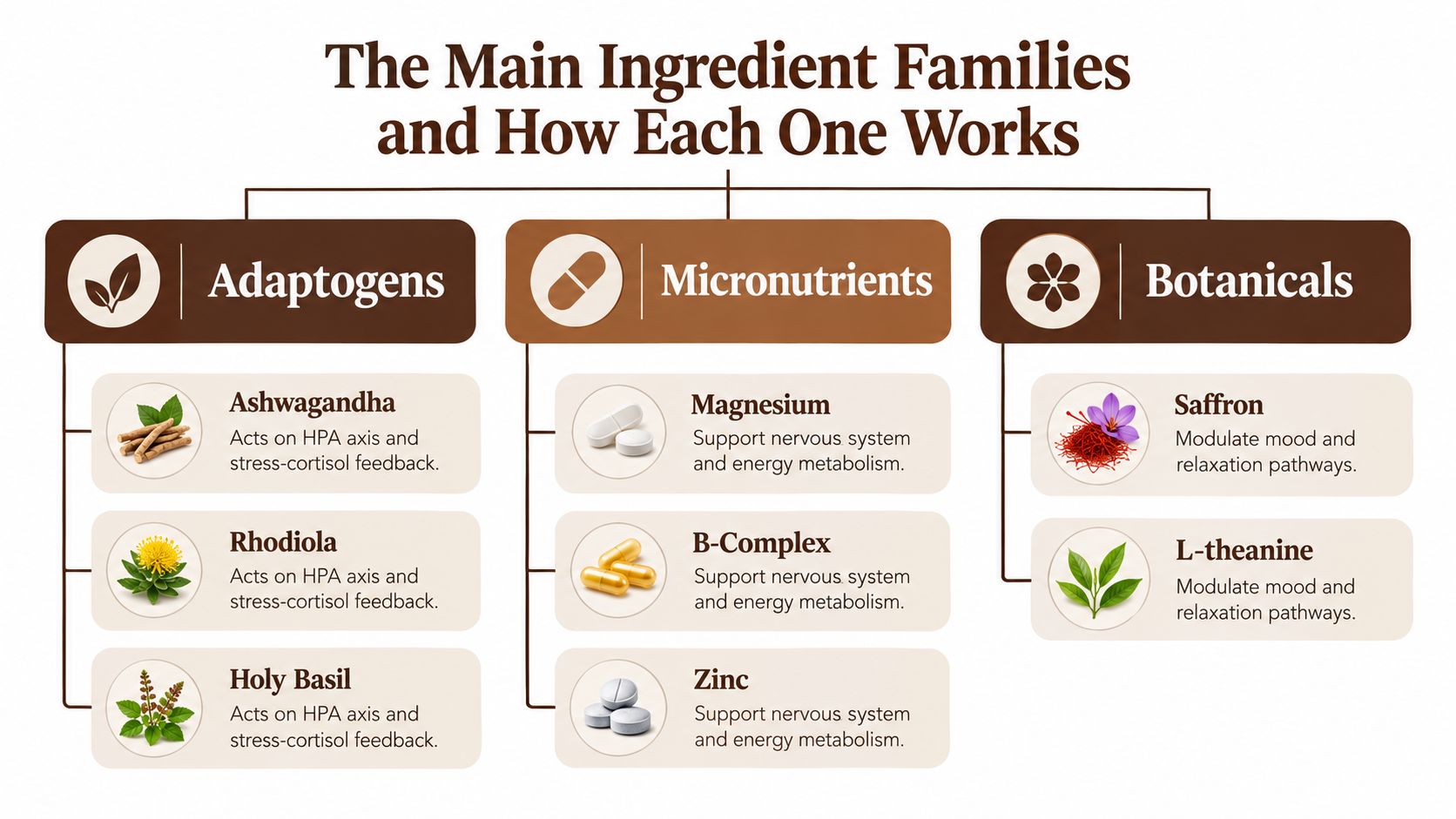
Ingredient labels become easier to read when you group products by their broad purpose. Adaptogens such as ashwagandha, rhodiola, and holy basil are commonly positioned for the body's response to ongoing demands. The research doesn't establish that every adaptogen works the same way, or that an “adaptogen” label guarantees a benefit. Think of this family as a prompt to check the specific extract, dose, evidence, and safety information.
Micronutrients such as magnesium and B vitamins support normal processes that the nervous system uses. If someone's intake or status is inadequate, correcting that gap may matter. But the presence of a nutrient in a formula doesn't show that a person is deficient, or that taking more will reliably ease stress. Magnesium deserves special label attention: look for the amount of elemental magnesium, not just the weight of its compound.
Botanicals and amino acids are another broad group. Saffron is studied for mood-related outcomes, while L-theanine is often used in products positioned for relaxation. The mechanisms and strength of evidence vary, so don't infer a proven effect from a familiar ingredient name alone. For sleep-driven stress, ask whether the formula is intended for evening use and whether its ingredients might cause drowsiness.
A simple choice framework helps: identify whether the main issue is tension, low mood, inadequate nutrient intake, or sleep disruption; then compare products designed for that goal. If magnesium forms are confusing, this guide to magnesium glycinate, citrate, and malate can help you understand how labels distinguish them.
The evidence base isn't equally developed across all ingredients. Saffron has a defined body of trial evidence, while familiar names on a crowded supplement shelf may have less directly relevant support. Use the ingredient family as a map, not as proof that a product will work for you.
The Most Researched Ingredients and What the Evidence Shows
How can you tell whether a supplement study applies to the product on a shelf? Start by comparing extract identity, daily dose, study population, and duration. These details work like the settings on a recipe: change the preparation or amount, and the result may not carry over. Match the evidence to your stress profile rather than choosing an ingredient because it is popular.
Saffron and ashwagandha
A systematic review identified five randomized controlled trials involving 379 participants across three countries studying saffron stigma extract. In a four-week trial of 121 adults with low mood but no diagnosed depression, 28 mg/day reduced total mood disturbance versus placebo, including stress- and anxiety-related symptoms (P < 0.001; Cohen's d = −1.10). The same trial found no significant treatment effect at 22 mg/day. A broader review of 46 randomized trials reported improvements versus placebo in anxiety and sleep outcomes, although formulations and trial durations varied. Together, these findings support cautious discussion of saffron for wellness, not a claim that it treats an anxiety disorder. (Saffron evidence review)
The NIH's ashwagandha review reports short-term improvements in validated stress and anxiety scores, sleep problems, fatigue, and cortisol compared with placebo. Most of the evidence covers only roughly three months, so it cannot establish long-term effects or guarantee that every product will work similarly. Readers exploring the overlap between stress support and hormone-related health can review adaptogens for women's hormonal health.
Magnesium and supporting ingredients
Magnesium is involved in processes related to stress regulation, but that biological role alone does not establish a consistent effect from supplementation. A systematic review of 18 studies found positive anxiety outcomes in some studies involving anxious participants, people with premenstrual syndrome, and people with hypertension. None used a validated subjective-stress measure as its primary outcome.
A separate randomized study of 264 adults found that magnesium alone reduced the DASS-42 stress score by approximately 42.4% over eight weeks, compared with 44.9% for magnesium plus vitamin B6. Among participants with severe stress and low serum magnesium, the combination produced a 24% greater reduction than magnesium alone. Those results describe the study groups, not a predictable response for every person. (Magnesium review and randomized study)
The practical question is whether the research fits the person and formulation. B vitamins and zinc support normal body processes, but that does not show that adding them relieves stress when there is no relevant nutritional need. Rhodiola and L-theanine also appear in stress products; for an overview of the research, see this guide to rhodiola rosea health benefits. The evidence cited here does not establish a specific effect size or dose recommendation for either ingredient.
For a comparison with a single-ingredient option, REVETIX SUPER™ Capsule is described as a multi-ingredient longevity capsule that includes saffron. Its inclusion does not show that the finished formula produces the same effects as a saffron-only trial. Ingredient names are clues to investigate, not proof that the complete product has been tested in the same way.
How to Choose a Quality Formulation
Start with the facts on the label, not the number of ingredients. A product should identify each active ingredient and its amount. If it uses a botanical extract, look for the plant name and extract details; if it contains magnesium, check whether the elemental amount is stated. Without those details, it's difficult to compare the product with research or assess how much of each ingredient you'd be taking.
A proprietary blend is a problem when it hides individual amounts. A long list can appear thorough while leaving you unable to tell whether an ingredient is present at a meaningful amount. More ingredients also make it harder to identify what caused a benefit or an unwanted effect if you start several products at once.
Third-party quality checks can offer another piece of the picture. Look for a clear explanation of what testing or certification applies, rather than assuming a logo guarantees effectiveness. Also review inactive ingredients and the delivery form. A product's format may affect how it's taken and tolerated, but marketing language about absorption isn't a substitute for transparent formulation details.
| Check | Why It Matters | What to Look For |
|---|---|---|
| Ingredient identity | Different extracts may not be interchangeable | Named plant, form, and extract details |
| Dose disclosure | Lets you compare products and evaluate exposure | Amount for each active ingredient |
| Mineral labeling | Compound weight can obscure nutrient content | Elemental magnesium amount |
| Blend transparency | Hidden amounts make evaluation difficult | No undisclosed proprietary blend |
| Quality testing | Helps clarify what checks were performed | Specific, verifiable testing information |
| Safety information | Supports a decision based on your circumstances | Warnings, interactions, and appropriate use |
With a multi-ingredient formula, ask whether several disclosed ingredients match your goals or make the label look busy. Transparency is more useful than an impressive ingredient count. If you're comparing ashwagandha products, this guide to full-spectrum ashwagandha extracts can help you focus on what the extract description says.
Safety, Interactions, and When to See a Clinician
Could a supplement affect more than stress? “Natural” doesn't mean safe for everyone. An ingredient may alter alertness, digestion, thyroid function, or how a medicine works. In a multi-ingredient formula, identifying what caused an unwanted effect can be like tracing one instrument in a crowded orchestra.
Ashwagandha shows why safety deserves separate attention from efficacy. The NIH review discussed in the evidence section above notes possible thyroid effects, medication interactions, drowsiness, gastrointestinal effects, and rare but serious liver problems.
Talk with a clinician before starting a product if you're pregnant or breastfeeding, have liver or thyroid disease, have a hormone-sensitive condition, or take prescription medication, especially psychiatric medication. Ashwagandha may interact with thyroid medicines or sedatives. Alcohol can add to drowsiness from sedating products. If a formula contains vitamin K2, consult a physician before using it if you take blood thinners. Over-the-counter availability does not mean an ingredient suits your circumstances.
Warning signs and support
Stop taking the product and seek medical advice if you develop jaundice, dark urine, severe itching, unusual nausea, marked fatigue, palpitations, or significant mood changes. These symptoms call for medical attention, not a dose adjustment or a switch to another product.
Supplements cannot replace care when stress persists or disrupts work, relationships, sleep, or daily responsibilities. Workplace pressure may be easier to address with a mental health professional. You can find therapy for workplace pressure as one way to explore that support.
A Practical Four-Week Trial Protocol
A supplement trial works better when you change one thing at a time. Before you begin, write down what you want to improve and record your usual experience. Without a baseline, a good or bad day can easily be mistaken for a product effect.
Set up a simple record
Choose one product and follow its label directions. Take it at a consistent time so that changing timing doesn't muddy the result. Some people prefer calming products in the evening; if a formula makes you drowsy, don't take it before driving or tasks that require alertness.
Keep a short daily log with three entries:
- Sleep quality: Rate how rested you feel using the same personal scale each day.
- Stress: Note a brief score or description, along with any obvious trigger.
- Morning energy: Record whether you feel restored, unchanged, or more tired than usual.
After two weeks, compare your notes with your baseline. Don't focus on one unusually good or poor day. Look for a pattern and note any adverse effects, changes in routine, or other factors that may explain what you feel.
At the end of four consistent weeks, decide whether the product seems helpful, unhelpful, or difficult to tolerate. If there's no meaningful improvement, the product, dose, or ingredient class may not match your needs. That doesn't mean you failed, and it doesn't justify adding several new ingredients at once. A clear trial gives you more useful information than changing products randomly.
Stop sooner and contact a clinician if you develop concerning symptoms or suspect an interaction. And if stress is substantially affecting daily life, don't wait for a supplement trial to end before seeking support.
Choosing the Right Anti Stress Supplement for You
Which stress pattern are you hoping to change? Start there, then assess whether an ingredient's proposed role, evidence, and safety fit your circumstances. Someone who struggles to wind down in the evening might compare relaxation-focused options. Persistent exhaustion calls for a wider look at sleep, workload, nutrition, and possible clinical factors before choosing an energizing product. Popularity alone is a poor guide.
| Your main pattern | What to consider | What to check |
|---|---|---|
| Evening tension or trouble settling | A relaxation-focused option, such as magnesium or a calming botanical | Elemental dose, tolerability, and possible drowsiness |
| Low mood alongside stress | Saffron stigma extract as an area to evaluate | Extract identity, dose, and limits of the trial evidence |
| Possible nutrient shortfall | A nutrient-focused approach | Diet, health context, and clinician advice where appropriate |
| Many goals at once | A transparent multi-ingredient formula | Disclosed amounts, interaction risks, and whether each ingredient suits you |
Use the label like a clinician would: connect each ingredient to a specific goal, then check whether its amount and formulation make sense for you. If your main pattern suggests a possible nutrient shortfall, ask a clinician to check your magnesium status before buying rather than dosing blindly.
Supplements may support normal nervous-system function or stress resilience. They do not diagnose or treat an anxiety disorder, and they do not replace professional care. As the magnesium evidence above showed, the right choice depends on matching the ingredient to your own needs, not assuming a supplement works the same way for everyone.
Before buying, confirm that ingredients and amounts are disclosed. Consider your health conditions and medications, and decide how you'll assess whether the product helps. If you're unsure about interactions or symptoms persist, ask a clinician rather than relying on a label to answer a medical question.
Your next step: Name the pattern you want to change, check the formula and its safety, then assess whether it fits your needs.
REVETIX offers SUPER, a multi-ingredient longevity formula with disclosed ingredients and no caffeine or stimulants. It is not a treatment for stress or anxiety. If you're considering a broader supplement routine, visit REVETIX to review the product details and safety information before deciding whether it fits your needs.