


Why does a label that says Alpha Lipoic Sustain sound like a stronger supplement, when difference may only be how fast the capsule empties into your bloodstream? That question matters because the word sustain can make people assume potency, when it often points to delivery design instead.
Alpha lipoic acid, usually shortened to ALA, is the active molecule. Sustain means the product is built to release that molecule more slowly. It is a faucet turned on full versus a slow drip. The water is the same, but the flow changes how long it stays coming out.
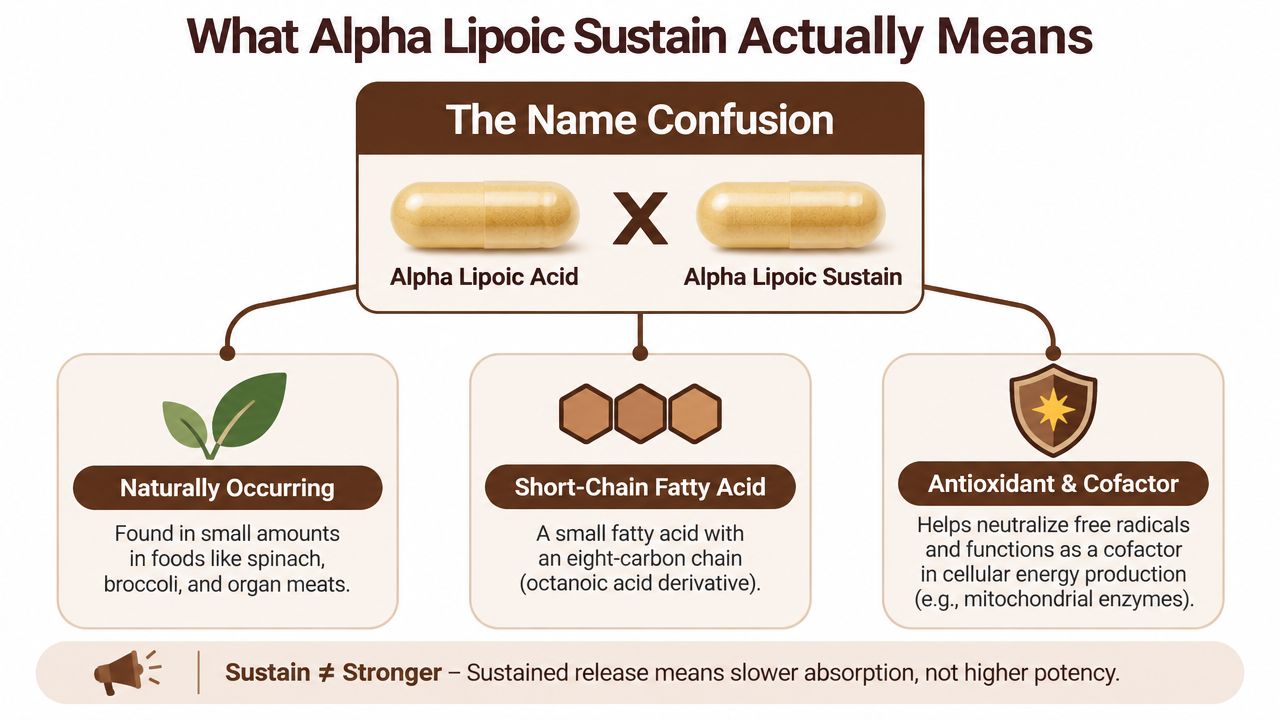
ALA itself is a naturally occurring compound made in small amounts by the body and also obtained from food. The sustain part is a formulation choice, not a new nutrient. That distinction is where most product-page confusion begins, and it's also where smarter label reading starts.
Practical rule: if two products contain the same form of ALA, the one with sustain-release technology is usually changing the time profile, not inventing a different ingredient.
This article walks through the chemistry, the body's handling of ALA, what the human evidence shows, and how to decide whether a sustained-release version fits your goal. It also separates what slow release can plausibly change, such as tolerability and plasma exposure, from what it can't prove on its own, which is better nerve outcomes or more daily energy.
Table of Contents
- What Alpha Lipoic Sustain Actually Means
- How Alpha Lipoic Acid Works Inside the Body
- Regular Release vs Sustained Release ALA
- What the Research Actually Shows
- Dosing, Timing, and Daily Use
- Common Misconceptions Worth Clearing Up
- How to Choose a Quality Alpha Lipoic Sustain Product
- The Bottom Line on Alpha Lipoic Sustain
What Alpha Lipoic Sustain Actually Means
Shoppers often compare alpha lipoic acid and alpha lipoic sustain and assume one must be the upgraded version. That's the wrong first question. The better question is whether the label is describing a different molecule or just a different release pattern.
ALA is the ingredient. Sustain describes the tablet or capsule technology that slows how quickly that ingredient is released after swallowing. The molecule inside is still alpha lipoic acid, but the delivery curve is flatter and longer.
Same active ingredient, different release pattern
A plain-release product can act more like a quick spill. A sustained-release product acts more like a controlled drip. In both cases, the active molecule is the same, but the body sees it over a different time window.
That matters because people don't experience supplements only as chemistry. They experience them as how they feel, how often they need to take them, and whether their stomach tolerates them. A slower release can be easier to live with, even if it isn't magically more powerful.
That's why the word sustain should be read as a formulation claim first. It can signal a product designed to release more gradually, but it doesn't automatically tell you whether the product uses R-lipoic acid, a racemic mixture, a matrix tablet, or a coated system. Those details matter more than the marketing shorthand.
The label is not the whole story. Two products can both say “sustained release” and still behave differently in the body.
If you're checking a bottle, read it in layers. First ask what the active ingredient is. Then ask what form it uses. Then ask how the release is controlled. That sequence is more useful than assuming “sustain” means stronger.
How Alpha Lipoic Acid Works Inside the Body
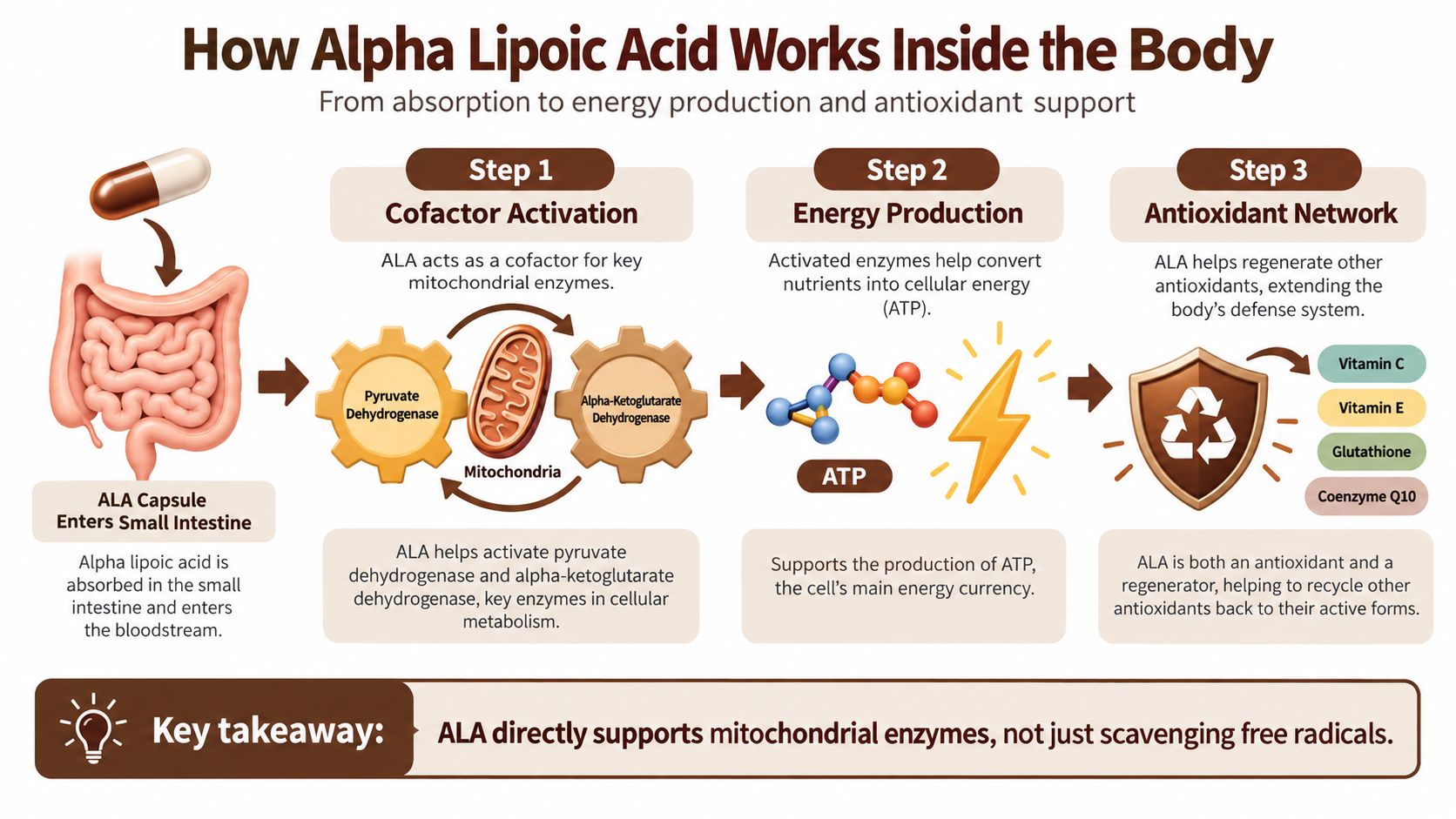
ALA earns its reputation because it does more than sit in the bloodstream. It participates in mitochondrial chemistry, which is the place where cells turn nutrients into usable energy. That's why people often link it to energy support, even though the supplement itself isn't a stimulant.
Mitochondrial cofactor and antioxidant network
Inside cells, ALA acts as a cofactor for key mitochondrial enzymes involved in energy production. It also behaves as a rare antioxidant that works in both watery and fatty environments, which helps explain why it gets described as an antioxidant of antioxidants. It can also help regenerate other antioxidants such as vitamins C and E and support the broader glutathione network, so its value isn't limited to one isolated reaction.
ALA also comes in two mirror-image forms, R and S. The body naturally makes R-lipoic acid, which is why many supplement shoppers look for that form first. Standard products may use a racemic mix, while stabilized R-form products aim to protect a molecule that's more delicate outside the body.
The relevance of sustain-release technology is straightforward here. If the tablet keeps ALA available longer in plasma, mitochondria may have a longer exposure window to the compound. That doesn't automatically mean better outcomes, but it does explain why slow release attracts interest in the first place.
If you want a good companion read on the antioxidant side of this topic, the section on glutathione absorption and uses is a useful complement, because it helps place ALA inside a wider antioxidant system rather than treating it as a standalone fix.
A practical way to think about ALA is this. It supports the machinery that helps cells make energy, then helps recycle parts of the antioxidant network that protect those same cells. That's a cleaner explanation than saying it “boosts energy” in a vague way.
The body doesn't just want ingredients. It wants ingredients at the right time, in the right form, and in the right amount.
Important distinction: ALA is not merely a free-radical scavenger. Its role in mitochondrial enzymes is part of why supplement form and timing can matter.
For readers comparing cellular support supplements, even something like the NMN Supplement illustrates a similar theme, where conversation is often about delivery, form, and metabolic context rather than a single flashy label word.
Regular Release vs Sustained Release ALA
The difference between regular-release and sustained-release ALA is easier to understand when you compare them side by side. Both deliver the same core ingredient, but they don't hand it to the body in the same way.
| Feature | Regular Release ALA | Sustained Release ALA |
|---|---|---|
| Absorption curve | Faster rise and fall in plasma levels | Slower rise, longer exposure window |
| Dosing pattern | Often split into more than one dose | Often taken once daily, sometimes with food |
| Stomach tolerance | More likely to feel sharper for sensitive users | Designed to feel gentler for some people |
| Outcome evidence | Better represented in clinical use cases | Fewer direct human outcome comparisons |
The practical appeal of sustained release is obvious. If a product releases more gradually, people may like it because it's easier on the stomach and easier to fit into a routine. That's a real advantage, especially for anyone who dislikes multiple daily doses.
What the human data can and can't tell you
Independent evidence shows controlled-release ALA can extend time to peak concentration and keep plasma levels up over time, and one human study reported a Tmax of 1.25 hours versus 0.5 hours for quick release, with no severe safety signals in that short trial (source study). That is solid pharmacokinetic evidence, but it's not the same as proving better symptom relief.
The gap matters. A flatter curve can be appealing on paper, yet consumer outcomes are another matter. That's why newer delivery-systems papers tend to focus on formulation performance, not whether people feel or function better with sustained release.
A better plasma profile is not the same thing as a better daily result.
A product like PDRN Volufiline NAD+ BALM belongs to a different category entirely, but it shows the same labeling problem in another form. A formula can be engineered for a specific delivery feel without that automatically proving stronger end results.
If you're deciding at the shelf, the biggest takeaway is simple. Sustain usually means convenience and tolerability first. It only becomes a performance claim if the brand can connect that release design to real human outcomes, and that's where the evidence is still thin.
What the Research Actually Shows
ALA has been studied for a long time, but the evidence isn't equally strong for every reason people take it. The clearest human use case is nerve support, while other uses are still more mixed or indirect. That's why a careful reader should separate what ALA does, what form was studied, and whether sustained release was part of the trial.
The most studied use case and what was tested
A lot of the classic human work around ALA used immediate-release racemic ALA at 600 mg daily for neuropathy-related outcomes, so claims that sustained release is superior for nerve support are usually extrapolations rather than direct comparisons. Recent reviews also call for more standardized human trials across populations and use cases, which is a polite way of saying the evidence still has gaps.
For people exploring clinical context, the IV alpha lipoic acid research at Sunridge offers a useful look at how this ingredient is discussed in a medical setting. The route is different from oral sustained-release products, but the contrast helps clarify why delivery method can't be ignored.
| Use Case | Standard ALA Evidence | Sustained-Release Adds Value? | Confidence Level |
|---|---|---|---|
| Nerve support | Most of the classic human studies used immediate-release oral or IV ALA | Not clearly proven for better outcomes | Moderate |
| Daily energy | Biological rationale exists, but consumer outcomes are less direct | Possibly for convenience, not clearly for performance | Low to moderate |
| Glucose-related goals | Studied in humans, but results vary by protocol and population | May help with smoother delivery, not proven superiority | Low to moderate |
| Antioxidant support | Mechanistic support is strong | May improve adherence and tolerability | Moderate |
Where the sustained-release question fits
The strongest case for sustain is not “it works better.” It's “it may be easier to stay on.” If a person can tolerate a product better and remember it more easily, that can matter in real life. But that's a practical advantage, not a new biological effect.
You can also see the distinction in formulation research from 2024 and 2025. The newer work suggests stronger sustained-release platforms can reduce early burst release and prolong absorption, but those data are still mostly preclinical or formulation-centric rather than consumer-outcome data. That means the science is moving, but the final health answer is not settled.
The same honest framing applies to any claim about energy, nerve comfort, or glucose support. A better release curve can support the journey through the body, but it does not guarantee better outcomes at the person level. That's the line most product pages blur.
Dosing, Timing, and Daily Use
ALA gets easier to use once you stop treating dose as a mystery and start treating it like a matching problem. The right amount depends on the goal, the form, and how well the person tolerates it. Sustained-release versions mostly change the timing decision, not the basic logic.
A practical daily routine
For general antioxidant support, people commonly use 300 to 600 mg daily, while 600 mg is the most-studied amount for nerve and glucose-related outcomes. Higher doses are not where the evidence becomes automatically better, and in many cases they just make the routine harder to tolerate.
General use
- Start low: Many people begin near the lower end of the range to see how their stomach reacts.
- Use food strategically: Sustained-release products are often taken with food because the release design already aims for smoother handling.
- Keep expectations realistic: ALA is a steady-use supplement, not a quick-fix stimulant.
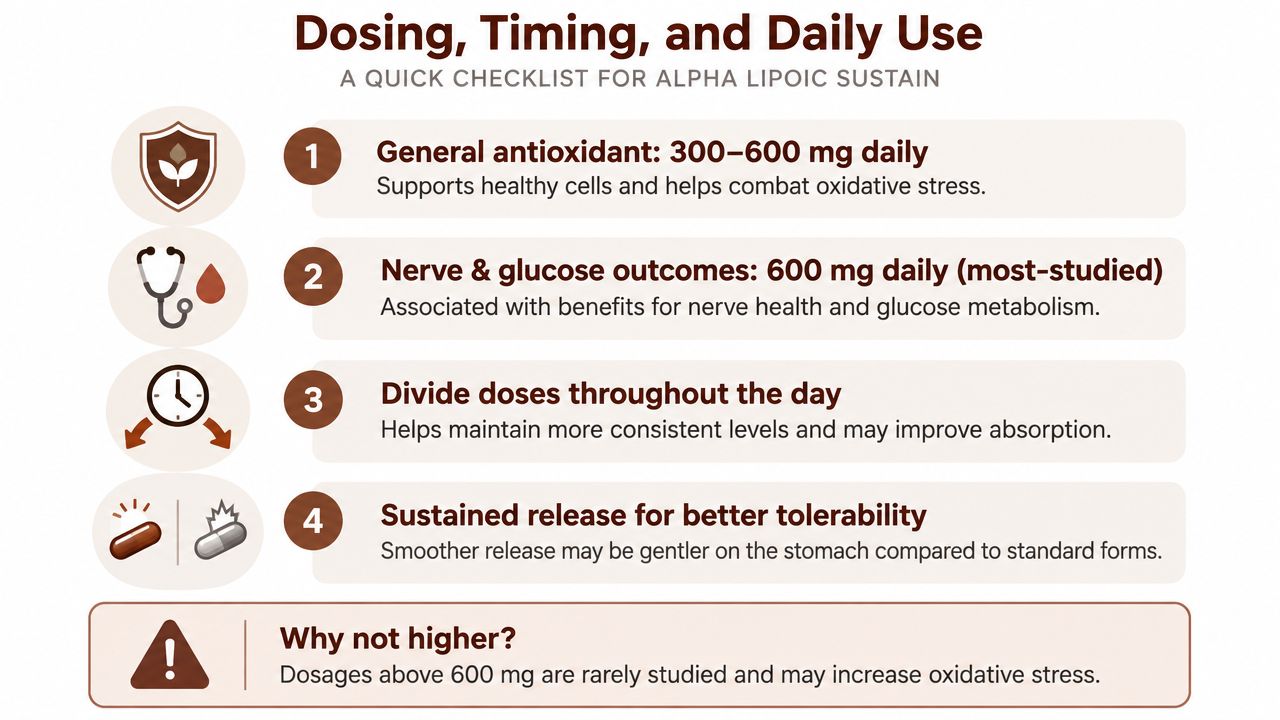
For immediate-release ALA, splitting the dose can help keep exposure steadier through the day. Sustained-release products often reduce that need, which is one of the most practical reasons people choose them. If a person wants a once-daily format, sustain-release is often the cleaner fit.
Pairing, spacing, and safety notes
ALA can recycle other antioxidants, so taking it alongside a multivitamin makes sense from a systems point of view, even if it isn't a magic combo. Biotin is different, because ALA can compete with biotin absorption, so separating them is the safer habit when the goal is to avoid overlap.
Safety note: People who are pregnant, use thyroid medication, take diabetes drugs, or are on chemotherapy should speak with a clinician before starting ALA, because it can affect glucose handling and may interact with treatment plans.
A few timing cues help too. Morning with breakfast can fit energy-focused routines, while evening use may feel more comfortable for people who notice nerve-related discomfort. The main thing is consistency, not chasing a perfect minute on the clock.
If you're building a broader antioxidant routine, the article on buffered vitamin C is a useful companion, because it shows how another common nutrient is adjusted for tolerance without changing the underlying molecule.
Common Misconceptions Worth Clearing Up
A lot of confusion around ALA comes from people treating label language as proof. That's risky, because supplement terms often describe design choices, not guaranteed results. The safest way to read alpha lipoic sustain is to challenge the assumption behind the wording.
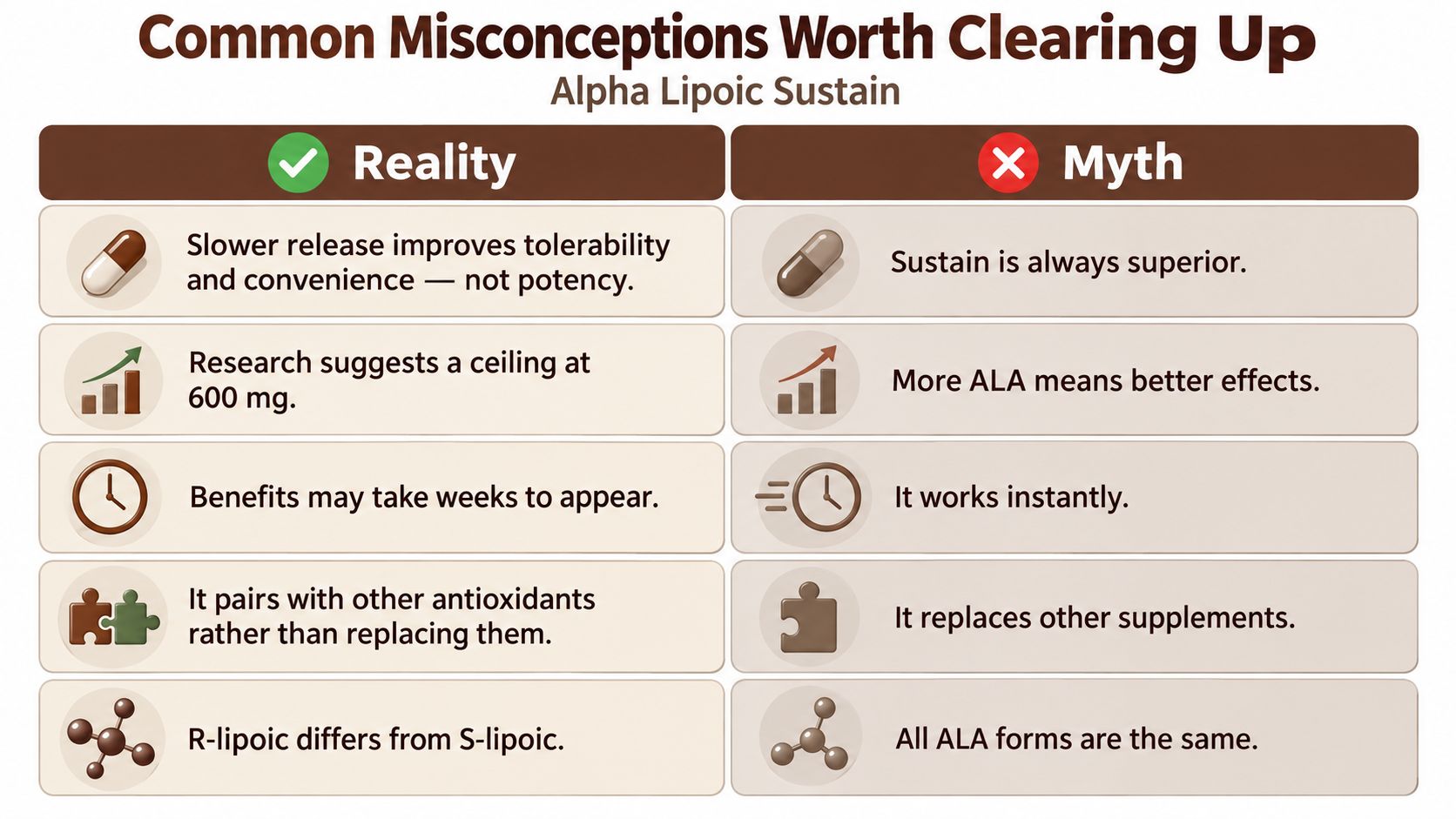
Five myths, corrected
- Myth, sustain is automatically superior. Reality, slower release mainly improves tolerability and convenience, while potency still depends on the ingredient, dose, and product quality.
- Myth, more ALA means better effects. Reality, the commonly discussed range centers around 600 mg in the evidence base, and more isn't automatically better.
- Myth, it works instantly. Reality, ALA is usually a consistency supplement, not a fast-acting one.
- Myth, it replaces other antioxidants or healthy habits. Reality, it sits alongside diet, movement, sleep, and medication when those are needed.
- Myth, all ALA forms are the same. Reality, R-lipoic acid and racemic ALA are different, and release technology is another separate layer.
The issue is that many product pages hide behind the word “sustained.” Without a clear description of the delivery system, it's just branding. A true sustained-release product should be able to explain how the release is controlled, not just state that it is.
The other confusion worth correcting is molecular. Alpha lipoic acid is not alpha-linolenic acid. They're unrelated compounds, and mixing them up leads people to compare the wrong products entirely.
How to Choose a Quality Alpha Lipoic Sustain Product
A good buying decision starts with the form, then moves to the release system, then to proof that the label matches the bottle. That order matters because the most expensive product isn't always the most transparent one.
What to check before you buy
First, look at whether the product uses R-lipoic acid or a racemic mixture. R-form products are often discussed as the body's naturally occurring version, while standard ALA supplements may contain both mirror-image forms. If the label is vague, that's a signal to slow down and read more carefully.
Second, ask how the release is built. Terms like matrix tablet, coated beads, or bilayer design are more informative than a generic “sustain” claim. If the product doesn't explain the mechanism at all, the wording may be doing more work than the formulation.
Third, check whether the brand gives a clear per-tablet dose and whether the tablet is meant to be split. That detail matters because sustained-release products are often designed as a single daily unit, while immediate-release products may rely on divided dosing.
Buying rule: the fewer unanswered questions on the label, the less guesswork you have to do later.
Red flags and storage details
Watch for proprietary blends that hide the actual ALA amount. Be cautious with claims that promise rapid absorption while also promising sustained release, because those ideas point in opposite directions. Third-party testing marks such as USP, NSF, or ConsumerLab can help, but only if the brand is transparent about the actual ingredient form and dose.
Heat and moisture matter too. ALA is not a product you want sitting in a steamy bathroom cabinet for months. Storage in a cool, dry place is the safer default.
For a broader systems view, the cell energy supplement discussion can help frame how ingredient form and delivery affect the final supplement experience, even when the nutrient itself stays the same.
The Bottom Line on Alpha Lipoic Sustain
Alpha Lipoic Sustain is a real formulation choice, not just marketing fluff. The slow-release design can flatten the exposure curve, improve tolerability for some people, and make daily use easier to stick with. What it does not do is turn ALA into a different molecule or guarantee better clinical results by itself.
That's the cleanest way to think about it. Choose sustained release when you want steadier handling, fewer dosing hassles, or a product that feels gentler on the stomach. Choose standard release when you want a simpler, often lower-cost option and you're comfortable splitting doses if needed.
The most honest verdict is that the release system changes the experience, while the ingredient still does the heavy lifting. If you care about energy, nerve support, or glucose-related goals, the bigger question is still which form, dose, and routine you can use consistently alongside the basics that matter every day.
If you want supplements and topical products that are built around clear ingredient logic, take a look at REVETIX. Its lineup focuses on cellular energy, longevity, and delivery formats that match different routines, which makes it a practical place to compare how formulation choices show up in real products.