


The most useful starting point for 8000 steps a day isn't a perfect streak. It's the finding that, in a nationally representative cohort of US adults aged 40 and older, walking 8000 steps a day was associated with substantially lower mortality than walking 4000 steps a day. The reported all-cause mortality hazard ratio was 0.49, with mortality rates of 7.1 versus 14.4 deaths per 1,000 adults per year. These figures come from the JAMA Network Open cohort study, and they help explain why 8000 has become a practical health benchmark.
That doesn't mean 8000 is a pass-or-fail rule. Age, current activity, walking pace, health conditions, and how you spread your steps through the day all matter. The most useful interpretation is more flexible: build toward a meaningful weekly pattern, include some purposeful walking when you can, and treat the number as a guide rather than a judgment.
Table of Contents
- Why 8000 Steps a Day Gets So Much Attention
- How Step Count Links to Health and Longevity
- 8000 Steps Compared With Other Daily Targets
- Does How You Accumulate Your Steps Matter
- Practical Ways to Reach 8000 Steps Without Overhauling Your Day
- How to Measure and Track Your Steps Accurately
- Making 8000 Steps a Sustainable Habit for the Long Term
Why 8000 Steps a Day Gets So Much Attention
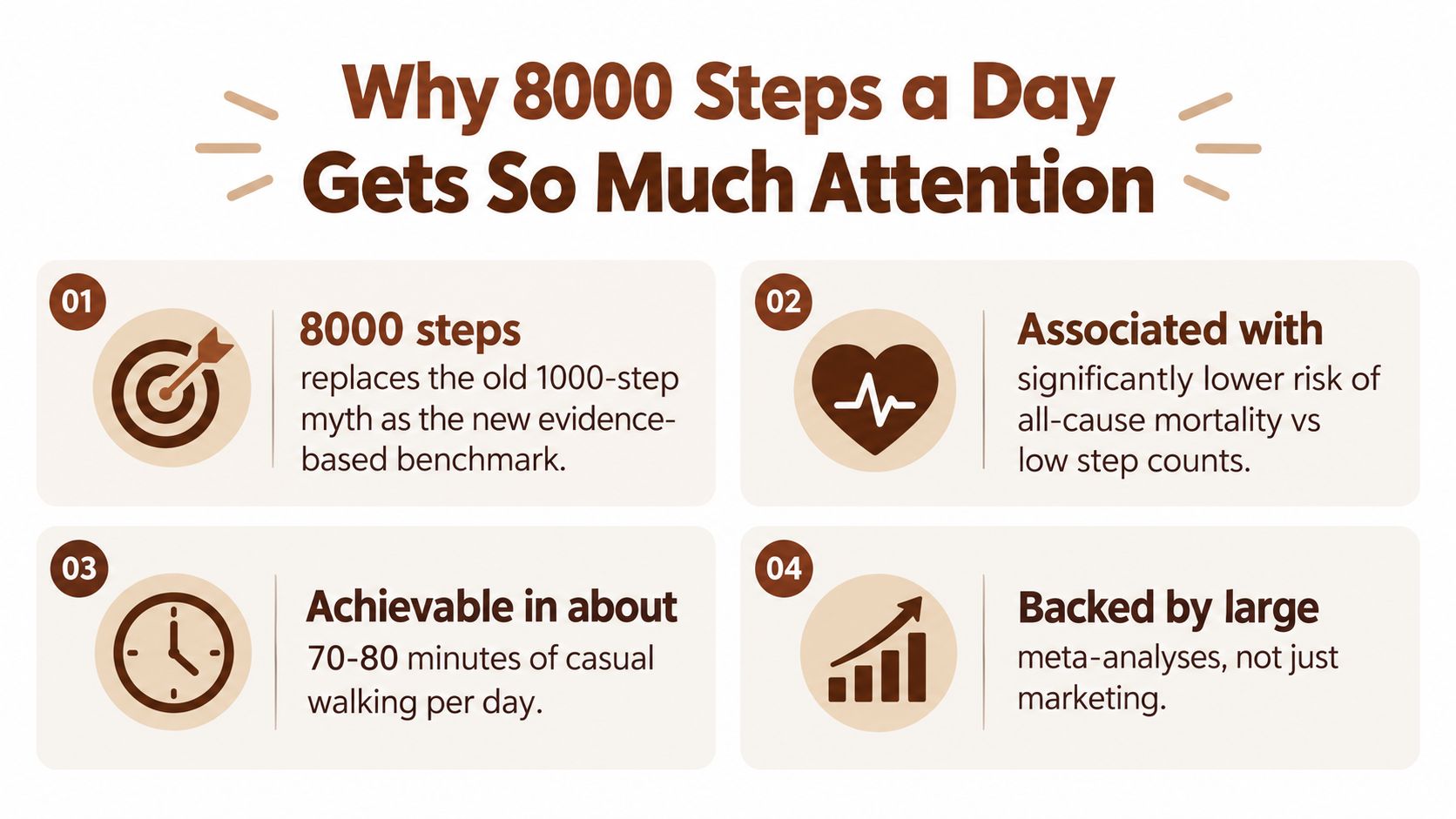
The familiar 10,000-step goal is easy to remember, yet it was not created as a universal medical threshold. 8000 steps a day has drawn attention because research places it near a range where health benefits appear to level off for many adults. It works better as a reference point than as a pass-or-fail rule.
A 2021 meta-analysis in The Lancet Public Health) pooled 15 studies and found that mortality risk continued to fall as daily steps increased. The curve flattened around 8000 to 10,000 steps for adults under 60 and around 6000 to 8000 steps for adults 60 and older. In practical terms, the number marks a useful neighborhood on the map, not one exact destination everyone must reach.
That changes the question. Rather than chasing a supposedly magical total, consider whether your usual activity is moving toward an evidence-based range. Your progress can come from several short walks, routine movement, or a longer purposeful walk. A weekly pattern with regular accumulation may be more realistic than demanding the same total every day.
The comparison with lower activity also gives the target practical meaning. In the JAMA Network Open cohort, 8000 steps a day was associated with a lower mortality rate than 4000 steps a day. Population research cannot guarantee the same result for each individual, but it helps explain why increasing movement may matter even before you reach a particular benchmark.
Why the target feels achievable
A useful step target fits ordinary life. Steps may come from walking to work, moving around the house, shopping, taking stairs, walking during a phone call, or taking a planned walk. You do not need every step to happen in exercise clothes on a dedicated route.
The count also captures movement that workouts can miss. A gym session may help, while long periods of sitting still reduce how much activity you accumulate across the day. Tracking steps makes that background movement easier to notice and build into a flexible weekly routine.
Practical rule: Treat 8000 steps as a useful benchmark, not a daily exam. A sustainable pattern beats an occasional heroic effort.
The useful questions are How many steps are enough for your age and starting point? Does a continuous walk differ from scattered movement? How can you reach your target without rebuilding your schedule? The answers are more nuanced than walking until a tracker displays 10,000, but they are also easier to apply.
How Step Count Links to Health and Longevity
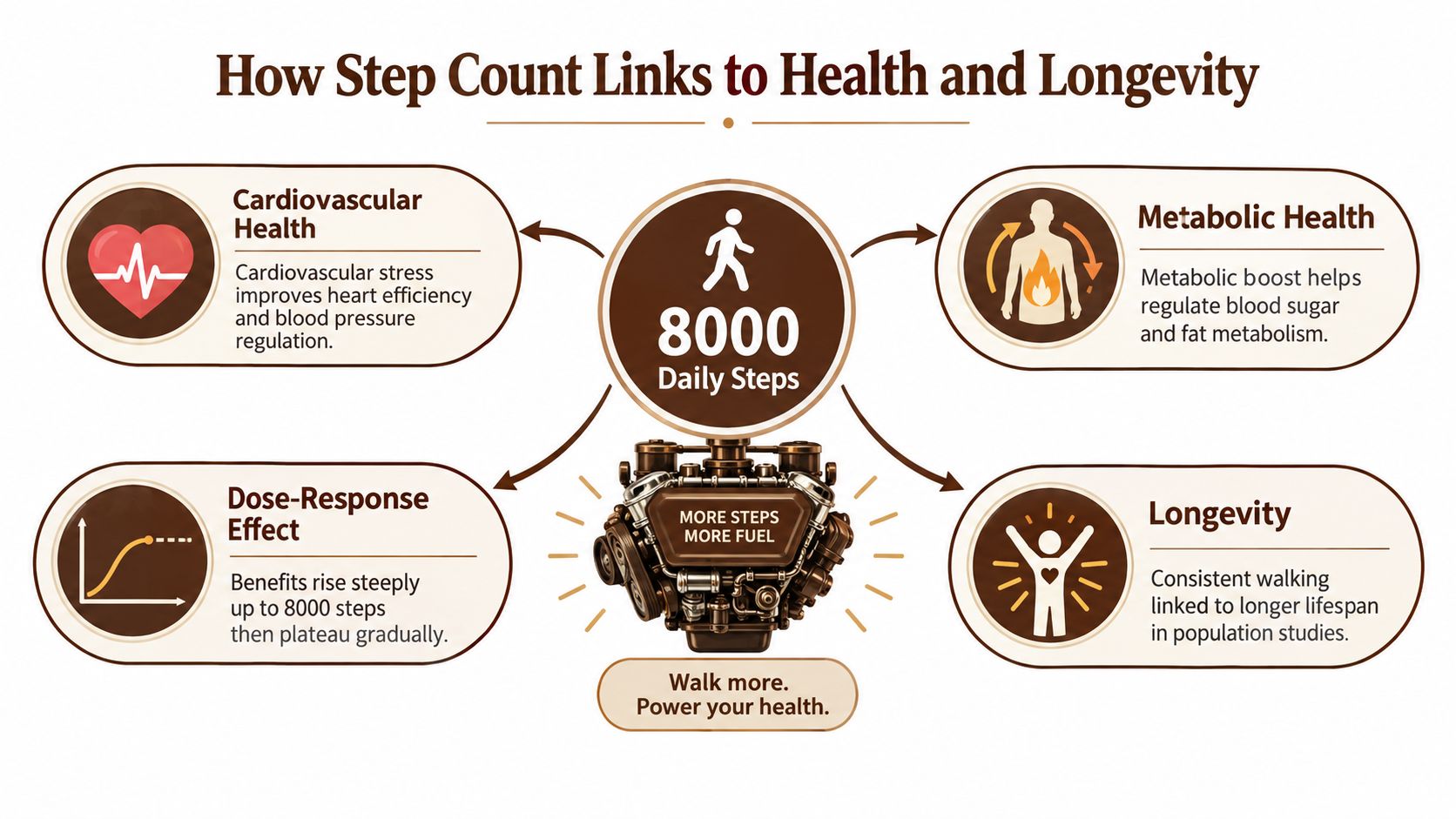
Walking affects the body through repeated, manageable demands. Each step asks your muscles to use energy, your heart to circulate blood, and your balance system to coordinate movement. Over time, regular walking can support cardiovascular fitness, metabolic function, mobility, and the ability to perform everyday tasks.
Researchers often describe this relationship as a dose-response curve. Think of a fuel gauge. Moving from very little activity to a moderate amount fills the gauge quickly, while moving from “nearly full” to “full” produces a smaller visible change. Steps tend to follow a similar pattern. The early increase from a low baseline can matter greatly, while additional steps at higher levels may provide smaller incremental benefits.
The Lancet Public Health review found that the lowest observed all-cause mortality risk sat in the 8000 to 10,000-step range for younger adults and the 6000 to 8000-step range for older adults. The curve flattened rather than stopping at one hard cutoff, which is why 8000 works well as a midpoint rather than a minimum requirement.
Reading risk numbers without getting lost
A hazard ratio compares the rate of an outcome between groups during a period of observation. A value below 1 generally indicates a lower observed rate in one group than in the comparison group. It doesn't mean that walking alone determines what happens to an individual, and it doesn't prove that step count is the only cause of the difference.
That distinction matters because walking habits often travel with other behaviors. People who walk more may also differ in sleep, diet, smoking status, access to safe walking areas, or existing health. Researchers adjust for some factors, but observational studies still show relationships rather than definitive cause and effect.
The useful conclusion is modest but strong: increasing movement from a low level is a sensible health strategy, and 8000 steps sits close to a broad benefit plateau for many people. You don't need to chase the highest possible number to make walking worthwhile.
The science-based guide to healthy aging supplements can provide broader context for people considering supplements alongside movement, sleep, and nutrition. A product such as the NMN Supplement is marketed as a dietary option related to NAD+ and cellular energy, but it shouldn't be treated as a substitute for walking or medical care.
8000 Steps Compared With Other Daily Targets
Different step targets serve different people. Someone currently walking 3000 steps may gain more from building toward 6000 than from worrying about the gap to 10,000. Someone already active and under 60 may choose 8000 to 10,000 as a broader range, while an older adult may capture most of the observed mortality benefit closer to 6000 to 8000.
The table below summarizes the evidence-based ranges without turning them into rigid prescriptions.
Step targets and expected health gains by age group
| Daily Steps | Adults Under 60 | Adults 60 and Older | Practical Takeaway |
|---|---|---|---|
| 6000 | A meaningful improvement over very low activity is plausible, but the observed benefit curve may continue rising | Near the range where benefits may begin to plateau for many adults | A realistic stepping stone or useful maintenance target |
| 8000 | Near the lower part of the range associated with the lowest observed mortality risk | Near the upper part of the range where benefits may level off | A flexible benchmark for many adults |
| 10,000 | May provide additional activity and possible incremental benefit, though the curve tends to flatten | May exceed the level needed to capture most observed mortality benefit for many older adults | An option, not a requirement |
The historical evidence doesn't support the idea that 4000 steps is useless. The JAMA Network Open study found a clear contrast between 4000 and 8000 steps, but health behavior isn't binary. Moving from a very low baseline to a moderate baseline can be a worthwhile change even before you approach 8000.
A 2023 cohort study of 3101 US adults found that the number of days reaching at least 8000 steps was associated with lower 10-year mortality risk. Compared with people who never reached 8000 steps on any day of the week, those who reached it on 1 to 2 days per week had a 14.9% lower all-cause mortality risk, while those who reached it on 3 to 7 days per week had a 16.5% lower risk. The JAMA Network Open study also reported lower cardiovascular mortality associated with 8000-step days.
That result changes the question from “Did I hit the number today?” to “How often can I reach a useful level?” The PDRN Volufiline NAD+ BALM belongs to a separate topical skincare category, so it shouldn't be confused with a walking intervention or a treatment for cardiovascular risk.
Does How You Accumulate Your Steps Matter
Total steps are a useful foundation, but they may not tell the whole story. Two people can reach 8000 steps through very different patterns. One may walk continuously for a substantial period, while the other accumulates steps through household chores, short errands, and repeated trips between rooms.
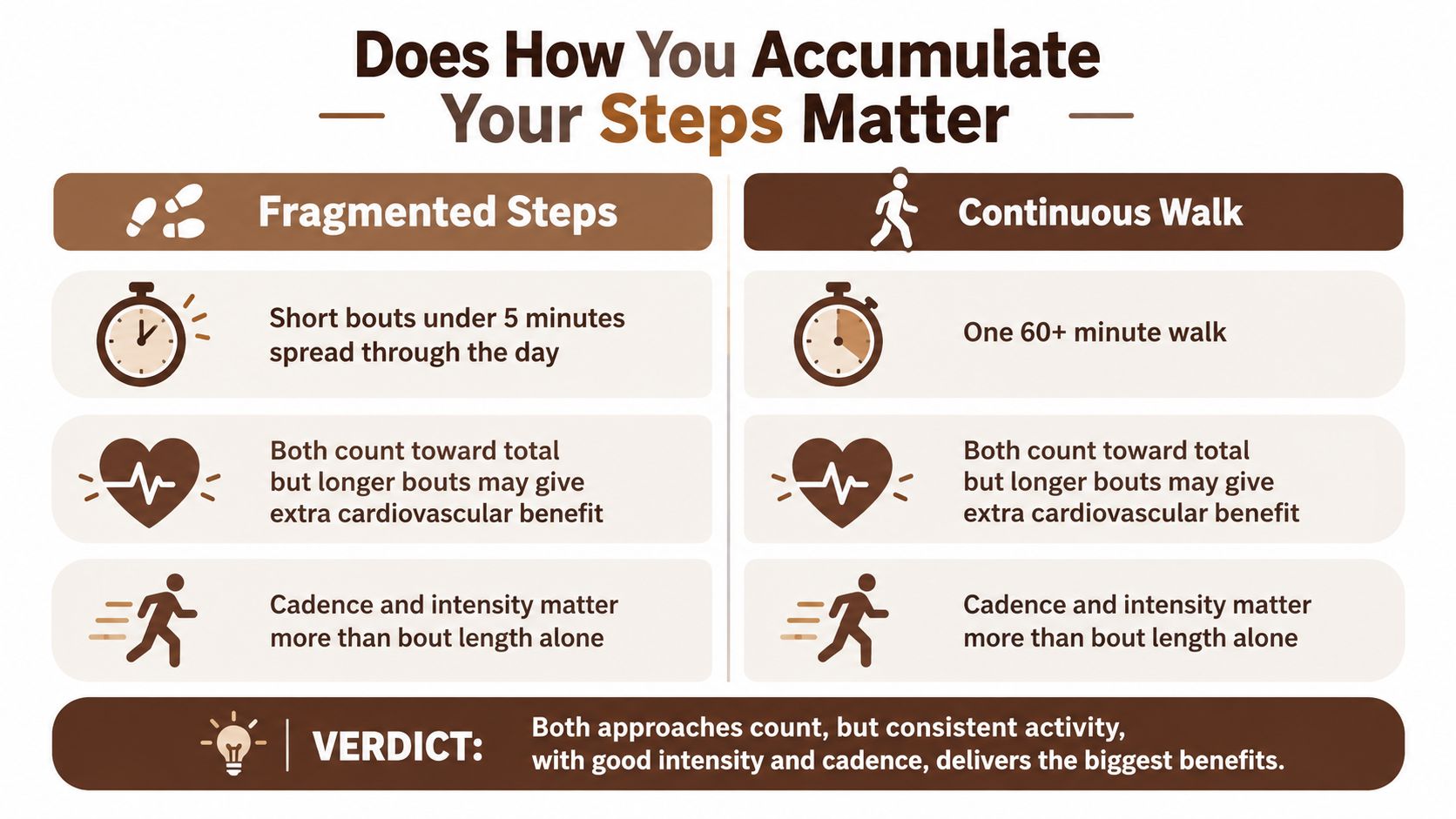
Recent evidence suggests that accumulation pattern may influence outcomes beyond total count, especially among adults who are not highly active. A study of suboptimally active adults linked getting most daily steps in one longer bout with lower cardiovascular and all-cause mortality than spreading the same steps across many short bouts. A separate 2025 cohort study found that more walking episodes lasting at least 10 minutes were associated with additional mortality reduction beyond total step count. These findings are summarized in the PubMed record for the recent bout-pattern research.
What this looks like in daily life
Consider two patterns:
- Fragmented movement: You walk around the kitchen, commute, shop, climb stairs, and complete short household tasks. These steps still contribute to your daily total and help reduce the amount of time spent completely sedentary.
- Purposeful walking: You add a continuous walk that raises your breathing and keeps your legs working steadily. This may provide a different cardiovascular stimulus from casual movement.
The research doesn't yet provide a universally accepted prescription for the perfect combination of total steps, bout length, and pace. It also doesn't mean short bouts are worthless. If fragmented movement is the only practical way to become more active, it remains a valuable starting point.
Cadence and effort deserve attention too. A slow stroll, brisk walk, and hurried commute may produce similar step counts but different physical demands. You can preserve the flexibility of an 8000-step target while adding one purposeful walk when your schedule and health allow.
Rhodiola Rosea is positioned as an adaptogenic supplement for stress, focus, and steady energy, but it doesn't replace walking, recovery, or guidance from a healthcare professional.
Practical Ways to Reach 8000 Steps Without Overhauling Your Day
The easiest way to reach 8000 steps is usually to divide the target into several ordinary opportunities. A planned walk can supply the largest share, while small changes prevent the remaining gap from becoming a nightly scramble.
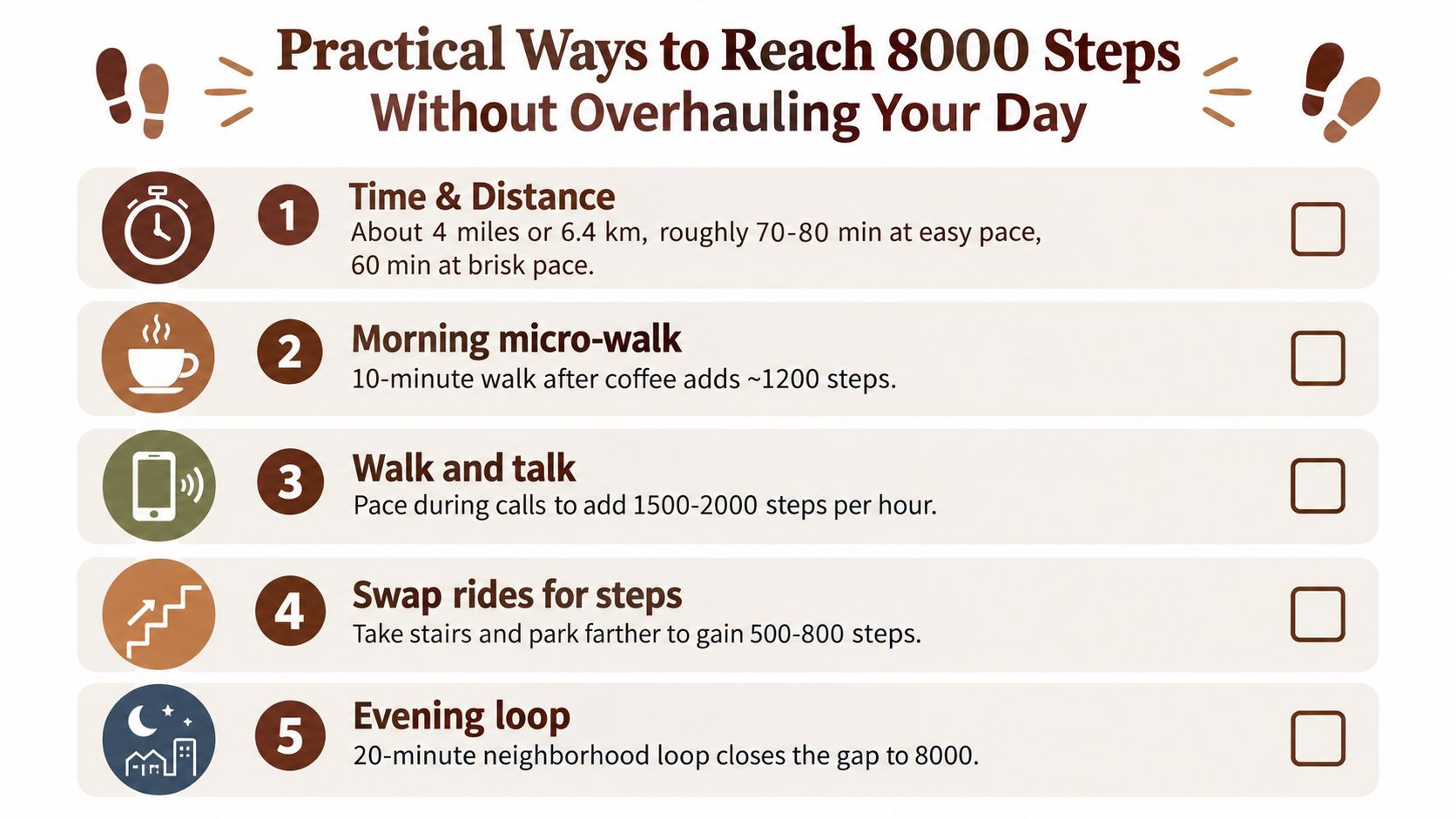
The exact time and distance vary with stride length and walking speed. The infographic below uses practical planning estimates, including about 4 miles or 6.4 kilometers, roughly 70 to 80 minutes at an easy pace, or about 60 minutes at a brisk pace. Treat those figures as planning guides rather than promises, because bodies and walking speeds differ.
Build steps around existing anchors
- Use a morning transition: Walk after coffee or breakfast, before opening your inbox. A short routine is easier to protect than an ambitious session that requires a new time slot.
- Turn calls into movement: Use voice calls as a cue to pace, provided the setting is safe and your attention stays on traffic and surroundings.
- Create a commute detour: Park farther away, exit public transport earlier, or walk to an errand that you'd normally complete by car.
- Add an evening loop: A neighborhood walk can close the day's gap while creating a clear boundary between work and home.
- Use meals as reminders: A brief walk after eating gives you a repeatable cue without asking you to remember another task.
A workday template might combine walking before work, movement during calls, a lunch route, and an evening loop. A work-from-home template can use movement between meetings, a walk before lunch, and a longer break later in the day. On weekends, errands, markets, parks, and social walks can replace formal exercise.
Don't wait until bedtime to discover that you're far below your target. Check your progress at a consistent point in the day, then choose the smallest realistic action that closes part of the gap.
For longer outdoor walks, footwear, weather, water, and carrying comfort affect whether the habit remains enjoyable. This guide on how to pack light for a long trail offers useful preparation ideas for extended walking environments.
A weekly approach also helps. If illness, weather, travel, or pain disrupts one day, you can return to your usual rhythm without treating the entire plan as failed. For ideas about the herb and its traditional uses, see this overview of Rhodiola rosea.
How to Measure and Track Your Steps Accurately
Step counters are useful because they make an invisible behavior visible. They aren't perfect, though. Phones may miss steps when left on a desk, wrist trackers can misread hand movements, and placement can affect what a pedometer records.
Choose one device and use it consistently before comparing it with another. A phone is convenient if you carry it throughout the day. A wrist tracker is easier to wear continuously, while a waist-mounted pedometer may work well for people who prefer a simple dedicated device.
Improve consistency before chasing precision
Start with a basic check. Walk a known route while counting your steps manually, then compare the result with your device. Repeat the check at your normal pace, because very slow walking, pushing a cart, or moving your arms unusually can change how a tracker detects steps.
The most useful tracker is the one you wear consistently and interpret sensibly.
Look at more than the headline number when possible:
- Total steps: Shows your overall movement volume.
- Walking pace or cadence: Helps distinguish gentle movement from more purposeful walking.
- Active periods: Reveals whether your day includes sustained bouts or mostly short fragments.
- Weekly pattern: Shows whether your routine survives busy days, weekends, and disruptions.
Set goals from your current baseline rather than copying another person's target. If your device consistently undercounts or overcounts, the trend still helps you see whether your activity is rising, stable, or falling.
Wearability matters too. A loose strap, uncomfortable band, or dead battery can create gaps in your record. If your device is worn on the wrist and the strap has become unreliable, you can replace your Fitbit Charge strap before using the tracker as part of a longer-term routine.
Making 8000 Steps a Sustainable Habit for the Long Term
A sustainable walking target has three parts: a realistic starting point, a repeatable routine, and enough flexibility for ordinary life. The 8000-step mark works as a useful reference, not a rule that every adult must meet every day.
Use your current activity as the starting line. Age can help guide the direction: adults under 60 may work toward a range around 8000 to 10,000 steps, while adults 60 and older may prefer a range around 6000 to 8000. These ranges reflect the mortality-risk pattern discussed earlier. If you have heart disease, balance problems, significant pain, or a long period of inactivity, ask a healthcare professional how to increase activity safely.
A simple decision framework
- Find your current average. Track your usual pattern before setting a new goal.
- Increase gradually. Add manageable walking opportunities rather than forcing a sudden jump.
- Use the week as your wider target. Reaching 8000 steps on several days may be more realistic than requiring the same total every day. A missed day does not erase the movement you accumulated earlier.
- Add purposeful bouts when practical. Short walks still build your total, while a continuous walk can provide a different training stimulus through sustained pace.
- Adjust for recovery. Pain, unusual fatigue, illness, or poor balance mean the challenge should be reduced, with professional advice when needed.
Small supports make repetition easier: comfortable shoes, a safe route, a regular bedtime, and a backup plan for bad weather. People who find consistency difficult can also use practical ideas to stay motivated with workouts.
Supplements are optional and should not become the foundation of a walking routine. Readers interested in cellular energy products and broader wellness can review this discussion of cell energy supplements. Regular movement, recovery, and clinical care still come first.
Begin with the next walk you can repeat. Whether your first milestone is below 8000 or you already reach it comfortably, a useful goal helps you move regularly, recover well, and continue tomorrow.
REVETIX offers products focused on cellular energy, longevity, stress resilience, and topical skincare, including NMN supplement and Rhodiola rosea capsules. Visit REVETIX to review those options and place any supplement choices alongside a consistent walking and recovery routine.