


Himalayan shilajit resin is a mineral-rich, tar-like substance formed over centuries from decomposed plant and animal matter in rock fissures roughly 1,000 to 5,000 meters above sea level, and it's primarily valued for its fulvic acid content. It isn't a simple herb or a single mineral, but a complex natural matrix whose quality depends heavily on purification, composition, and batch testing.
You may have encountered it while looking for a gentler alternative to stimulants, a traditional Ayurvedic rejuvenator, or a supplement that fits a modern longevity routine. The dark resin can sound mysterious, but the useful questions are practical: What is in it? What does the evidence support? And how can you tell whether a jar is safe?
Table of Contents
- What Is Himalayan Shilajit Resin
- The Science Behind the Resin
- Health Benefits and Traditional Uses
- Safety Concerns and Purity
- How to Choose High-Quality Shilajit
- Resin vs. Other Formats
- Frequently Asked Questions
What Is Himalayan Shilajit Resin
You open a jar expecting a mineral supplement and find a dark, sticky substance instead. That appearance reflects shilajit's unusual origin. Ayurvedic traditions have used it for centuries as a rasayana, a substance associated with rejuvenation and long-term vitality. Modern discussions connect it with energy, performance, mineral support, and healthy aging, but its traditional reputation does not explain its chemistry or safety.
Himalayan shilajit resin is a rock-seeping biological material. Plant and animal matter breaks down over long periods inside mountain formations, where pressure, heat, minerals, and microbial activity shape the resulting material. In warmer weather, the dark resin may ooze from cracks in rock. Reference summaries place its classic occurrence at approximately 1,000 to 5,000 meters above sea level, while also noting that shilajit occurs in other mountain ranges. Fullscript's shilajit reference describes its high-altitude origin and Ayurvedic context.
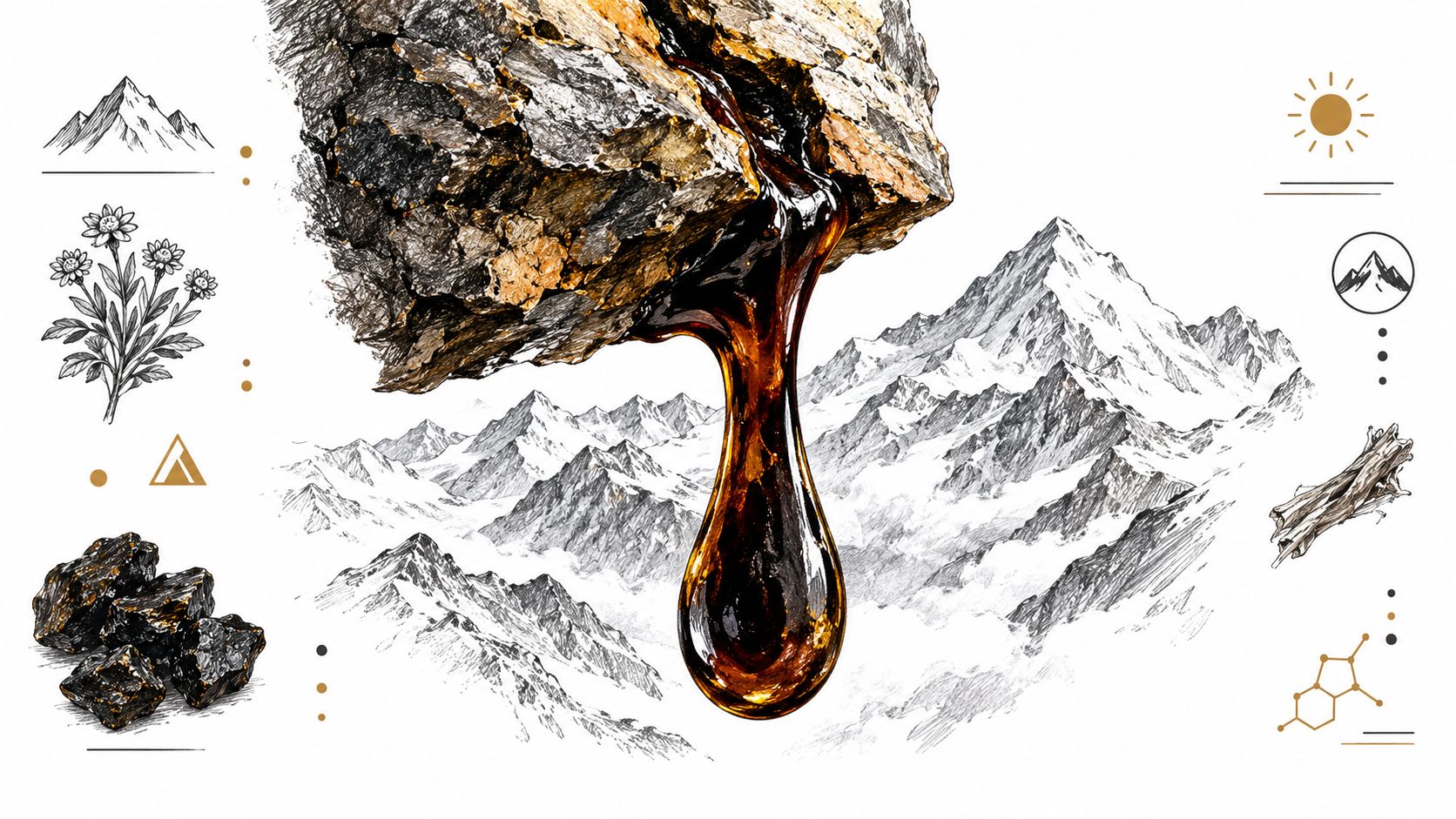
More than a mountain mineral
The word mineral captures only part of shilajit. A better comparison is a natural mineral-organic ecosystem in miniature. The resin combines decomposed organic matter with inorganic minerals, while geology, location, extraction, and processing influence the final profile.
Independent summaries describe shilajit as containing about 60% to 80% organic material, with the rest consisting of inorganic minerals, as the same reference notes. This helps explain why product labels may call it both a mineral-rich resin and a complex phytocomplex.
Its chemical identity comes from a broad mixture rather than one isolated molecule. Two samples can share the name Himalayan shilajit while differing in humic substances, mineral content, contaminants, and purification quality. The fulvic acid matrix is part of what makes the material interesting, yet it also makes simple comparisons between products difficult.
Safety deserves equal attention. A mountain origin does not show that a finished resin is free from heavy metals or other contaminants. Only appropriate purification and batch testing can help establish whether the product is suitable for use.
Practical rule: High altitude may describe where a material came from, but it doesn't prove that the finished resin is safe or chemically consistent.
The setting explains how shilajit forms. A quality assessment must examine what remains in the jar.
The Science Behind the Resin
A jar of shilajit may look like a single dark substance, yet its chemistry resembles a small ecosystem. The material contains many organic compounds and minerals that interact with one another. Its defining feature is a humic-substance matrix, a tangled network rather than one isolated “active ingredient.”
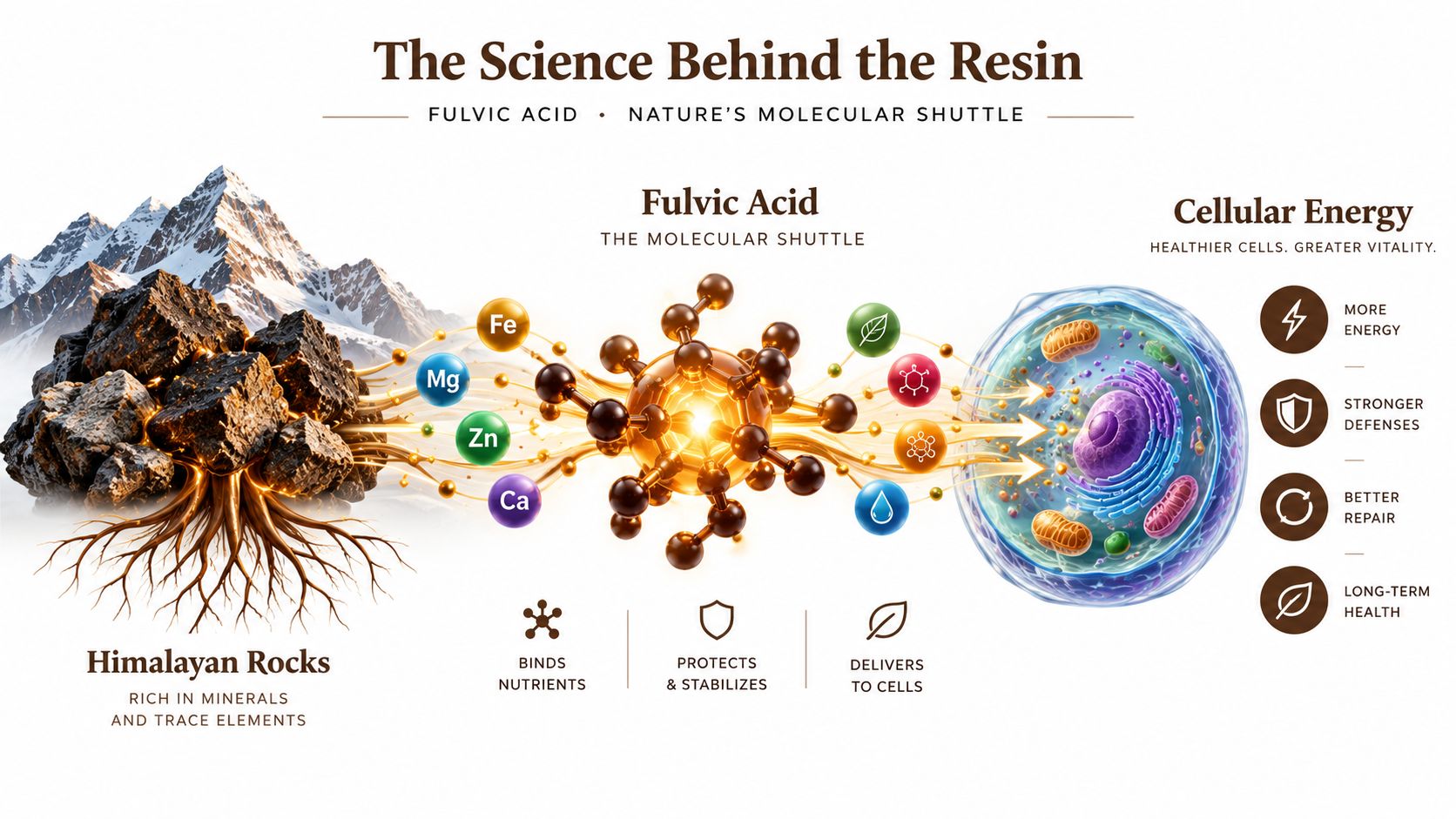
Fulvic acid sits within that humic family. It is commonly described as a lower-molecular-weight organic fraction. One useful analogy is a fleet of small delivery vehicles. The vehicles do not create minerals, but they may bind with mineral ions and influence how those ions move through a biological environment. This helps explain scientific interest in fulvic acid without implying that every mineral in shilajit is absorbed or produces a particular health result.
The proportions vary between samples. Published descriptions place fulvic acid and related humic substances at about 60% to 80% of the total material, while other analyses describe roughly 60% to 80% organic matter and 20% to 40% inorganic minerals by weight. These ranges describe a variable natural substance, not a universal recipe. The clinical-evidence review cited later in this guide also treats shilajit as a broad chemical mixture rather than a fixed formula.
Why the mineral list can confuse buyers
A product page may highlight a long trace-mineral list. One review reports that some samples contain over 84 minerals and trace elements in ionic form. That figure does not mean every sample contains the same substances at the same concentrations. A long list also cannot replace identity checks, purity controls, or laboratory testing.
A published chemical analysis of native Himalayan material measured a slightly alkaline pH of 8.11, potassium at 21.93 ppm, and calcium at 11.04 ppm, with magnesium among the predominant elements. The analysis also identified variable trace constituents, including zinc, boron, silicon, strontium, aluminum, and manganese. The published chemical analysis concluded that fulvic acid may contribute to mineral chelation and bioavailability.
That conclusion describes a possible chemical function, not a guarantee for a finished supplement. It also highlights the safety gap that consumer guides often overlook. The same geological conditions that contribute minerals can introduce unwanted elements, including heavy metals. A fulvic-acid profile may explain how the material behaves, but it cannot prove that a batch is safe.
A more useful buying question asks whether the supplier can document the fulvic-acid fraction, pH, mineral panel, and contaminant controls. For help separating measured findings from promotional conclusions, use this guide to reading scientific papers. The method is simple: check what the study tested, then compare it with what the product claims.
Shilajit is a matrix, not a magic molecule. Fulvic acid may help explain how that matrix interacts with minerals, while purification and batch testing determine what ultimately reaches the jar.
Health Benefits and Traditional Uses
A person may reach for shilajit after hearing that it supports energy, stamina, or healthy aging. Those ideas come from two different sources: traditional Ayurvedic practice and modern interest in the resin's chemistry. Keeping them separate makes the evidence easier to understand.
In Ayurveda, shilajit is described as a rasayana, a rejuvenating substance associated with vitality and resilience. That history explains its reputation, but it does not confirm every claim now used in supplement marketing. Traditional use can show that a substance held cultural value over time. It cannot establish a universal dose or prove a specific medical outcome.
Modern research has examined several possible uses:
- Energy and stamina: Fulvic compounds and minerals make the resin biologically interesting, somewhat like a complex toolkit rather than a single active ingredient. They may help explain interest in vitality, but they do not guarantee that every user will feel more energetic.
- Mineral support: Shilajit contains organic and inorganic fractions that may interact with minerals. A varied mineral profile does not mean the product will correct a nutritional deficiency.
- Healthy aging: Humic substances are often studied for antioxidant or chelating activity. Results observed in laboratory settings should not be treated as proof of an anti-aging effect in people.
- Male reproductive health: This is one of the more specific areas of human research, although the available evidence remains limited.
A clinical study of men aged 45 to 55 who received 250 mg twice daily for 90 days reported an approximately 23.5% increase in total testosterone, as summarized in this clinical-evidence review. The finding helps explain shilajit's presence in performance and longevity marketing. It does not predict the same change for every person, and it should not be stretched into proof of improved exercise performance or general health.
Tradition is not a dosing guarantee
Ayurvedic history cannot confirm that modern gummies, capsules, and resin preparations have identical effects. Nor can it establish long-term safety for every user. Preparation, dose, product composition, and individual health all matter.
The most measured conclusion is that shilajit has a plausible chemical basis for further research, some short-term human evidence, and a substantial traditional history. Broad claims about cognition, anti-aging, testosterone, or exercise performance remain unsettled.
People with medical conditions, those taking prescription medicines, and anyone who is pregnant or breastfeeding should discuss supplementation with a qualified healthcare professional. A complex natural product contains multiple active fractions, and the composition may differ from one batch to another.
Safety Concerns and Purity
The most important distinction in the shilajit market is not resin versus capsule. It's tested material versus unverified material.
Raw shilajit forms in geological environments, and that environment can concentrate unwanted elements along with desirable minerals. Independent analytical summaries have reported lead, arsenic, cadmium, mercury, and thallium in some natural or commercial samples. Other analyses have found properly purified material with no detectable lead, cadmium, mercury, or arsenic under the methods used. This review of shilajit analysis and safety shows why the answer depends on purification and testing rather than origin alone.
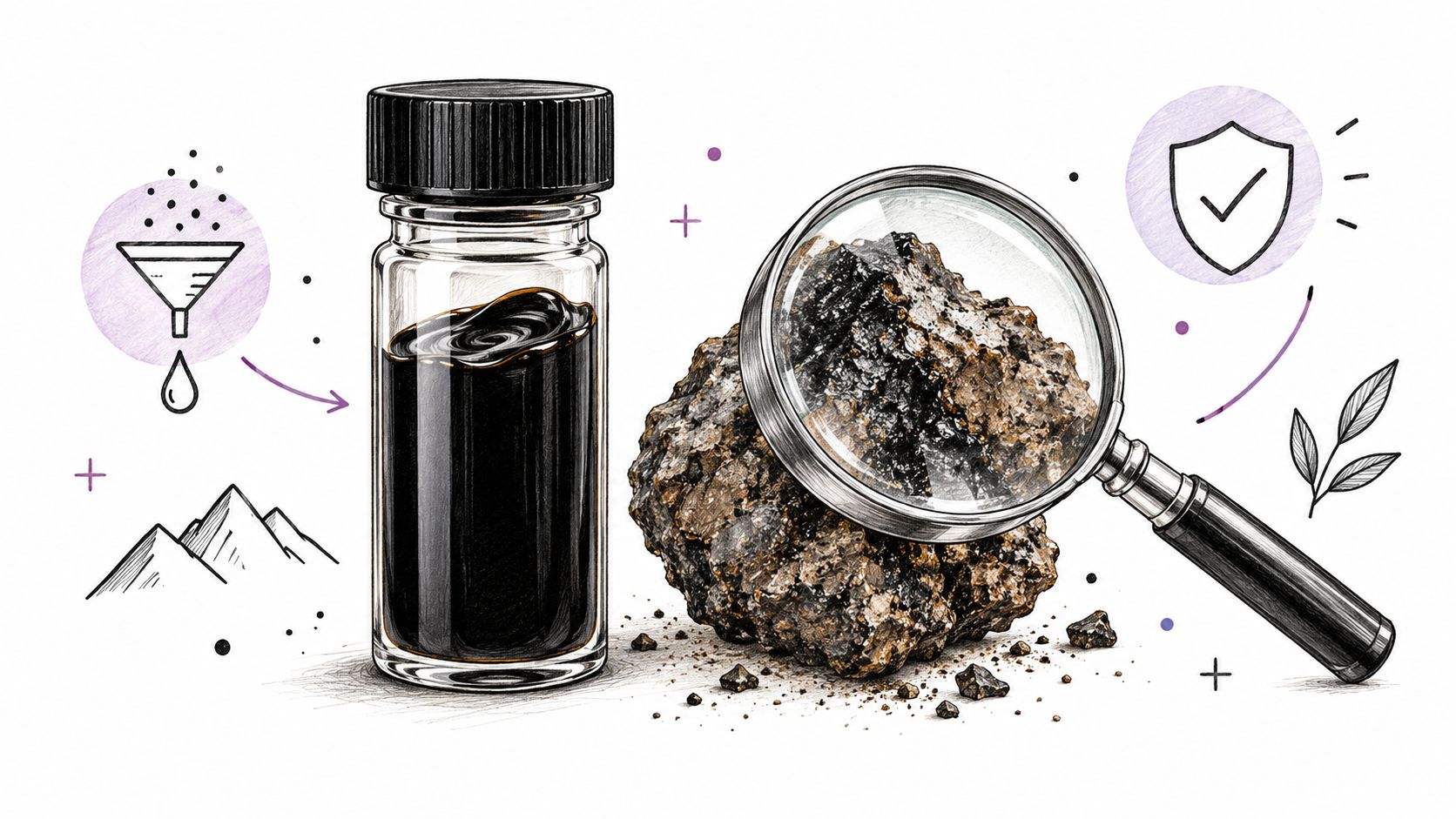
Natural doesn't mean automatically safe
A mountain source isn't a purity certificate. In fact, geological sourcing is one reason a supplier must take contamination seriously. The same broad source material can vary according to the rock, collection site, handling, purification method, and storage conditions.
Recent market coverage cites thallium at up to 0.5 µg/g in some shilajit supplements and identifies contamination and adulteration as continuing concerns. The market analysis explains the safety gap. That figure applies to reported samples, not to every product, but it makes one point clear: checking only for lead isn't enough.
A meaningful certificate of analysis, or COA, should identify the tested batch and show results for a broad contaminant panel. Look for:
- Heavy metals: Lead, arsenic, cadmium, mercury, and thallium deserve attention.
- Identity and adulteration: The report should establish that the material is shilajit and not a cheaper substitute or diluted mixture.
- Microbial quality: Raw biological material can carry microbial concerns if handling and processing are poor.
- Testing laboratory: Independent laboratory information is more useful than an unverified “lab tested” badge.
- Batch connection: A generic certificate may not represent the jar you're buying.
Purified is a processing description, not independent proof of safety. Before purchasing any supplement, it may help to review this NSF certification guide for supplements to understand how certification and verification differ from marketing language.
The NMN Supplement is a separate product category, but its listed third-party purity and potency testing illustrates a useful principle for supplement buyers: quality claims become more meaningful when they're tied to defined testing rather than broad wording.
How to Choose High-Quality Shilajit
A shopper comparing two jars may see the same Himalayan origin claim on both labels. The better choice depends on the evidence attached to the finished product, especially its batch testing and chemical description.
Start with the certificate
Ask the supplier for a recent, lot-specific COA. The lot number should match the product packaging. A report without a batch identifier, laboratory details, or test dates offers limited reassurance.
Read the contaminant panel closely. It should cover lead, arsenic, cadmium, mercury, and thallium, with a result or detection limit for each. Geological materials can concentrate heavy metals, so a lead-only result leaves a meaningful safety gap. Look for identity testing, adulterant screening, and microbiological results where relevant.
An independent laboratory name and a clear connection to the purchased batch make the document more useful than a general “lab tested” badge.
Read the composition, not just the slogan
A specification sheet should describe the fulvic-acid matrix and the controls used to verify it. Useful entries may include:
- Fulvic-acid standardization: A stated percentage range helps define the humic fraction and gives you something more specific than “pure.”
- Heavy-metal panel: Results paired with detection limits show what the laboratory could measure and how clearly.
- Mineral panel: Quantified amounts are more informative than a long list of minerals without values.
- pH: A measured pH can help characterize the material and support consistency between batches.
- Processing details: The supplier should explain how unwanted material was removed and whether solvents were used.
- Source description: A named region provides more context than a broad claim about “the Himalayas.”
A native-material analysis cited earlier in this guide illustrates why chemical results should be treated as a product profile, not a universal target for every commercial resin. Commercial processing and natural variation can change the final composition. Use the earlier findings as context, then judge the product in front of you by its own specification sheet and batch documentation.
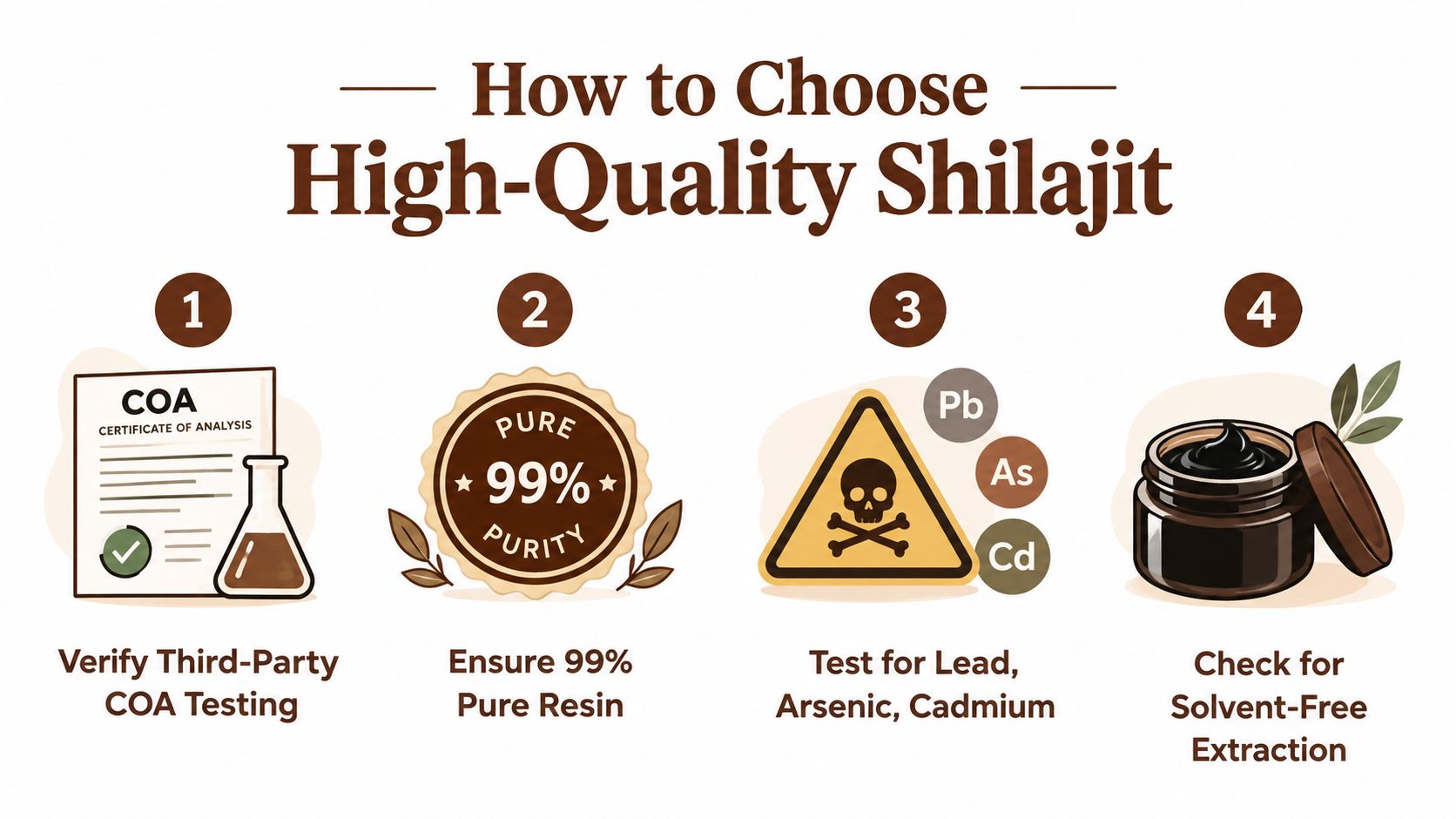
Use a simple decision test
Reject a product if the seller makes strong purity claims but will not provide a batch-level report. Treat altitude, ancient tradition, a large mineral count, and thick texture as background details rather than safety evidence.
The NMN supplement evaluation checklist offers a broader lesson for supplement buyers: assess identity, purity, testing, formulation, and transparency together. For shilajit, choose documented safety controls and a clear fulvic-acid specification over attractive packaging or an unsupported purity slogan.
Resin vs. Other Formats
A spoonful of resin keeps shilajit close to its original, concentrated form, but that does not make it automatically better or safer. Its earthy taste and sticky texture can make measuring and daily use inconvenient. Texture may reveal fillers or excess processing, yet appearance cannot confirm the fulvic-acid matrix, composition, or heavy-metal safety.
That matrix works like a carrier network for several compounds rather than a single isolated ingredient. Processing can change what remains in the finished product, so the format alone cannot establish equivalence. A batch-specific COA and clear ingredient information still matter.
Capsules provide portability and a more neutral experience. Their sealed shell, however, can conceal whether the contents are dried resin, a concentrated extract, a blend, or a mixture with other ingredients. Read the supplement facts panel and testing documents before judging capsules as weaker or stronger than resin.
Gummies make taste and routine easier for people who dislike resin. They may also include sweeteners, binders, or other ingredients, and their shilajit or fulvic-compound amount may differ from a resin serving. Himalayan Shilajit Gold Gummies illustrate this format, combining shilajit and ashwagandha in a convenient daily product.
Choose the form whose ingredients, testing, and serving instructions you can verify and follow consistently.
Frequently Asked Questions
When should you take shilajit?
Many people prefer morning use because they associate it with daytime energy, but there isn't enough evidence to establish one universally ideal time. Follow the product instructions and avoid changing several supplements at once.
Can it interact with medication?
Potentially. Discuss it with a healthcare professional if you take prescription medicines, have a chronic condition, or are pregnant or breastfeeding. A complex resin can't be assessed safely from its marketing label alone.
How quickly will you notice benefits?
There isn't a reliable timeline. Short trials have generally examined purified shilajit over 8 to 12 weeks, with reported daily amounts of 250 to 500 mg. The evidence summary outlines this limited trial window. Long-term daily use beyond 6 months remains poorly studied, so sustained benefits and risks shouldn't be assumed.
What's the safest first step?
Choose a purified product with a lot-specific COA, review the heavy-metal panel, and stop if you experience concerning symptoms. Evidence and testing matter more than a promise of instant vitality.
REVETIX offers supplement formats for people exploring cellular energy, minerals, performance, and healthy aging, including shilajit and ashwagandha gummies alongside other targeted products. Visit REVETIX to review the available formulations and compare them with the testing and transparency standards discussed here.