


Can food cover your creatine needs, or are many people guessing because they only hear about powders? The answer is more useful than a simple yes or no. Creatine natural food sources do contribute meaningful amounts, but the practical value depends on serving size, preparation, food preference, and how easy the food is to eat again and again.
The ranking below weighs concentration and real-world usability together. A food that is very dense in creatine but hard to afford or hard to fit into a normal week may be less useful than a slightly lower source that people buy, cook, and repeat. That's the framework here, choose a primary source, rotate a few others, and build repeatable servings instead of chasing one perfect food. If you're comparing food-first intake with a supplement approach, a product like creatine monohydrate for workout support exists for people who want a direct supplement route, but food still has a place in everyday routines.
Table of Contents
- 1. Beef
- 2. Salmon and Fatty Fish
- 3. Chicken and Poultry
- 4. Pork
- 5. Venison and Game Meat
- 6. Eggs
- 7. Milk and Dairy
- Creatine Content in 7 Natural Foods
- Build a Repeatable Creatine-Focused Plate
1. Beef
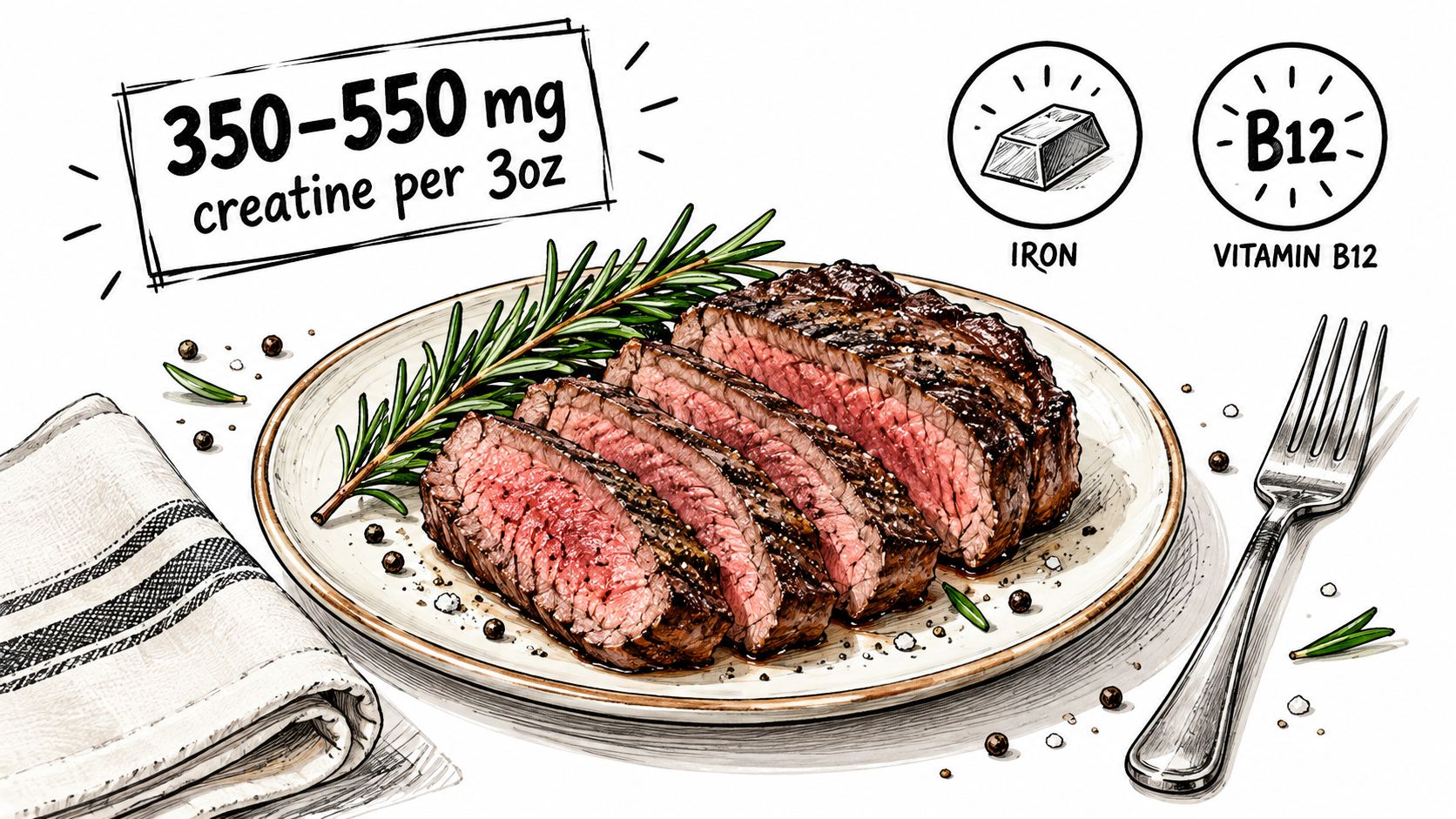
Beef is near the top of the list because it combines strong creatine density with everyday usefulness. Nutrition reviews report about 4.5 to 5 g/kg in beef and pork, and food guidance says a 100 g serving of beef or fish usually provides roughly 0.4 to 1.0 g of creatine (creatine in natural food sources). That makes a normal beef portion one of the easiest food-based ways to get creatine without building an oversized plate.
Why beef is so practical
Beef is practical because it is already familiar. People regularly buy ground beef, sirloin, and chuck roast, so creatine intake can fit into meals they already make. A beef, rice, and vegetable meal-prep box is easier to repeat than a special-food plan built around rare ingredients.
Practical rule: If you want food-based creatine without complicating dinner, make beef your default red-meat choice and keep portions steady.
Beef also helps compare natural food sources in a useful way. Serving size matters, so a food that looks dense on paper is not always the one people eat most often. Beef usually wins because it is affordable for many households, cooks in several styles, and works with different preferences, from quick pan meals to slow-cooked dishes. For readers who want ideas that fit that pattern, browse our beef recipes.
The main limitation is balance, not creatine content. Beef also provides heme iron and vitamin B12, which can help people who eat little animal food, but large portions can push saturated fat higher than needed. Leaner cuts and moderate cooking methods make more sense than oversized servings or heavily charred steak.
A practical rotation is grass-fed ground beef for batch cooking, sirloin for a simpler plated meal, and lean chuck roast for slow-cooker prep. If beef appears several times a week, it can build a steady baseline of natural creatine without requiring a separate supplement routine every day. For readers who still want a food-first plan with room for targeted support, REVETIX's cellular-energy framing appears in its cell energy supplement guidance.
2. Salmon and Fatty Fish
Fish is useful for a different reason than beef. It gives you creatine and a food profile many people already want on the table, especially when the goal is lighter meals that still feel substantial.
The verified food tables show that fish can be among the densest natural sources, with herring often cited as especially high. That makes the category worth understanding, but usefulness is not only about concentration. A food also has to fit real life, and fish often does because the serving is familiar, the cooking time is short, and the result works in simple meals.
Why fatty fish moves up the list
Salmon, mackerel, sardines, and herring add more than creatine. They also bring omega-3 fatty acids, which helps explain why this group is often chosen by people who want variety beyond red meat. For many households, that variety matters as much as the nutrient content.
The practical advantage is how easily fish fits into regular eating. A fillet can become a lunch bowl, a sheet-pan dinner, or a quick plate with potatoes and vegetables. Canned sardines do something different. They reduce prep almost to zero, which can matter more than chasing the highest number on a table.
Preparation also shapes whether people keep eating it. Fish that is cooked gently and served soon after cooking is usually easier to enjoy than fish that dries out or sits too long. That is why fatty fish works best as a rotation food, not as an occasional special order.
A simple salmon plate with potatoes and greens gives a balanced meal without much effort. Sardines are another practical option for people who want animal-sourced creatine with minimal cooking. The category scores well because it combines usefulness, nutrient density, and different price and prep options.
Rhodiola Rosea and Himalayan Shilajit Gold Gummies are part of REVETIX's broader wellness framing, but fish still does the food-based work. If the question is which creatine food people are most likely to keep using, fatty fish ranks high because it fits everyday routines better than many denser but less convenient choices.
3. Chicken and Poultry
What makes chicken and poultry useful for creatine intake is not peak concentration, but repeatability. Natural creatine comes from animal foods, especially meat, poultry, and fish, and whole-food intake is useful even if it usually stays below supplemental dosing. That makes chicken the kind of food many households can keep using without much planning, especially when they want something lean, simple, and affordable (major review of natural creatine sources, natural food concentration overview).
Why poultry is the workhorse
Chicken breast is the familiar example, but thighs and turkey can fill the same role. The practical advantage is straightforward. Poultry is easy to cook in bulk, easy to portion, and easy to fit into different eating patterns. Busy professionals can grill a batch, athletes can divide it into training meals, and families can turn it into stir-fries, wraps, or rice bowls.
Serving size matters here. A food only helps if it fits real meals often enough to become routine. Poultry works like a dependable tool in a kitchen drawer, useful because it is there, not because it is flashy.
Best ways to use poultry
- Use grilled or poached chicken: It keeps prep simple and avoids the heaviness that can come with frying.
- Keep portions repeatable: A moderate serving is easier to build into your week than an oversized one.
- Pair it with carbs: Rice, potatoes, or sweet potatoes make the meal feel complete and easier to keep repeating.
- Batch-cook once, eat twice or more: That lowers friction and helps the habit stick.
Poultry also has a mild flavor, so it takes seasoning well and does not require the kind of premium sourcing that game meat often does. For people balancing dietary preference, prep time, and cost, that is a real advantage.
For readers comparing food sources beyond creatine alone, poultry can sit alongside other practical ingredients. l-arginine and pycnogenol are different compounds with different roles, but the same general rule applies. Foods and supplements matter most when people can use them consistently.
4. Pork
What makes pork useful is not only its creatine content, but how easily it fits into ordinary meals. It sits between chicken and game meat in practical value. You get a familiar animal-food source of creatine, usually at a price and cooking level many households can handle, without needing to reserve it for special occasions.
Pork belongs in the group of common animal foods that contribute creatine naturally. Broader reviews show that creatine from food is modest compared with supplements, so the central question is not just “which food is richest,” but “which one is easy to eat often?” That is why pork often matters more in practice than a single concentration number suggests. For a general overview of creatine-rich foods, the natural food concentration overview and population intake review both frame food creatine as part of a mixed diet, not a stand-alone strategy.
Why pork deserves a spot
Lean cuts like pork tenderloin and sirloin chop work well for people who want a change from chicken without moving all the way to premium red meat. Pork also fits many cooking styles, from roasted dinners to skillet meals with vegetables and grains. That flexibility helps keep a creatine-focused eating pattern from feeling repetitive.
Pork is also a useful middle option for readers who split their meals between taste and convenience. Some people want something heartier than poultry. Others want a protein that holds up better than fish in meal prep. Pork can cover that gap without asking for a complicated recipe.
Pork works like a rotation protein. Use it when you want creatine from a food that cooks easily, but still feels more substantial than the lightest white-meat meals.
Affordability matters too. A simple roast or chop can give households an easy way to vary their weekly menu while staying within the same broad animal-food category. That kind of repetition is what makes a food useful over time.
5. Venison and Game Meat
Venison and other game meats rank highly for usefulness because they sit near the top of the creatine-dense whole foods in this guide. The verified data place game meats at around 400 to 500 mg per 3 oz cooked serving, with venison backstrap cited at about 500 mg per 3 oz, elk sirloin at about 480 mg, and bison steak at about 420 mg in the provided plan notes. Those numbers make game meat a strong choice for readers who want a concentrated animal-food source and are comfortable treating it as a premium purchase.
Why game meat works well, and where it falls short
Game meat is easier to use as a periodic optimization food than as an everyday staple. Density matters, but practical usefulness also depends on where it comes from, what it costs, and how much cooking confidence it asks from the cook. A venison backstrap can be a very good meal. It is still less convenient than keeping a standard protein in the fridge for an ordinary weeknight.
The difference is simple. Game meat scores well on creatine density and on special-occasion planning. It scores lower on day-to-day convenience because many households do not buy it often, and some cooks are less familiar with handling it.
A better way to place it is as a rotation protein for people who enjoy hunting culture, regenerative sourcing, or a more adventurous menu. The flavor is distinct, the nutrient profile is appealing, and it can keep a creatine-focused pattern from feeling repetitive when the menu leans too heavily on supermarket staples.
Best fit scenarios
- Weekend meals: When there is time to cook carefully, game meat is easier to handle well.
- Premium protein rotation: It fits when you want a higher-end source now and then.
- Seasonal eating: People who buy from wild-game suppliers can use it as a seasonal anchor.
- Diet variety: It helps keep a meat-based routine from becoming monotonous.
For households feeding several people on a normal budget, game meat is useful in rotation, not as the main plan. It brings strong creatine value, but availability and price shape how often it belongs on the table.
6. Eggs
Eggs are lower on creatine concentration, but high on practicality. The verified data note that creatine is found almost exclusively in meat, poultry, fish, with only very small amounts in eggs and dairy (major review on food composition gaps). That means eggs shouldn't be treated like a major creatine source, but they still belong in this ranking because they're easy, affordable, and useful alongside stronger foods.
Why eggs still matter
Eggs are the simplest “add-on” food in the list. They don't require a full meal setup, and they work at breakfast, lunch, or dinner. For people trying to make a creatine-focused routine stick, that convenience matters more than perfect concentration.
They also bring choline and complete protein, which makes them a strong companion food for anyone already eating meat or fish. A breakfast of eggs plus toast, or an omelet with vegetables, doesn't just add a little creatine-related support, it builds a more complete morning meal. The yolk is especially important for nutrient density, so whole eggs make more sense than egg whites alone when the goal is everyday nourishment.
Eggs are not a top creatine source, but they're one of the easiest foods to repeat without friction.
Eggs make nutrition automatic. People can keep them in the fridge, boil them in batches, or scramble them in minutes. That makes them a practical supporting food for anyone who already gets stronger creatine intake from beef, poultry, pork, or fish.
If your diet is busy and inconsistent, eggs help you avoid “all or nothing” thinking. They're not the whole solution, but they make the solution easier to live with.
7. Milk and Dairy
Milk and dairy rank near the bottom for creatine concentration, but they still have a place in a real eating plan because they are easy to use often. Ordinary food databases still leave gaps in creatine data, so exact intake from dairy is harder to pin down than from a lab table, and the broader food composition picture remains incomplete (public-health data gap discussion). That limitation matters, but it does not make dairy useless. It just means practicality has to count alongside concentration.
Why dairy is still useful
Greek yogurt, cottage cheese, and skyr are low-effort foods. They keep well in the fridge, pair easily with fruit or nuts, and fit after training or before bed without much planning. That makes them more useful in daily life than their creatine level alone would suggest.
Dairy also helps when appetite is low. A bowl of Greek yogurt is easier than cooking another meat-based meal, especially for older adults, people recovering from training, or anyone who wants a simple late-day option. It is a support food, not the main creatine source.
Best ways to use dairy
- Choose plain varieties: Unsweetened yogurt and cottage cheese keep the meal simpler.
- Add fruit or nuts: That improves flavor and adds a little more staying power.
- Use it as a snack or recovery food: It fits between meals without much effort.
- Keep lactose tolerance in mind: Some people do better with lactose-free options or smaller portions.
Dairy does not replace meat or fish if the goal is to raise natural creatine intake as much as possible. It works more like a steady backup than a primary source. That is why it sits low on creatine content, while still scoring well for convenience, price, and ease of repetition.
Creatine Content in 7 Natural Foods
| Item | 🔄 Implementation complexity | ⚡ Resource & accessibility | ⭐ Expected outcomes (creatine & impact) | 💡 Ideal use cases | 📊 Key advantages |
|---|---|---|---|---|---|
| Beef (Red Meat) – 350–550mg / 3oz | Moderate, simple cooking, temp-sensitive to preserve creatine | Widely available; higher cost; ethical/environmental considerations | ⭐⭐⭐⭐, 350–550mg/3oz; strong ATP support, B12, heme iron | Performance, recovery, cellular energy optimization | High creatine density; synergistic B12, iron, carnosine |
| Salmon & Fatty Fish – 200–350mg / 3oz | Low–moderate, gentle cooking/storage to protect omega‑3s | Moderately available; wild-caught premium; mercury considerations | ⭐⭐⭐, 200–350mg/3oz; adds EPA/DHA and astaxanthin for mitochondrial health | Longevity, anti‑inflammatory recovery, cognitive/cardio support | Creatine + omega‑3s; antioxidant protection (astaxanthin) |
| Chicken & Poultry – 250–400mg / 3oz | Low, easy prep, stable creatine with common cooking methods | Highly accessible and economical | ⭐⭐⭐, 250–400mg/3oz; lean protein supporting muscle synthesis | Daily meal prep, weight management, consistent creatine intake | Best value-to-creatine; very lean, versatile protein source |
| Pork – 300–450mg / 3oz | Moderate, cook to safe temp (145°F) to preserve B vitamins | Widely available; moderate cost; sourcing quality varies | ⭐⭐⭐⭐, 300–450mg/3oz; thiamine and choline support energy & cognition | Nutrient diversity, alternative to beef for metabolic support | High creatine similar to beef; rich in thiamine & choline |
| Venison & Game Meat – 400–500mg / 3oz | Higher, requires careful cooking to avoid dryness | Limited availability; high cost; specialty sourcing needed | ⭐⭐⭐⭐⭐, 400–500mg/3oz; maximal creatine, CoQ10, superior micronutrients | Biohacking, longevity optimization, periodic high‑quality intake | Highest creatine per serving; CoQ10 and low inflammatory profile |
| Eggs (Whole & Yolk‑Rich) – 100–150mg / 2 eggs | Very low, minimal skill; versatile preparations | Extremely accessible and low cost; pasture‑raised improves density | ⭐⭐, 100–150mg/2 eggs; modest creatine + high choline and lutein | Daily convenience, cognitive support, affordable stacking | Very affordable; choline-rich; quick preparation |
| Milk & Dairy (Greek yogurt, cottage cheese) – 80–200mg / serving | Very low, ready‑to‑eat or minimal prep | Widely available; moderate cost; lactose may limit use | ⭐⭐, 80–200mg/serving; protein + probiotics + bone support | Recovery, aging populations, post‑workout protein sourcing | Combines creatine with casein/whey, probiotics, and calcium |
Build a Repeatable Creatine-Focused Plate
The easiest way to use creatine natural food sources is to stop treating them like a puzzle and start treating them like a routine. If higher dietary creatine is the priority, choose beef, poultry, pork, fish, or game meat as your main anchors. If convenience matters more, use eggs and dairy as steady add-ons that support the pattern without demanding much from your schedule.
Rotation helps more than perfection. Beef can anchor one meal, fish can anchor another, chicken can carry the middle of the week, and eggs or yogurt can smooth out the gaps. That mix also respects the differences in serving size, preparation, affordability, and dietary preference, which is why a practical list like this is more useful than chasing the single densest option.
The supplied serving estimates are helpful, but they're still estimates. Cooking method, cut, species, and product quality all shift the final number, and the public food database is still incomplete for creatine, which makes exact tracking difficult (food composition gap discussion). If you have a medical condition, a dietary restriction, are pregnant, or take medication, talk with a qualified healthcare professional before changing your diet or adding any REVETIX product.
REVETIX fits this topic mainly as a supplement-and-routine brand, not a replacement for food. Its NMN, Rhodiola, and shilajit-based products are positioned around energy and recovery, while food remains the first place to build a creatine baseline. The practical goal is simple, eat the sources you can repeat, and let the rest of your wellness plan support that habit.
If you want to build a creatine-focused routine with food-first guidance and complementary longevity products, visit REVETIX to review the brand's current lineup. Use the foods in this article as your base, then choose only the products that fit your goals, schedule, and dietary preferences.